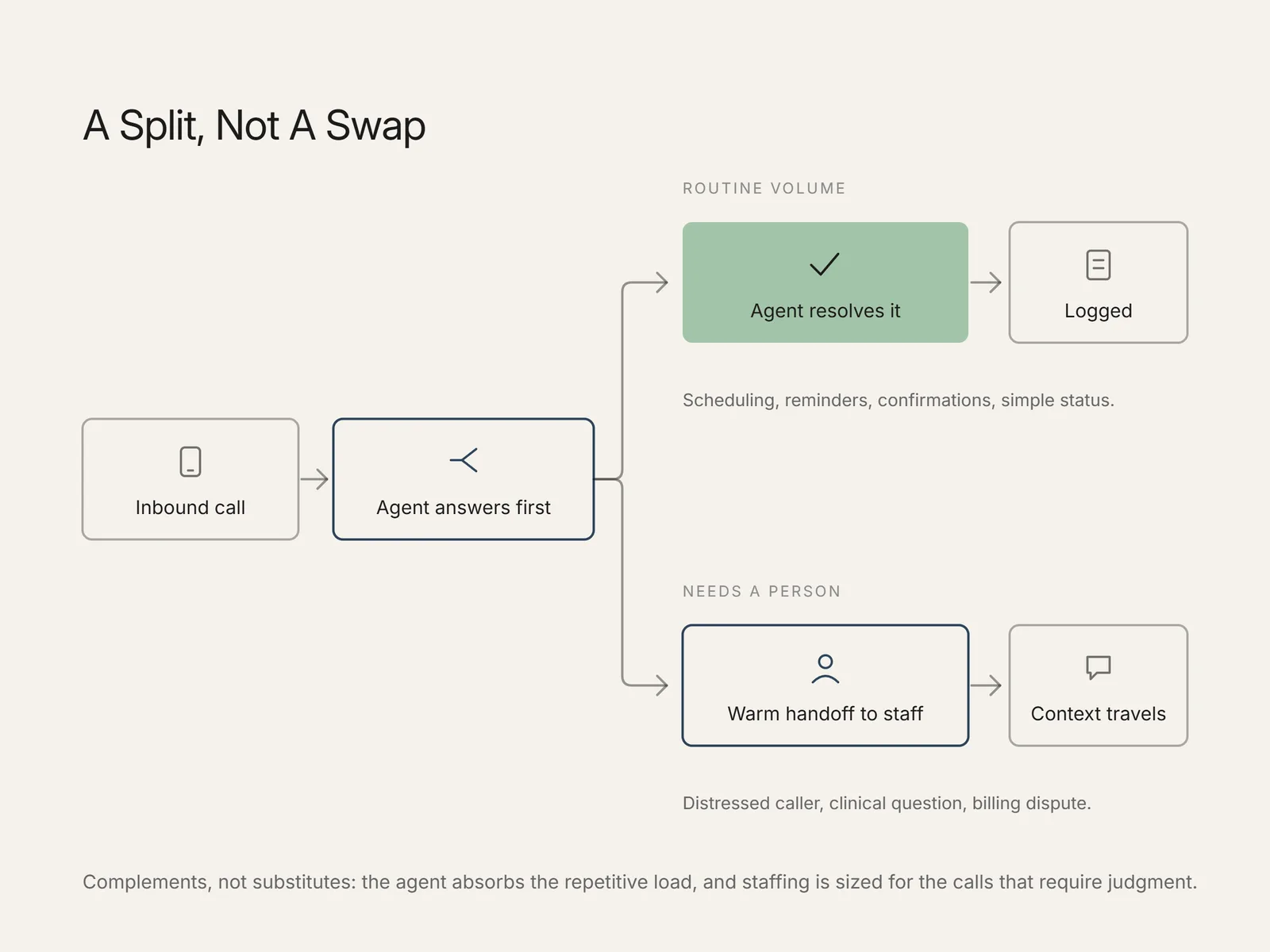
For most front desks, AI will not replace medical receptionists; it will change what they spend the day doing. The realistic outcome is a division of labor rather than a swap. An AI receptionist absorbs the routine, high-volume calls, such as scheduling, reminders, confirmations, and simple status questions, and it covers after-hours and overflow so no call goes to a busy signal. People keep the calls that need judgment, empathy, or discretion: a distressed caller, a clinical question, a sensitive billing issue, or a request that fits no script. The reason this split matters is that the phones are already a bottleneck. MGMA reports that phones remain a persistent backlog that costs practices time. Handing the repetitive load to software frees staff for the calls that actually need a person, instead of removing them from the front desk.
Will AI replace medical receptionists?
The short answer for most front desks is no, and framing it as replacement misses how the work actually divides. An AI receptionist is strong on the repetitive, well-defined parts of front-desk work and deliberately weak on the parts that need a person, so the two are complements rather than substitutes. In the engagements we run, the pattern is consistent: the agent answers first, resolves the routine volume, and escalates anything ambiguous, clinical, or emotional to staff with the call context attached. That keeps two things true at once. No call goes unanswered, because the agent covers overflow and after-hours. And the people on the team stop spending their time on hold-and-repeat scheduling calls and instead handle the smaller set of calls that need judgment. The front desk does not disappear; its workload shifts from volume to the calls where a human response is the point.
Want this mapped against your own call and claim volume? Book a 30-minute audit
What can an AI receptionist do that a human cannot at scale?
An AI receptionist is strongest on volume, availability, and consistency, which are exactly the dimensions where a single person hits a ceiling. It answers many calls at the same moment, so a mid-morning rush does not produce a busy signal or a five-minute hold. It works around the clock, so a call that arrives at night, on a weekend, or during a lunch break still gets answered rather than dropped or sent to voicemail. Because it follows a defined script grounded in the practice's own information, it asks the same intake questions and gives the same answers each time, without the drift that appears when one staffer is new and another is tired. It also captures a structured record of each call automatically, with a transcript and an outcome, rather than relying on someone to write it down afterward. These are the repetitive, well-defined tasks where software holds up, and they are the reason a small team can cover far more inbound demand with an agent in front.
Flexbone's position is that the question is which calls, not which people: an agent takes the scripted calls that fill the phone queue, and receptionists keep the patients who need a person. That split is drawn from the practice's recorded calls. See healthcare call automation.
See what AI can run at your facility. In a 30-minute audit we map the calls, eligibility, and follow-ups Flexbone can take off your team first.
Book an auditWhat still needs a person at the front desk?
The calls that need a person are the ones that require judgment and reading another human. When a caller is upset, confused, or dealing with a sensitive situation, a person can hear it in their voice and adjust: slow down, change tone, or simply listen. People handle ambiguity well, such as a request that matches no script, a question with an unstated assumption, or a caller who is not sure what they need. Clinical and urgent questions belong with staff or a clinician, not with an agent making a call it should not make. Billing disputes and complaints also tend to need a person who can weigh context and take responsibility for the outcome. In the engagements we run, these are the calls we deliberately route to staff rather than trying to automate, and a well-built AI receptionist is configured to recognize them and escalate quickly with a warm handoff, so the caller reaches a person without repeating themselves.
How much does an AI medical receptionist cost?
The honest answer is that it depends, and a single sticker price tends to mislead. The cost of an AI medical receptionist is driven by call volume, how many of those calls need a human, and which tasks the agent runs, such as scheduling only versus scheduling plus eligibility checks and outbound confirmations. Comparing agent versus person purely on price also frames the decision wrong, because the two are not doing identical work. The more useful comparison is how the combination covers demand: the agent absorbs the predictable, repetitive load, and staffing is sized for the calls that require judgment. When you evaluate vendors, ask them to price against your actual call patterns, a real week of call logs, rather than a flat per-seat number, and ask what happens to the price as volume grows or as you add tasks. That gives you a cost you can tie to the coverage you actually get.
Is an AI receptionist HIPAA compliant?
An AI receptionist can be HIPAA compliant, but compliance is a property of the deployment, not a badge the software carries by default. Because the system creates, receives, and stores protected health information on the practice's behalf, the vendor is a business associate and must sign a business associate agreement before it handles any calls. Beyond that contract, look for encryption in transit and at rest, access controls with audit logging, workforce training, and a defined breach-notification process. Ask specifically where call recordings and transcripts are stored, who can access them, and how long they are retained, since a front-desk agent handles PHI on nearly all of its calls. A vendor that treats HIPAA as a signed BAA plus documented technical safeguards, rather than a marketing line, is the one to trust with patient calls. Compliance is a baseline to verify before go-live, not a feature to assume.
How Flexbone runs an AI front desk alongside your team
A generic answering service takes a message and stops. Flexbone deploys AI voice, browser, and document agents that resolve front-desk work inside your EHR: answering calls, scheduling and confirming, verifying coverage on payer portals, and escalating clinical or sensitive calls to your team with full context. The approach is audit-first, HIPAA compliant, and SOC 2-aligned, so each call leaves a transcript and an outcome you can review.
See it run against your workflows: book a demo. You can read more about how Flexbone runs voice agents or our AI medical receptionist.