AI automation in ModMed (EMA) works by driving the same web interface your staff already sign into, rather than through a custom integration. A browser agent opens ModMed EMA and Practice Management in a session, reads the registration, scheduling, or worklist screen, decides the next step, takes the action, and writes the result back to the same record. Because it uses the interface a person uses, it does not need an HL7 or FHIR interface or a developer API to reach ModMed. In revenue cycle, that means an agent can run insurance eligibility checks, submit and track prior authorizations, follow up on claim status, and read remittance detail, mapping to the standard 270/271, 278, 276/277, and 835 transactions. Voice agents handle the phone work around those screens, such as calling a payer to confirm coverage, and the outcome is recorded in the same ModMed record.
What can AI automate in ModMed?
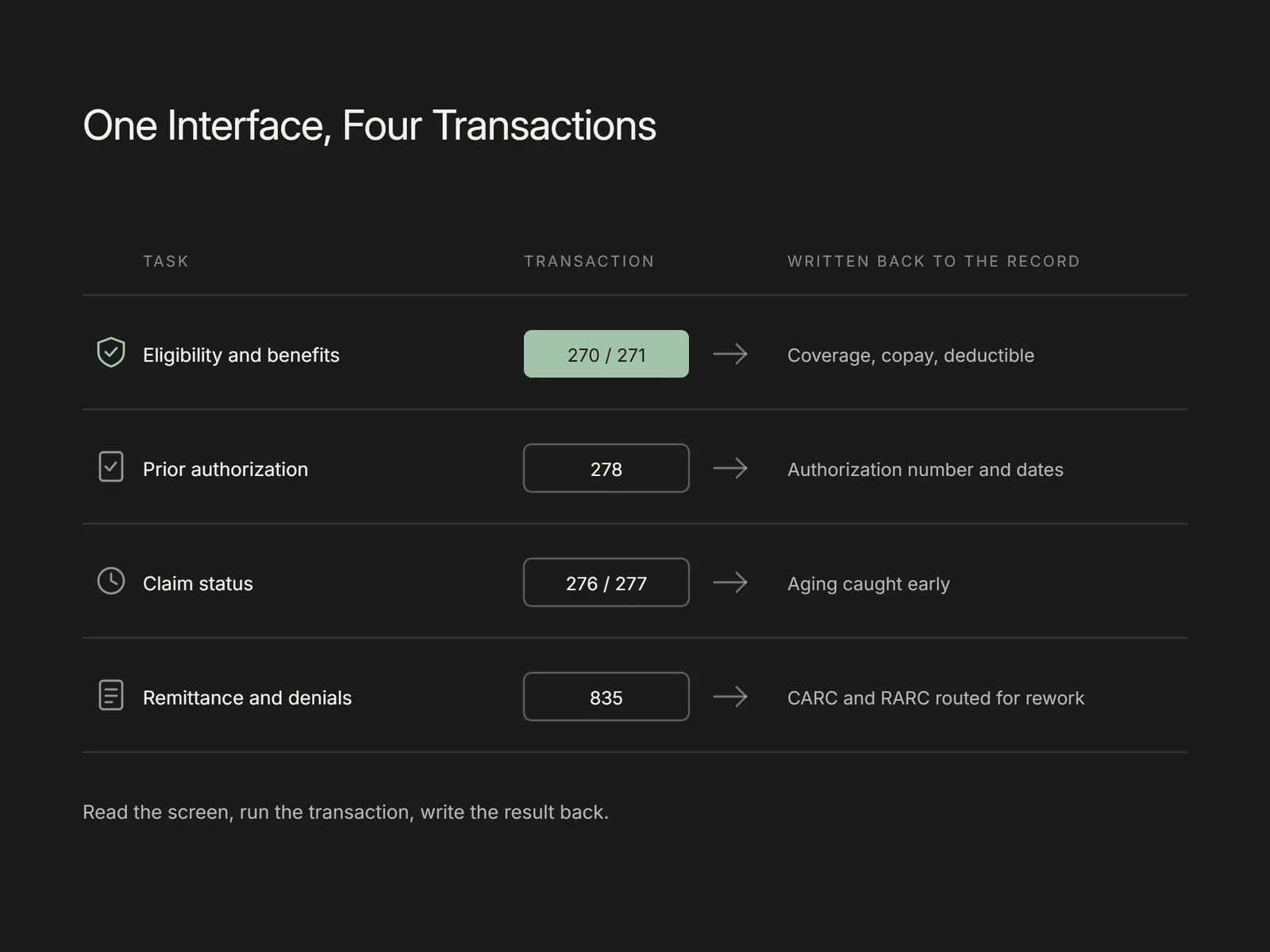
AI fits the repetitive, rules-based revenue cycle work that feeds clean claims inside ModMed, the tasks defined well enough to run the same way each time. In the engagements we run, that centers on patient access and payer follow-up:
- Insurance eligibility and benefits. Confirm coverage before the visit through the 270/271 eligibility transaction, or the payer portal where no electronic path exists, and write the result into the ModMed registration record.
- Prior authorization. Submit the request and track its status, which maps to the 278 prior authorization transaction, then record the authorization number in the encounter.
- Claim status. Follow up on submitted claims through the 276/277 claim status transaction so aging is caught early.
- Remittance and denials. Read 835 remittance detail, including the CARC and RARC codes, to route denials for rework rather than reworking them blindly.
Each of these runs on a defined CPT or procedure context, and the agent writes structured results back so the EMA record stays complete. To see how this reaches ModMed without an integration, read our overview of AI for ModMed.
Want this mapped against your own call and claim volume? Book a 30-minute audit
Can AI verify eligibility in ModMed EMA?
Yes. An agent verifies insurance eligibility in ModMed EMA by driving the 270 eligibility inquiry and reading the 271 response, then writing coverage status, plan, copay, and deductible detail back into the ModMed registration record. The 270/271 pair is the standard HIPAA eligibility benefit inquiry and response transaction. When a payer supports an electronic 270/271 path, the check is fast and structured; when it does not, the agent works the payer portal or places a call and records the same fields. Running the check before the visit means a benefit is confirmed rather than assumed, which prevents the eligibility-related denials that otherwise surface after the claim is billed. Because ModMed practices tend to schedule procedures ahead, a clean eligibility read early gives the front desk time to resolve gaps before the day of service. For the mechanism in depth, see insurance eligibility verification.
ModMed practices are specialty practices, so the automatable work skews toward authorizations and specialty scheduling rules. Flexbone builds agents to those rules from the practice's recorded calls and work queues and writes results back to EMA. See EHR integrations.
See what AI can run at your facility. In a 30-minute audit we map the calls, eligibility, and follow-ups Flexbone can take off your team first.
Book an auditCan AI handle prior authorization in ModMed?
Yes. An agent handles prior authorization in ModMed by submitting the request, which maps to the 278 prior authorization transaction, and then tracking its status through the payer portal or ModMed worklists until it resolves. It reads the ordered CPT codes and diagnosis from the encounter, assembles the submission, and on approval writes the authorization number and validity dates back so scheduling and billing can see them. Prior authorization is a heavy manual load: physician practices report completing nearly 40 requests per physician each week, per the AMA. When the payer requires clinical documentation the agent cannot supply, or the request pends for review, it routes the case to a person instead of guessing. For how this runs end to end, see prior authorization automation.
Which specialties run on ModMed?
ModMed is built around specialty-specific EMA content rather than a single generic chart, and it has a strong presence in dermatology, ophthalmology, orthopedics, and gastroenterology, along with plastic surgery, ENT, urology, and others. These are procedure-heavy specialties: a Mohs case in dermatology, a cataract procedure in ophthalmology, a joint injection or arthroscopy in orthopedics, or a colonoscopy in gastroenterology each carries defined CPT codes and, often, a prior authorization requirement. That combination of high scheduled volume and payer rules is exactly where the repetitive access and follow-up work maps well to AI agents, because the agent can drive the same ModMed screens and payer portals a coordinator uses to check eligibility and clear an authorization before the procedure. The specialty content changes the codes and the payer rules, not the mechanism: read the screen, run the transaction, write the result back.
Flexbone can map which of these tasks run cleanly inside the ModMed (EMA) environment your specialty already uses, from eligibility and prior authorization to claim status and 835 remittance, and where a voice agent should handle the call around them. To walk through your ModMed workflows and see what AI can run, book a call with Flexbone.