Aetna prior authorization, which Aetna often calls precertification, is a review Aetna runs before certain services are provided to confirm the plan considers them medically necessary and eligible for coverage. It commonly applies to advanced imaging such as MRI, CT, and PET, specialty and injectable drugs, some elective procedures and surgeries, durable medical equipment, and certain diagnostic tests. What needs review is not fixed: it varies by plan type, including commercial, Medicare Advantage, and Medicaid, and it changes over time as Aetna updates its lists. Aetna uses Availity as its provider portal partner for many precertification and eligibility functions, and it uses radiology benefit managers to review some imaging requests. Because the details depend on the member's specific plan, the plan's own precertification list and the member's benefits are the reliable source rather than a general rule.
What requires Aetna prior authorization?
Aetna's precertification requirements center on higher-cost and higher-variation services, but the exact list is plan-specific. Categories that many Aetna plans commonly require review for include advanced imaging (MRI, CT, PET, and nuclear studies), specialty and injectable drugs, some elective procedures and surgeries, inpatient admissions that are not emergencies, durable medical equipment, and certain diagnostic and genetic tests. Behavioral health services and some outpatient procedures can also require review depending on the plan. The category alone does not settle it, because two members with different Aetna plans can have different requirements for the same service. The dependable step is to check the precertification requirement for the specific procedure code against the member's plan before scheduling, since requirements change over time and a service that was exempt last year may need review now.
Want this mapped against your own call and claim volume? Book a 30-minute audit
How do you submit an Aetna prior authorization?
Start by verifying the member's eligibility and benefits, then confirm whether the specific service needs precertification for that plan. For medical services, many practices submit through the Aetna provider portal on Availity, which is Aetna's portal partner for eligibility and precertification, and attach the clinical documentation that supports medical necessity. Advanced imaging requests may route to a radiology benefit manager rather than directly to Aetna, so the submission path can differ by service. Medication requests often follow a separate path: provider-administered drugs billed under the medical benefit may go through the provider portal, while pharmacy-benefit drugs are frequently submitted electronically through CoverMyMeds or the pharmacy benefit manager's own channel. Whichever path applies, submitting complete clinical records with the initial request, rather than after a follow-up, is the single most useful habit, because incomplete documentation is a leading cause of delay. Confirming benefits up front through reliable insurance eligibility verification also reduces the chance of a request stalling on a coverage question.
How long does Aetna prior authorization take?
Turnaround depends on the plan, the product line, and whether the request is standard or expedited, so the specific deadline comes from the applicable plan and any governing state rules rather than a fixed number. In practice, requests submitted with complete clinical documentation tend to resolve faster than those that trigger a records request, because the reviewer can decide without waiting on missing information. Expedited or urgent requests, used when a delay could seriously affect the patient's health, carry shorter timeframes than standard ones. Federal interoperability and prior-authorization rules are shortening the standard and expedited decision windows that many payers must meet over the coming years, which affects how quickly a decision comes back. To manage the wait, track the reference number Aetna returns at submission and the plan's stated decision window, and follow up before the deadline rather than after it.
See what AI can run at your facility. In a 30-minute audit we map the calls, eligibility, and follow-ups Flexbone can take off your team first.
Book an auditWhy do Aetna prior authorizations get denied?
Many denials are procedural rather than a judgment that the care was wrong. Common causes include incomplete or missing clinical documentation, the submitted information not meeting the plan's medical-necessity criteria, a coding mismatch between the service requested and the service covered, a request sent to the wrong review path (for example, to Aetna when a radiology benefit manager handles that imaging study), or a service that simply is not a covered benefit under the member's plan. The volume of these reviews is part of the problem across payers: the American Medical Association reports that physicians complete about 39 prior authorizations per physician per week, taking roughly 13 hours of physician and staff time, which leaves room for avoidable errors under time pressure. The practical response is to read the denial reason on the notice, since it distinguishes a fixable documentation or coding gap from a coverage exclusion, and to correct and resubmit or appeal accordingly. A structured approach to AI denials management helps a practice sort those reasons and route each denial to the right correction.
How can a practice reduce Aetna prior authorization delays?
Delays cluster in a few predictable places, and each has a preventable cause. Confirm eligibility and precertification requirements before the visit, so a needed review is not discovered at check-in or after the service. Standardized electronic eligibility checks help here: the federal HIPAA eligibility transaction, the 270 request and 271 response, is designed to return coverage information in a consistent format, as described in the CMS eligibility benefit inquiry and response guidance. Assemble the full clinical packet before submitting, since a missing note is the most common reason a decision stalls. Send the request through the correct path for the service, whether that is the Aetna provider portal on Availity, a radiology benefit manager for imaging, or CoverMyMeds for a pharmacy-benefit drug. Track every reference number and decision deadline, and follow up before the window closes. Building these steps into a consistent prior authorization automation workflow keeps them from depending on memory during a busy day.
Where do Aetna medication prior authorizations differ from medical ones?
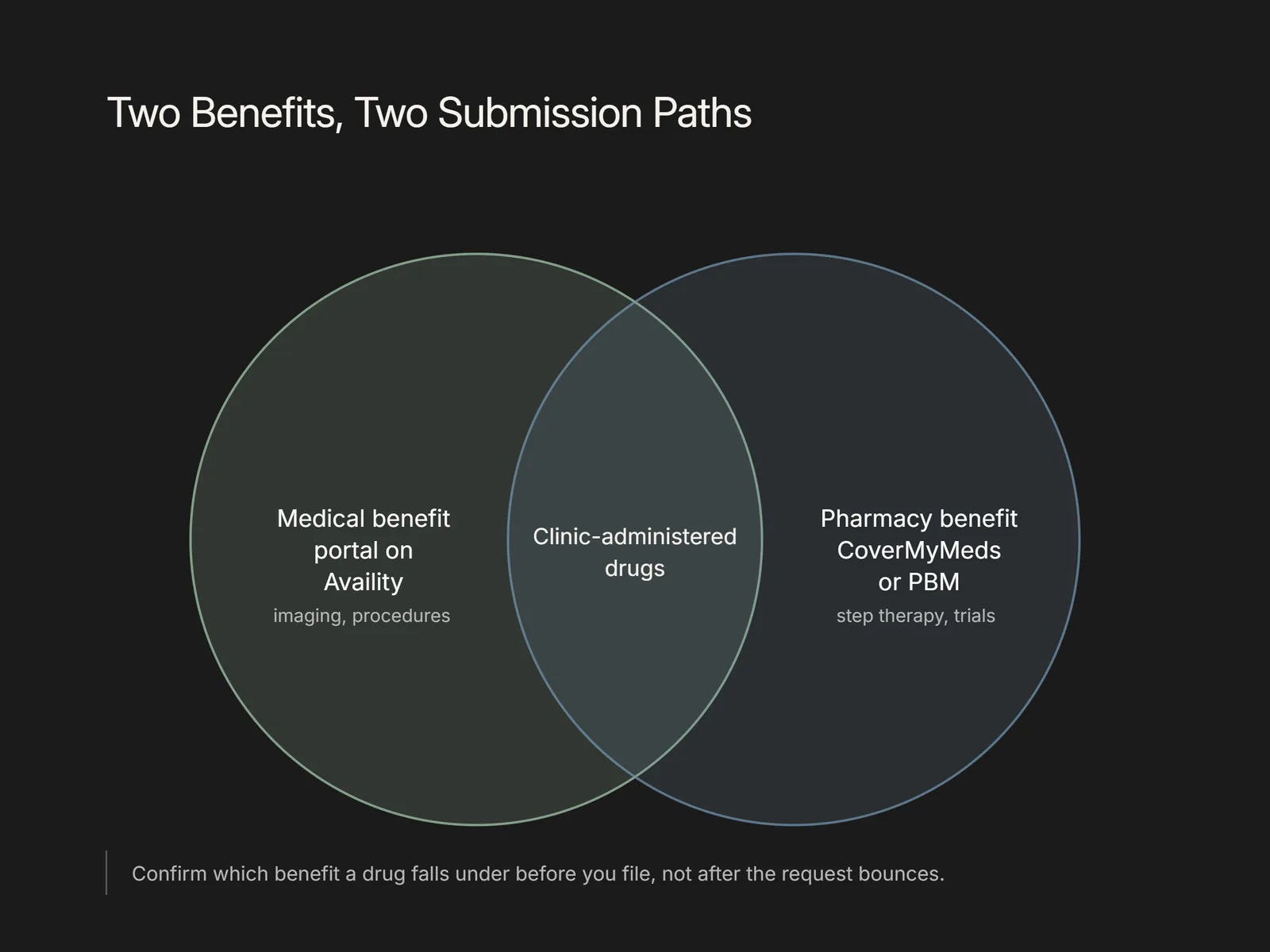
Medication prior authorizations frequently follow a different route than medical-service precertification, which is a common source of confusion. Drugs covered under the pharmacy benefit are often submitted electronically through CoverMyMeds or the pharmacy benefit manager, and they may carry step-therapy or trial-history requirements that the request has to document. Drugs administered in a clinic and billed under the medical benefit, such as certain injectables and infusions, may instead go through the Aetna provider portal on Availity as a medical precertification. The clinical evidence a reviewer wants also differs, since drug requests often turn on prior therapies tried and specific diagnostic criteria. Confirming which benefit a given drug falls under, and therefore which submission path and criteria apply, before you file avoids a request bouncing between the two systems. As with medical services, requirements vary by plan and change over time, so the member's specific plan is the reference.
Aetna prior authorization is manageable when the eligibility check, the documentation, the submission path, and the follow-up are handled consistently for every request. If your team wants to see what that could look like with less manual portal and phone work, book a call with Flexbone and we will map which parts of your Aetna prior authorization workload AI voice and browser agents can take on.