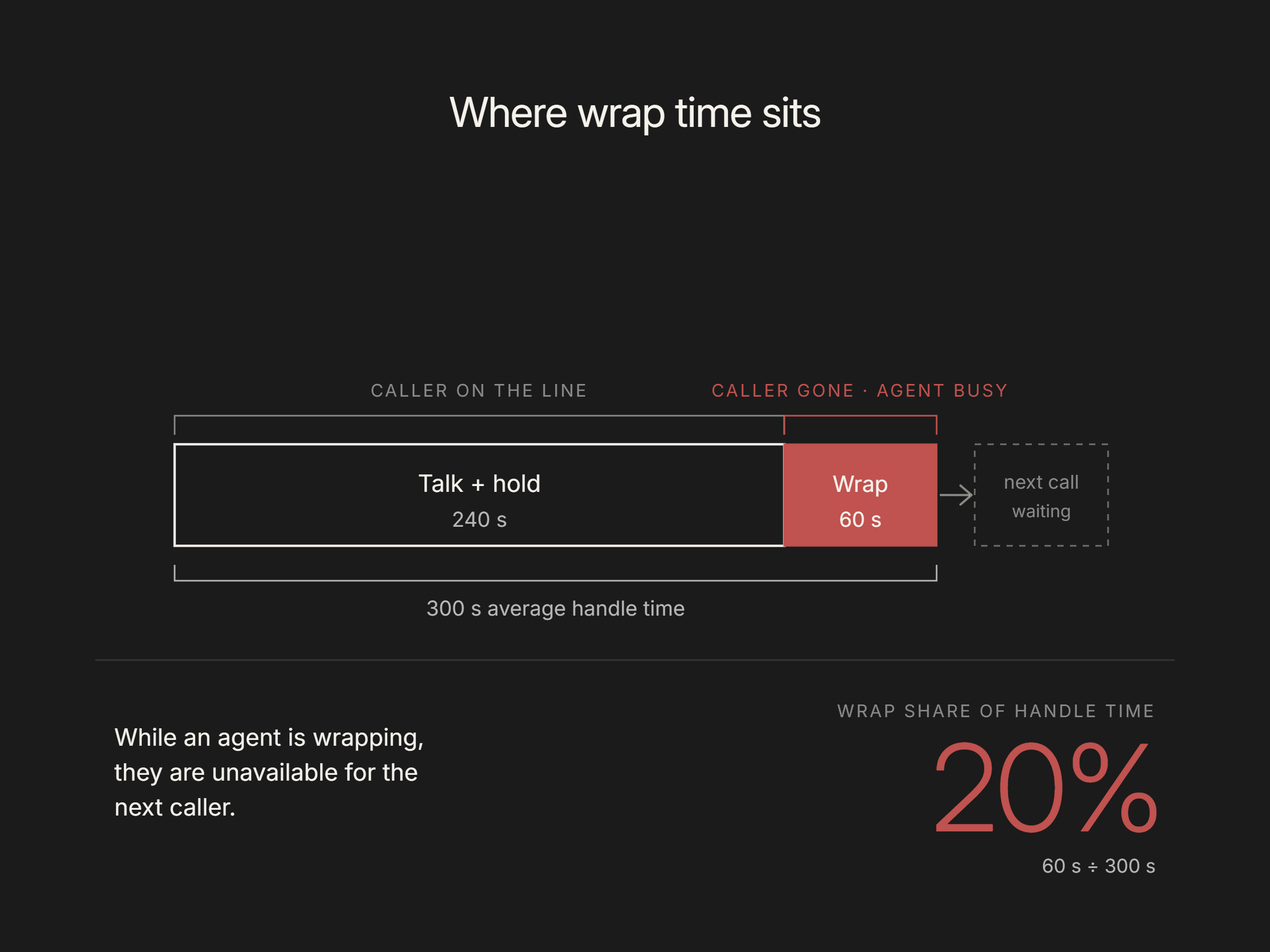
After-call work (ACW) is everything an agent does to close out a contact after the caller hangs up and before taking the next one: logging notes, updating the CRM, coding the disposition, and filing follow-ups. The total time spent on it is called wrap time. According to CallCentreHelper, ACW is part of the interaction even though the customer is no longer on the line, which is why it is counted inside average handle time. You measure it as wrap time divided by total handling time over the same period, expressed as a percentage. ACW matters because it sits on the critical path to the next call: while an agent is wrapping, they are unavailable, so long wrap time quietly shrinks capacity and pushes up queue waits. It is also one of the most automatable parts of the job.
What counts as after-call work?
After-call work is the set of tasks an agent completes once the caller disconnects, before becoming available again. Calabrio defines it as the post-interaction work that keeps an agent occupied between calls, sometimes called post-call processing or wrap-up. In practice that includes writing the call summary, updating the customer record or CRM, entering a disposition or reason code, sending a follow-up email, creating a ticket, and scheduling any callback the call generated. In regulated settings it also covers compliance notes and documentation the interaction requires. What it is not is talk time or hold time, which happen while the caller is still connected. Drawing that line clearly matters, because if agents log documentation done during the call as ACW, your wrap time and your handle time both distort.
Want this mapped against your own call and claim volume? Book a 30-minute audit
How much of AHT is ACW?
ACW is folded directly into average handle time, so its share is worth measuring on its own. Balto gives the calculation as wrap time divided by total handling time, expressed as a percentage. A worked example from that framing: if an agent spends 60 seconds on after-call work and total handle time is 300 seconds, ACW is (60 / 300) x 100, or 20 percent of handle time. The share varies widely by call type, since a quick informational call carries almost no documentation while a complex service or claims call can generate several minutes of it. Break ACW out by call type rather than reading a single blended figure, because that is where the outliers hide. The call types with the heaviest wrap time are usually the best automation candidates.
Most after-call work is transcription in disguise: summarizing what was said, choosing a disposition, and keying the outcome into another system. Flexbone writes that record from the call itself, so the summary and the system update happen without anyone retyping them, and which call types get it first is chosen from the center's own recordings. More on contact center automation.
See what AI can run at your facility. In a 30-minute audit we map the calls, eligibility, and follow-ups Flexbone can take off your team first.
Book an auditWhy is ACW a problem?
Long ACW is a problem because of where it sits: on the path to answering the next caller. Observe.AI notes that while an agent is doing wrap-up, they are not available for the next contact, so heavy ACW ties up capacity and lengthens queues. It also creates a quality tension. Push agents to wrap faster and documentation gets thin, which weakens the record the next agent relies on and can create compliance gaps. Leave it unmanaged and it inflates handle time, drives up cost per contact, and adds to the monotony that wears agents down. There is variance risk too: when one agent's wrap time runs double another's for the same call type, the gap is usually a process or tooling problem, not effort, and it distorts your staffing math.
How do you reduce it?
The most durable way to cut ACW is to do less of it manually. Parloa points to AI-generated summaries and wrap-time automation as the main levers, drafting the notes and disposition so the agent confirms rather than types from scratch. Beyond automation, standard practice helps: templated notes and pre-filled disposition fields per call type, and doing lightweight documentation during the call when it does not hurt the conversation. Cut the number of systems an agent has to touch after a call, since app-switching is a hidden driver of wrap time. Measure ACW by call type and by agent so you can target the outliers instead of pressuring the whole team. The goal is a shorter, more consistent wrap, not rushed notes that push work onto the next interaction.
How Flexbone automates ACW away
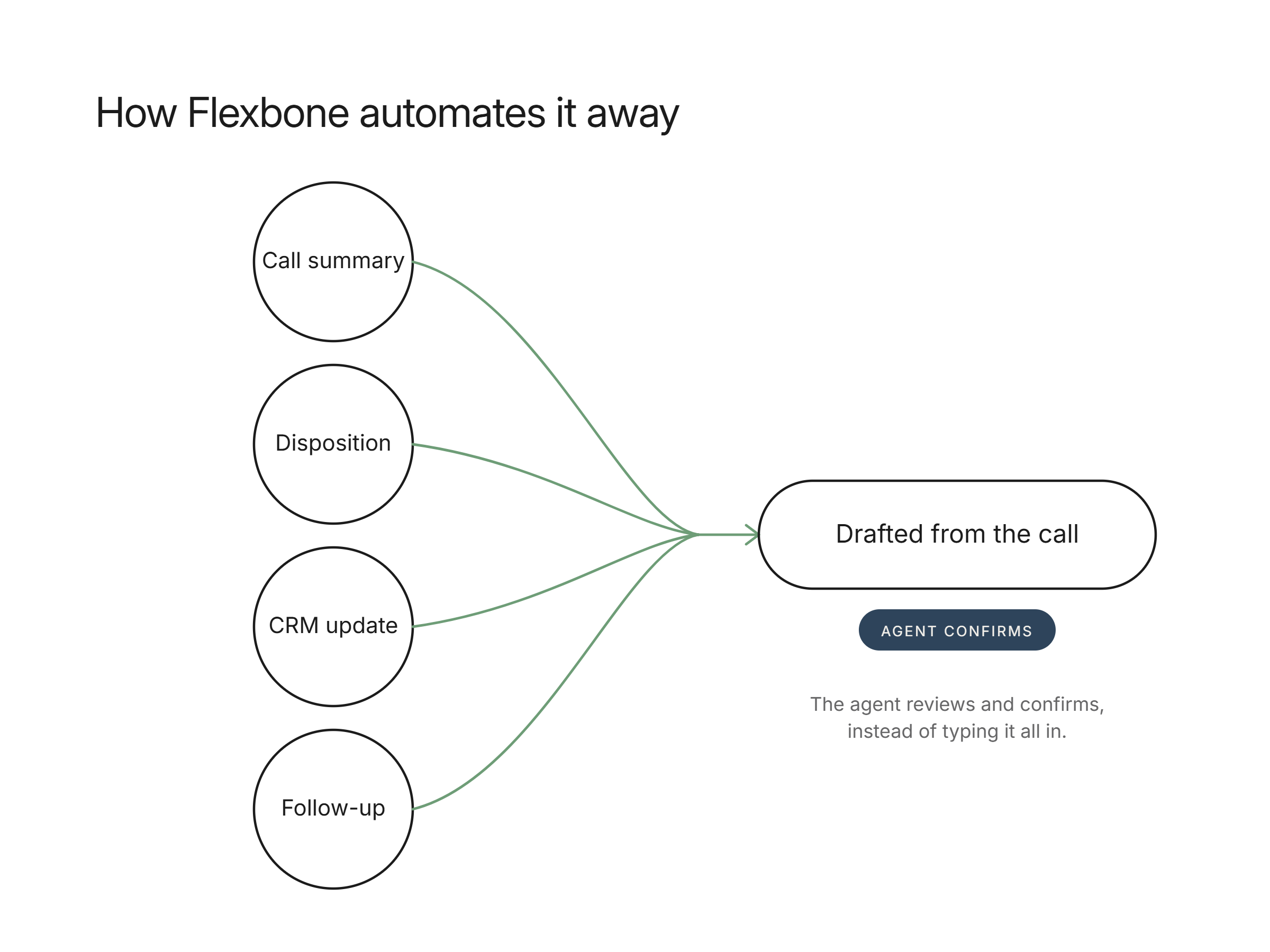
After-call work is the clearest case for a document and desktop agent, because most of it is structured, repeatable, and happens after the customer is gone. Flexbone's agents draft the call summary, write the disposition, update the CRM, and open the ticket or follow-up automatically from the interaction, leaving the human agent to review and confirm rather than type it all in. In a BPO, an insurance operation, a health system, or a public-sector office, that pulls minutes of wrap out of every handled call, which frees agents for the next contact and shrinks average handle time without cutting the quality of the record. Because Flexbone audits your call mix and documentation steps first, you can see exactly which wrap tasks are safe to automate before anything ships. Book a demo to see it on your own workflow.