Agent attrition, also called turnover, is the rate at which agents leave over a period. The formula is attrition rate = (agents who left / average headcount) x 100, usually measured annually. Call-center attrition runs high: reported industry averages sit around 30 to 45 percent a year, well above most other roles Insignia. The cost is the reason it matters. Replacing one agent commonly runs $10,000 to $20,000 once you count recruiting, onboarding, training, and the ramp to full productivity. For a 100-seat center at 40 percent turnover, that is roughly $400,000 to $800,000 a year. This page gives the attrition formula, the average turnover rate, a replacement-cost model you can run on your own numbers, and the levers that actually reduce churn, with automating repetitive tier-1 volume among them.
How do you calculate attrition rate?
Attrition rate = (number of agents who left during the period / average number of agents during the period) x 100. Average headcount is usually (starting headcount + ending headcount) / 2. For example, a center that starts the year with 120 agents, ends with 100, and lost 55 people along the way has an average headcount of 110 and an annual attrition rate of 50 percent AmplifAI. Decide whether you count only voluntary departures or all exits, and whether you separate involuntary terminations, because blending them hides the churn you can actually influence. Track first-year attrition separately too. A large share of call-center turnover happens inside the first months, so the new-hire cohort tells you more about your onboarding and role design than the blended annual figure does.
Want this mapped against your own call and claim volume? Book a 30-minute audit
What is the average call-center turnover rate?
Call-center turnover is among the highest of any industry. Commonly cited annual figures land in the 30 to 45 percent range, and some high-stress operations run higher. SQM's analysis argues attrition has become one of the most important call-center metrics precisely because it is both high and expensive, and it correlates tightly with agent dissatisfaction SQM Group. For economy-wide context, the Bureau of Labor Statistics tracks quits, hires, and total separations across industries in its Job Openings and Labor Turnover Survey, a useful baseline when you benchmark your own rate BLS. Two patterns are worth noting when you benchmark. First, much of the loss is concentrated in the first year, so a center with heavy new-hire churn will post a high blended number even if tenured agents stay. Second, the rate varies by model: remote and hybrid operations tend to report lower turnover than fully on-site floors. Compare against your own staffing model and tenure mix rather than a single headline percentage.
Turnover cost scales with how many people a center needs, and headcount scales with repetitive volume. Flexbone moves the scripted call types, identified from recordings, to voice agents, which lowers the headcount exposed to that cost. See contact center automation.
See what AI can run at your facility. In a 30-minute audit we map the calls, eligibility, and follow-ups Flexbone can take off your team first.
Book an auditWhat does it cost to replace an agent?
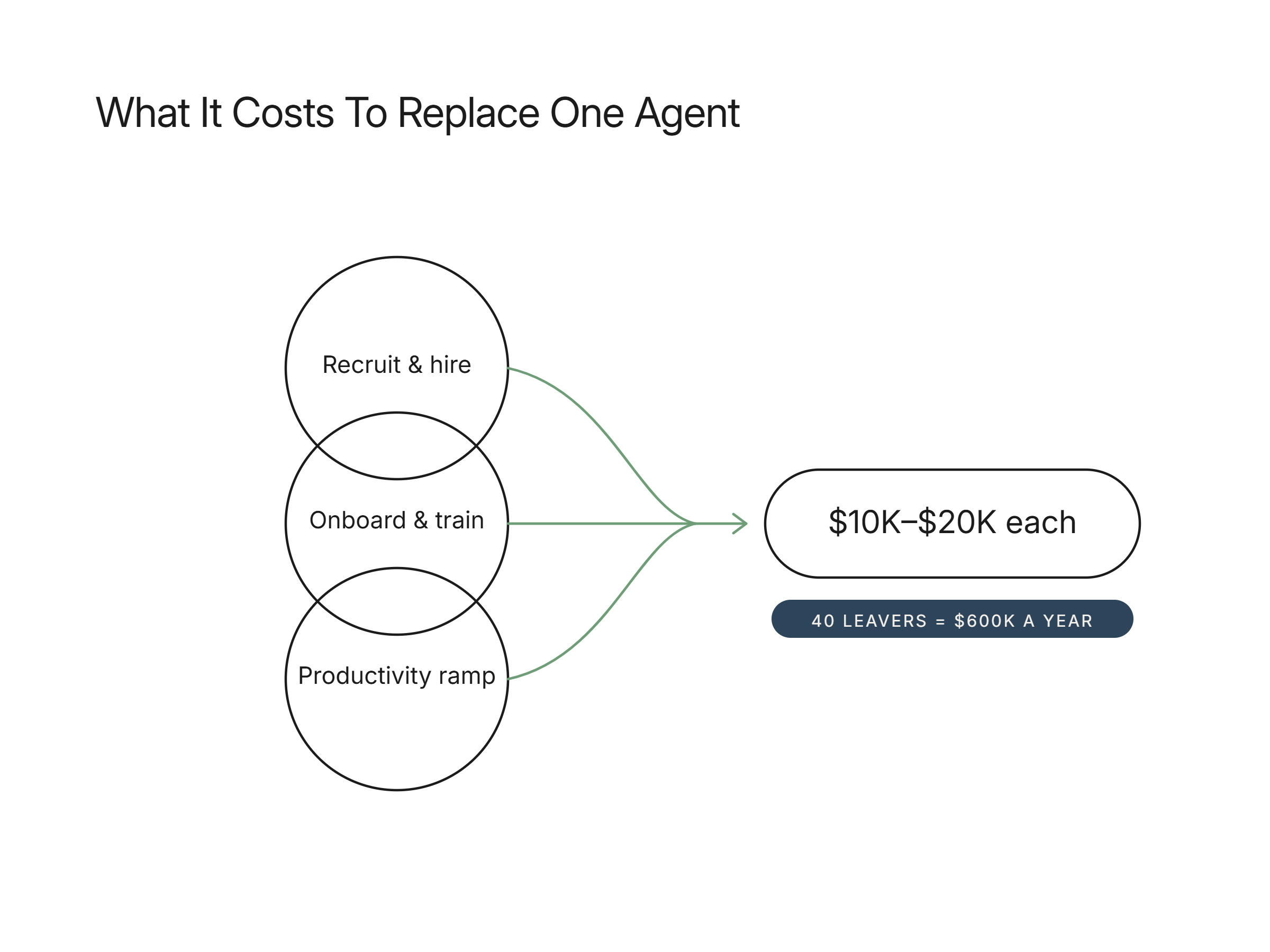
The cost to replace a call-center agent commonly runs $10,000 to $20,000, a range McKinsey research supports, covering recruiting, hiring, onboarding, training, and the productivity ramp SymTrain. The largest hidden piece is that ramp: new agents typically need around 90 days to reach full productivity, so you pay a wage before you get full output. Build your own estimate by adding recruiting and hiring costs, training hours at loaded wage, supervisor and trainer time, and the productivity gap during ramp, then multiply by the number of agents you lose each year. A 100-seat center at 40 percent turnover loses 40 agents; at $15,000 each that is $600,000 annually. Seeing the total in dollars is usually what moves attrition from an HR footnote to an operations priority.
How do you reduce attrition?
You reduce attrition by attacking its top cause, which is burnout. Contact-center burnout statistics tie chronic workplace stress and relentless call volume to agent exits, which is why the fix starts with the workload HiveDesk. The levers that work: give agents realistic occupancy and recovery time instead of back-to-back calls, invest in onboarding so new hires are not thrown into hard contacts unprepared, offer schedule flexibility and remote options, and remove the most repetitive, draining volume from the queue. That last lever is where automation helps directly. When an AI layer handles the high-volume, low-variety tier-1 contacts that agents find most monotonous, the remaining work is more varied and less grinding, which lowers the burnout that fuels turnover. Reducing attrition is cheaper than replacing agents, so the retention math usually favors prevention.
How Flexbone reduces burnout-driven churn
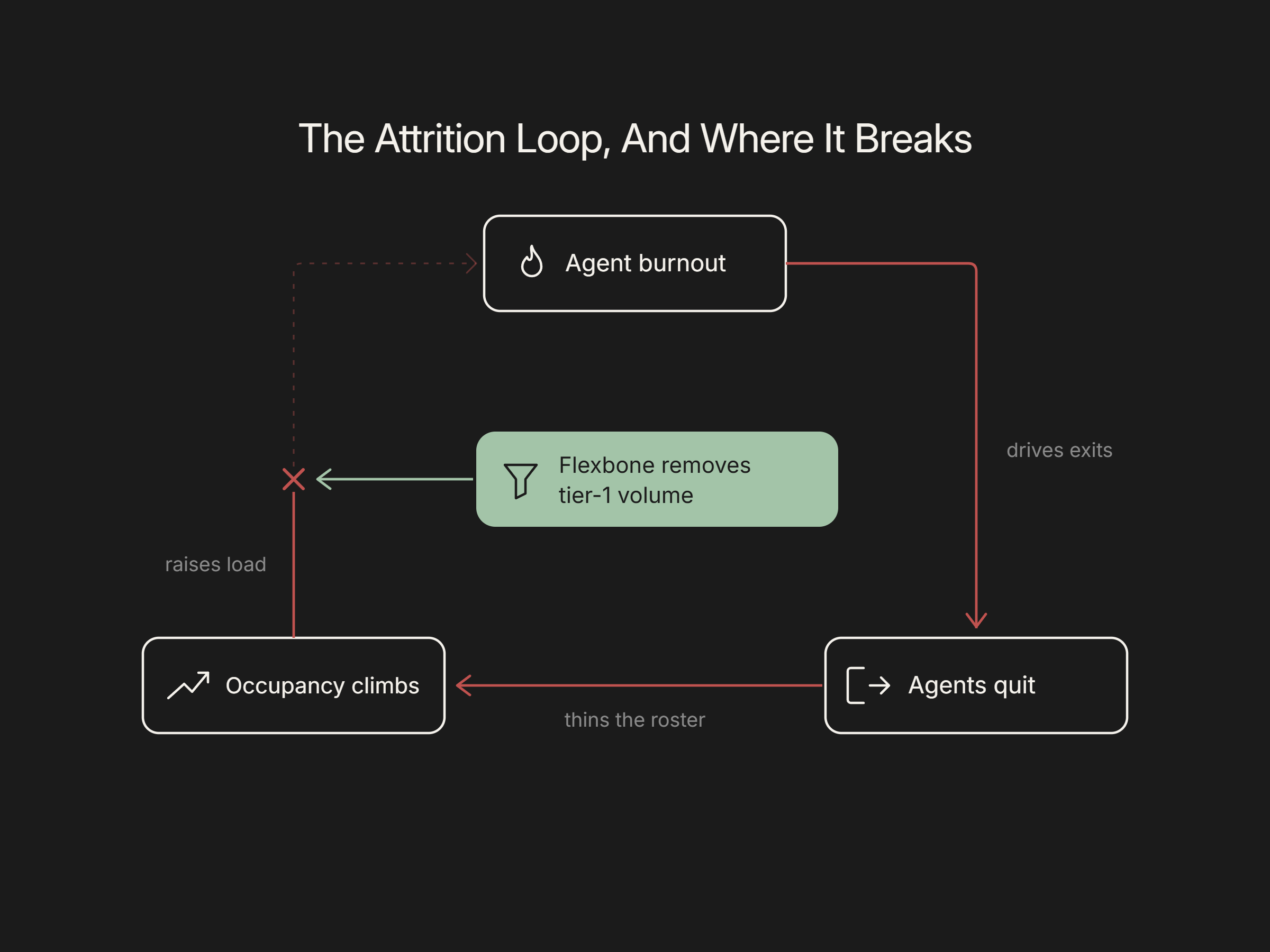
Attrition math is brutal because it compounds: burnout drives exits, exits raise occupancy on the agents who remain, and higher occupancy drives more burnout. Flexbone breaks the loop from the volume side. We audit your contact reasons to find the repetitive, low-variety tier-1 work that agents find most draining, then deploy AI voice, chat, and document agents to handle it end to end. That leaves your agents on the varied, higher-judgment contacts that are more engaging and less monotonous, and it lets you staff a healthy occupancy instead of over-driving a thin roster. The result we aim for is lower burnout-driven churn and a smaller annual replacement bill, across BPO, insurance, healthcare, and public-sector teams. We measure it against your own baseline attrition and replacement cost.
See what removing tier-1 volume does to your retention math: book a demo.