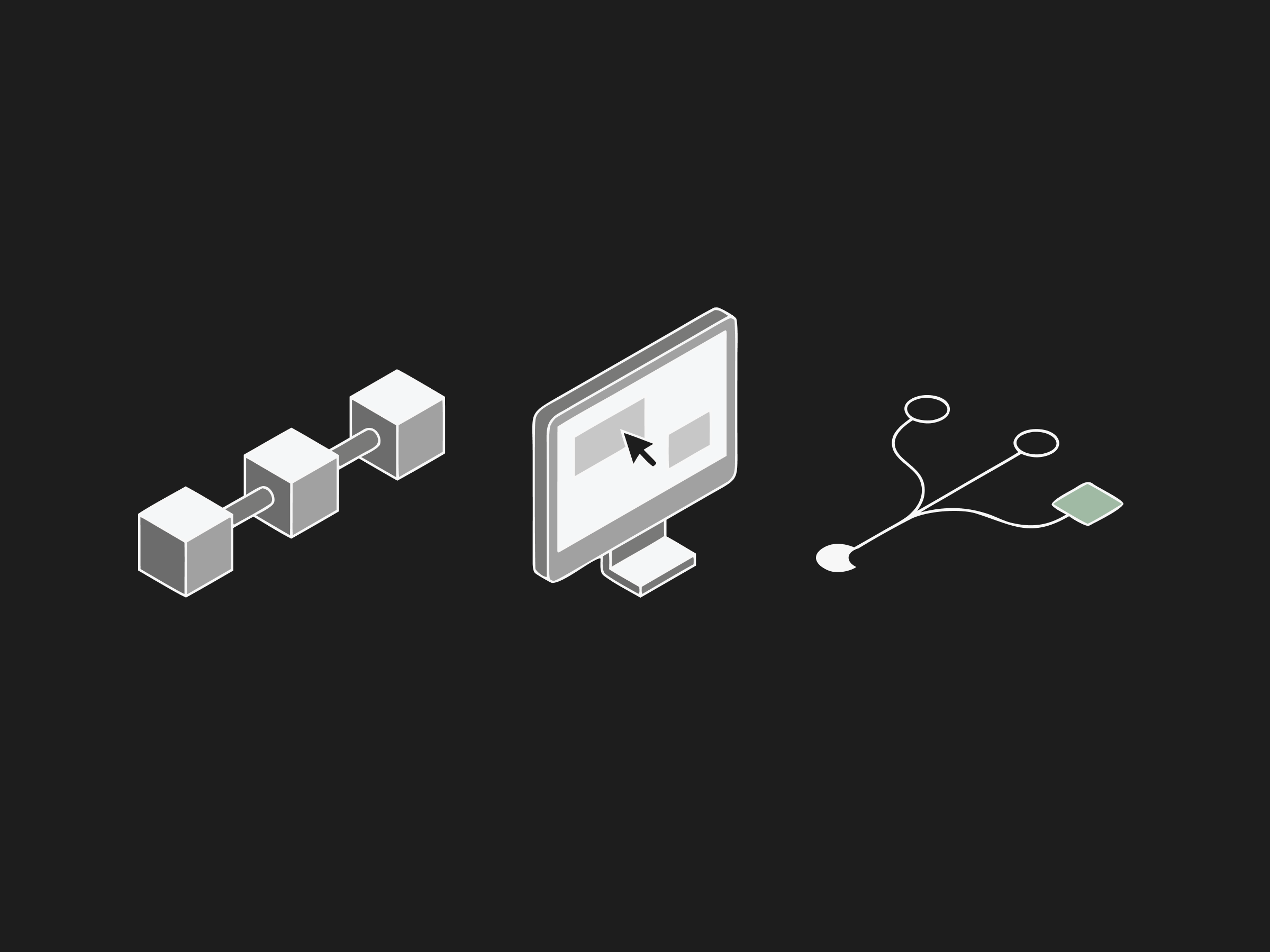
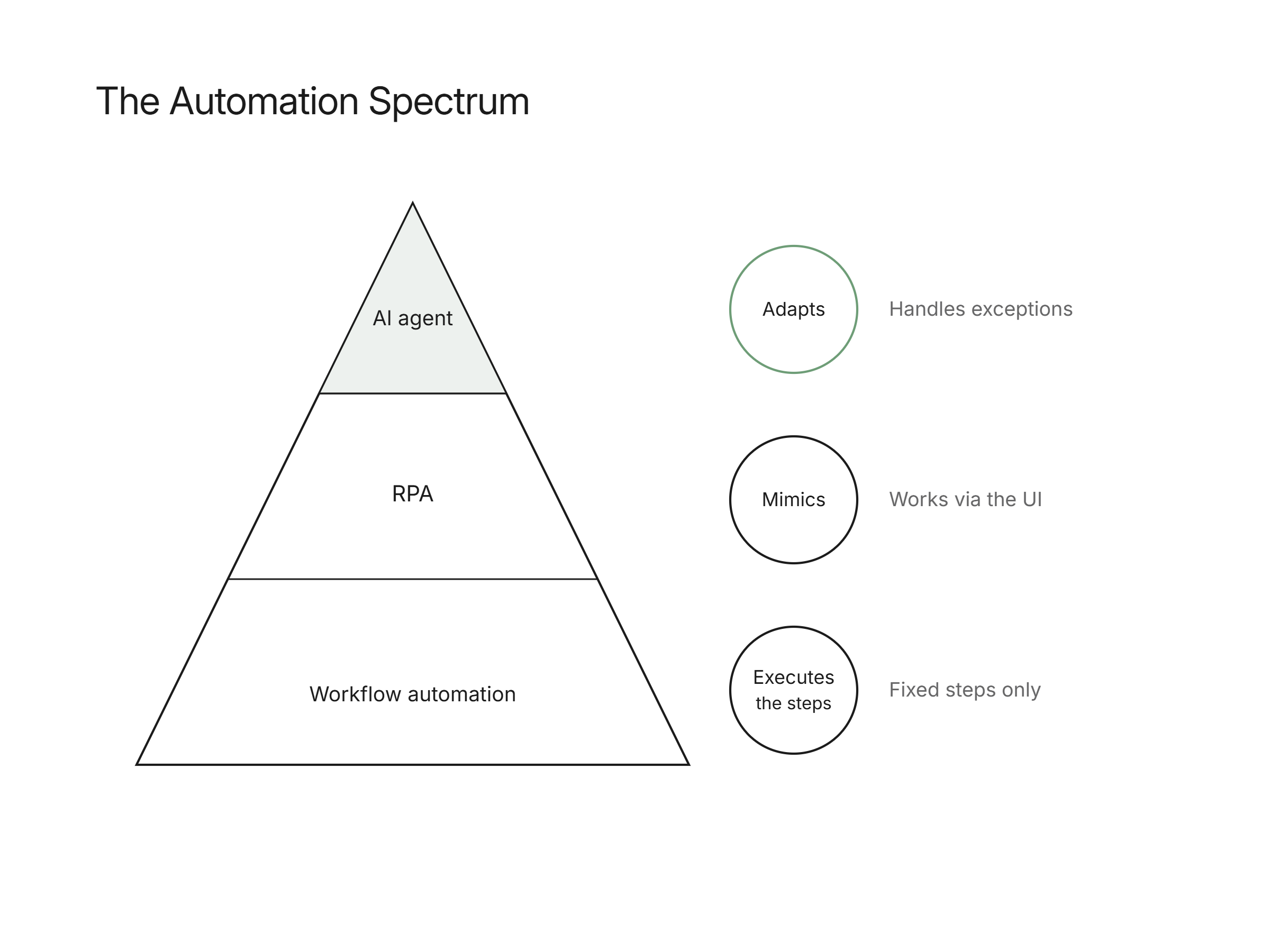
Workflow automation, RPA, and AI agents solve related problems at different points on a spectrum of flexibility. Workflow automation orchestrates a defined sequence of steps across systems. RPA runs software robots that mimic a person clicking and typing through rule-based tasks. An AI agent uses a language model to decide what to do next, adapting when inputs vary. Anthropic's guidance on building effective agents draws the sharpest line: workflows follow predefined code paths you control, while agents let the model direct its own process and tool use. The practical rule is to match the tool to the process, using the simplest option that works and reserving agents for the cases that genuinely need judgment. This guide defines each approach and gives a three-question framework for choosing among them per process, not per vendor.
What is workflow automation?
Workflow automation coordinates a defined series of tasks across people and systems, moving work from one step to the next according to rules you set. Think of an approval that routes a request to a manager, updates a record, and notifies a requester: the path is fixed and known in advance. This is the territory of business process management and integration platforms, which connect applications and enforce the sequence. Gartner's definition of hyperautomation lists business process management and iBPMS alongside RPA and AI as the tools organizations combine, which reflects how workflow automation typically forms the backbone that other tools plug into. Its strength is predictability: given the same input, it does the same thing every time, which is exactly what you want for structured, well-understood processes. Its limit is that it cannot handle inputs or decisions the designer did not anticipate.
Want this mapped against your own call and claim volume? Book a 30-minute audit
What is RPA?
RPA, robotic process automation, uses software robots to carry out repetitive, rule-based tasks by mimicking human actions in a user interface: clicking buttons, entering data, and moving information between systems. UiPath, a leading vendor, describes RPA as software robots that automate repetitive, rule-based work and mimic human actions to run quickly and accurately. RPA shines where you need to bridge systems that have no API, because the robot operates the screen the way a person would. Its constraint is brittleness: because it follows a fixed script tied to specific screen elements, it tends to break when a layout changes or an input falls outside the expected pattern. RPA does not reason about what it sees; it replays a recorded path. That makes it excellent for stable, high-volume, structured tasks and poor at the long tail of exceptions that structured processes tend to generate.
Flexbone uses AI agents where screens or inputs vary and leaves a stable, unchanging task to a simple script; an audit of the workflow decides which case applies. See browser agents.
See what AI can run at your facility. In a 30-minute audit we map the calls, eligibility, and follow-ups Flexbone can take off your team first.
Book an auditWhat is an AI agent?
An AI agent is a system where a language model decides what to do next, chooses which tools to use, and adapts based on what each step returns, rather than following a fixed script. Anthropic's building effective agents defines agents as systems where the model dynamically directs its own processes and tool usage, keeping control over how it accomplishes a task. The difference from RPA is the reasoning loop: an agent observes the result of each action and can change course, which lets it handle variable inputs and the exceptions that break a fixed path. That flexibility has a cost. Agents trade some predictability, latency, and expense for the ability to handle ambiguity, so the same guidance recommends using the simplest approach that works and reaching for an agent only when the task genuinely needs model-driven decisions rather than a defined path.
How do you choose among them (a buyer's framework)?
Choose per process, not per vendor, using three questions. First, is the path fixed and known? If yes, workflow automation is the cheapest, most predictable fit. Second, does the task need to operate a user interface with no API, but still follow stable rules? That is RPA's home. Third, does the work involve variable inputs, judgment, or a long tail of exceptions a script cannot enumerate? That is where an AI agent earns its added cost and latency. These are complements, not rivals. Gartner's hyperautomation frames the mature approach as orchestrating multiple tools together rather than betting on one, so a real deployment often has workflow automation as the spine, RPA reaching legacy screens, and an agent handling the decisions and exceptions. Start with the simplest tool that clears the bar, and add reasoning only where the process demands it.
How Flexbone fits the framework
Flexbone builds audit-first AI agents, voice, browser, document, and desktop, for the exception-heavy, judgment-shaped work in regulated back offices where fixed scripts fall short. Much of healthcare revenue cycle is exactly the third case in the framework: a 270/271 eligibility response reads differently from one payer to the next, an 835 remittance posts an unexpected CARC code, Availity and Medicare and Medicaid portals shift their layouts, and the long tail of exceptions is where the cost hides. Our agents read the screen in Epic or athenahealth and the document, reason about what each step returns, and adapt, while human approval and a full audit trail keep the work reviewable. Because the platform is HIPAA compliant and SOC 2-aligned, teams can apply agents to the cases that need judgment without new compliance risk, and keep simpler workflow automation or RPA where the path is already fixed. See how this plays out in insurance eligibility verification.
Book a demo: https://www.flexbone.ai/contact