An AI answering service for an orthopedic practice is a voice agent that answers patient calls, books and reschedules appointments, triages symptoms by protocol, and routes urgent cases, at any hour and without hold time. It handles the high volume that ties up an orthopedic front desk: post-op questions, injury calls, imaging and surgery scheduling, and cast or brace concerns. This matters because a large share of practice calls never get answered; one analysis of medical practice phone data found that about 23% of calls go unanswered and most callers who reach voicemail hang up without leaving a message. For a specialty where a single surgical consult carries real value, those missed calls are missed patients. An AI agent picks up each call, completes the routine ones itself, and escalates the rest to staff or the on-call clinician.
What can an AI answering service do for an orthopedic practice?
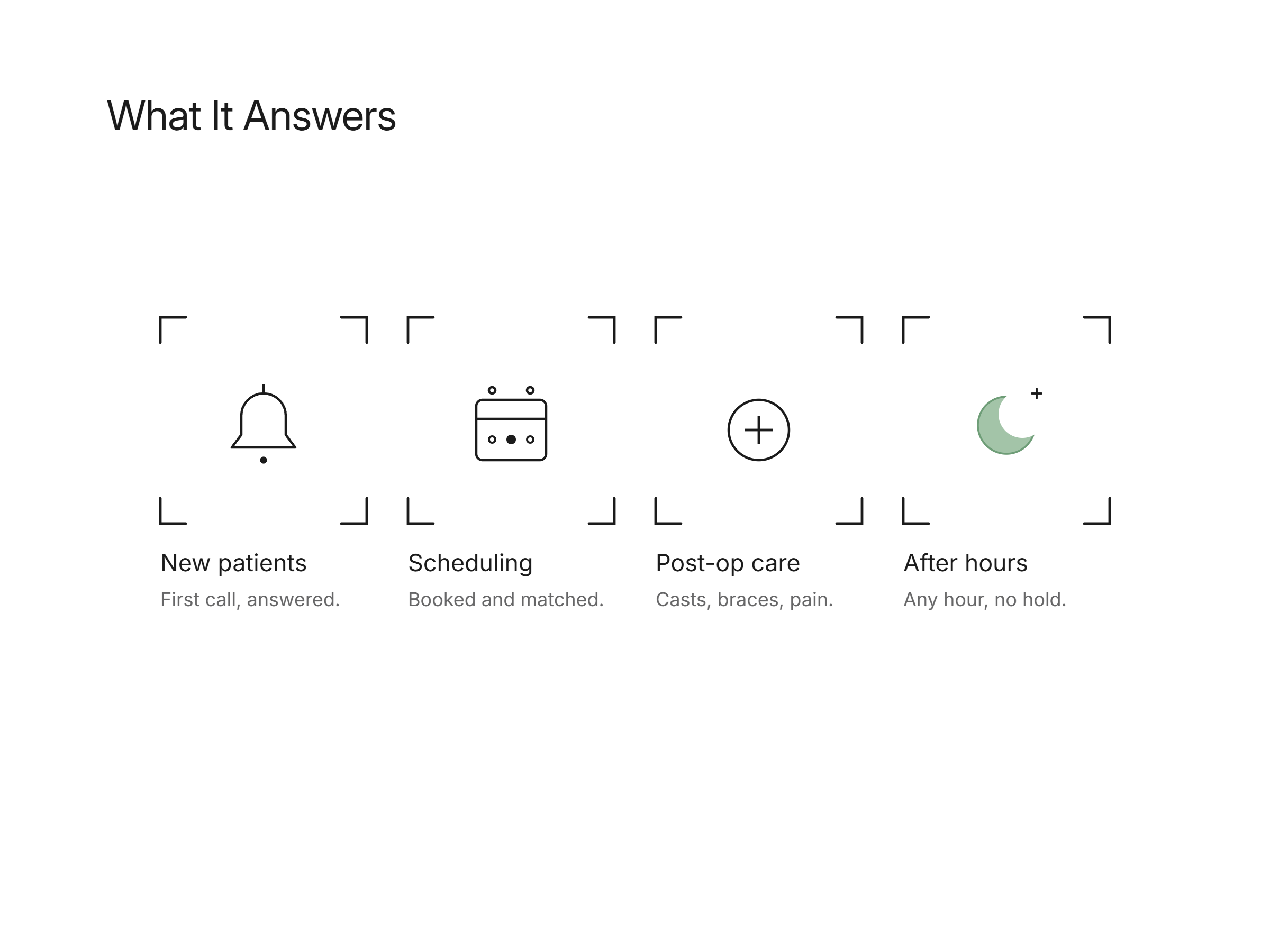
An AI answering service handles the calls an orthopedic front desk cannot reliably reach: new-patient inquiries, appointment booking and rescheduling, post-operative questions, prescription and imaging follow-ups, and after-hours injury calls. It answers on the first ring, works from the practice's own scripts and scheduling rules, and captures each caller instead of sending overflow to voicemail. That coverage is the core value, because missed calls carry a real price. Guidance on the cost of missed after-hours calls describes how unanswered calls send patients to a competing practice and quietly drain new-patient revenue. Unlike a voicemail box, an AI agent resolves the routine request in the moment, books the slot, and logs the call, so the daytime team inherits completed work rather than a queue of callbacks.
Want this mapped against your own call and claim volume? Book a 30-minute audit
How does it handle scheduling and triage?
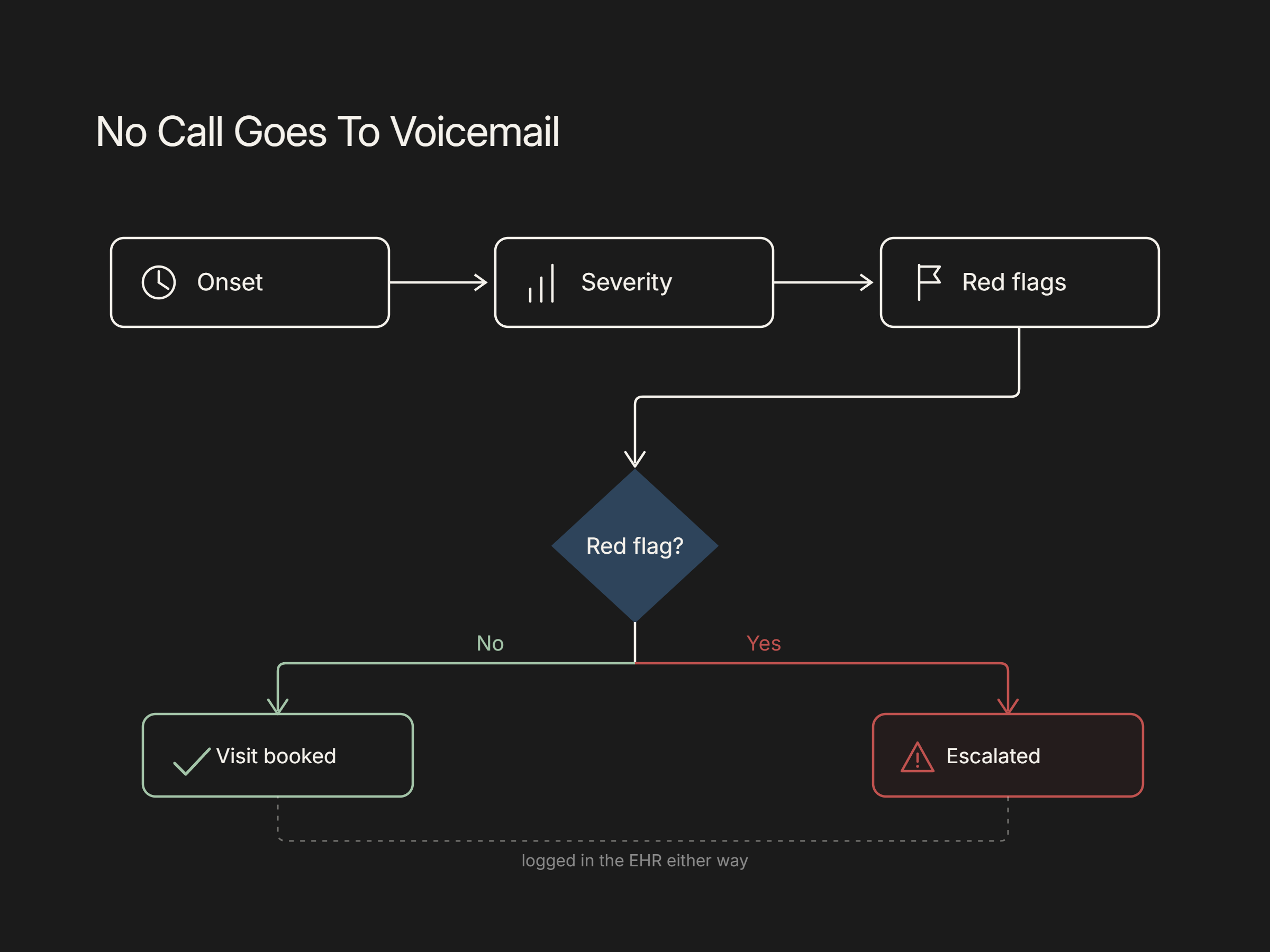
It handles scheduling by reading the practice's calendar rules and booking, moving, or canceling appointments directly, matching visit type to the right slot length, which matters for orthopedics where a surgical consult and a cast check need very different blocks. For triage, the agent follows standardized clinical protocols, asking structured questions about onset, severity, and red-flag symptoms, then routes the call to self-care guidance, a same-day visit, or urgent escalation. Structured telephone triage is a well-studied practice, and research on phone triage assessment shows how trained protocols balance safe escalation against unnecessary visits. When booking depends on coverage, it can run an eligibility check through the payer's 270/271 transaction before it commits a surgical consult slot. The agent documents each call in a standard format and pushes notes into the practice's EHR, whether that is athenahealth, eClinicalWorks, NextGen, or Epic, and it escalates anything outside its protocol, a possible fracture, uncontrolled pain, or signs of infection, to a nurse or the on-call surgeon under rules the practice sets in advance.
Scheduling is a lookup against the template and triage is a decision about who hears the call next; neither asks the agent for a clinical judgment. Flexbone keeps that boundary explicit: the agent books, confirms, and routes, anything symptomatic goes to a person, and the routing rules are built from the practice's recorded calls. See orthopedic call automation.
See what AI can run at your facility. In a 30-minute audit we map the calls, eligibility, and follow-ups Flexbone can take off your team first.
Book an auditIs it HIPAA compliant?
An AI answering service can be HIPAA compliant, and for a healthcare practice it must be, because it creates and handles protected health information on the practice's behalf. Under HIPAA, an answering service that takes patient calls is a business associate, which means the practice needs a signed business associate agreement and the vendor is directly responsible for safeguarding that information, as HHS explains in its guidance on business associates. Compliance in practice means encrypting call data, limiting access, logging activity, and signing the BAA before any calls are handled. When you evaluate a vendor, confirm it will sign a BAA, ask how call recordings and transcripts are stored and for how long, and check whether it can support additional standards such as SOC 2. A vendor that cannot commit to a BAA should not be handling patient calls.
What does it cost compared to a traditional answering service?
Traditional medical answering services usually bill by usage, with per-minute rates commonly running from about $0.70 to $1.20 and monthly costs that scale with call volume, plus add-on fees that many providers charge for HIPAA handling and after-hours coverage, as laid out in this medical answering service pricing guide. Because the meter runs on operator time, a busy orthopedic line gets more expensive exactly as volume grows. An AI answering service changes that shape: it can take many concurrent calls without per-minute operator cost, so pricing tends to track capability and volume tiers rather than raw minutes. The fair comparison is not just the invoice but the work completed. A traditional service takes a message; an AI agent books the appointment, runs the triage protocol, and hands the daytime team a resolved call.
How Flexbone runs an AI answering service for orthopedic practices
Most answering services stop at taking a message, which still leaves your staff each callback, booking, and triage the next morning. Flexbone deploys an AI voice agent tuned to orthopedic call types that answers each call, books and reschedules inside your system, runs triage by your protocols, and escalates urgent cases under rules you set. It works around the clock, documents each call, and is audit-first, HIPAA compliant, and SOC 2-aligned.
Hear it handle your call types: book a demo, or see how we handle orthopedic calls and healthcare calls more broadly.