AI email agents automate inbox workflows by reading each inbound message, classifying its intent, routing it to the right owner, drafting a grounded reply, and tracking follow-up until the item is closed. For an operations team, the inbox is often where work actually arrives, so automating it means the agent triages the queue the way a coordinator would, then hands anything ambiguous to a person. The reasoning step is what separates this from mail rules. Anthropic's guidance on building effective agents describes routing as a pattern where a model classifies an input and directs it to a specialized follow-on task, which is the backbone of inbox automation. This guide covers which workflows AI can handle, how routing and drafting work, and the guardrails an ops inbox needs before you let an agent send anything.
What inbox workflows can AI automate?
AI can automate the repetitive, high-volume parts of an inbox: sorting and labeling, prioritizing by urgency and service level, routing to the right team, acknowledging receipt, drafting first replies, extracting data from attachments, and chasing open items. The reason it is worth doing is that email consumes a large share of the workday. McKinsey's research on the social economy found interaction workers spend about 28 percent of their week reading and answering email. An agent does not eliminate the workflow; it pre-processes it, so people spend their time on judgment calls rather than sorting. In operations settings such as claims, benefits, or records handling, the same message types recur constantly, which makes them good candidates to automate one intent at a time and measure before expanding.
Want this mapped against your own call and claim volume? Book a 30-minute audit
How does automated routing work?
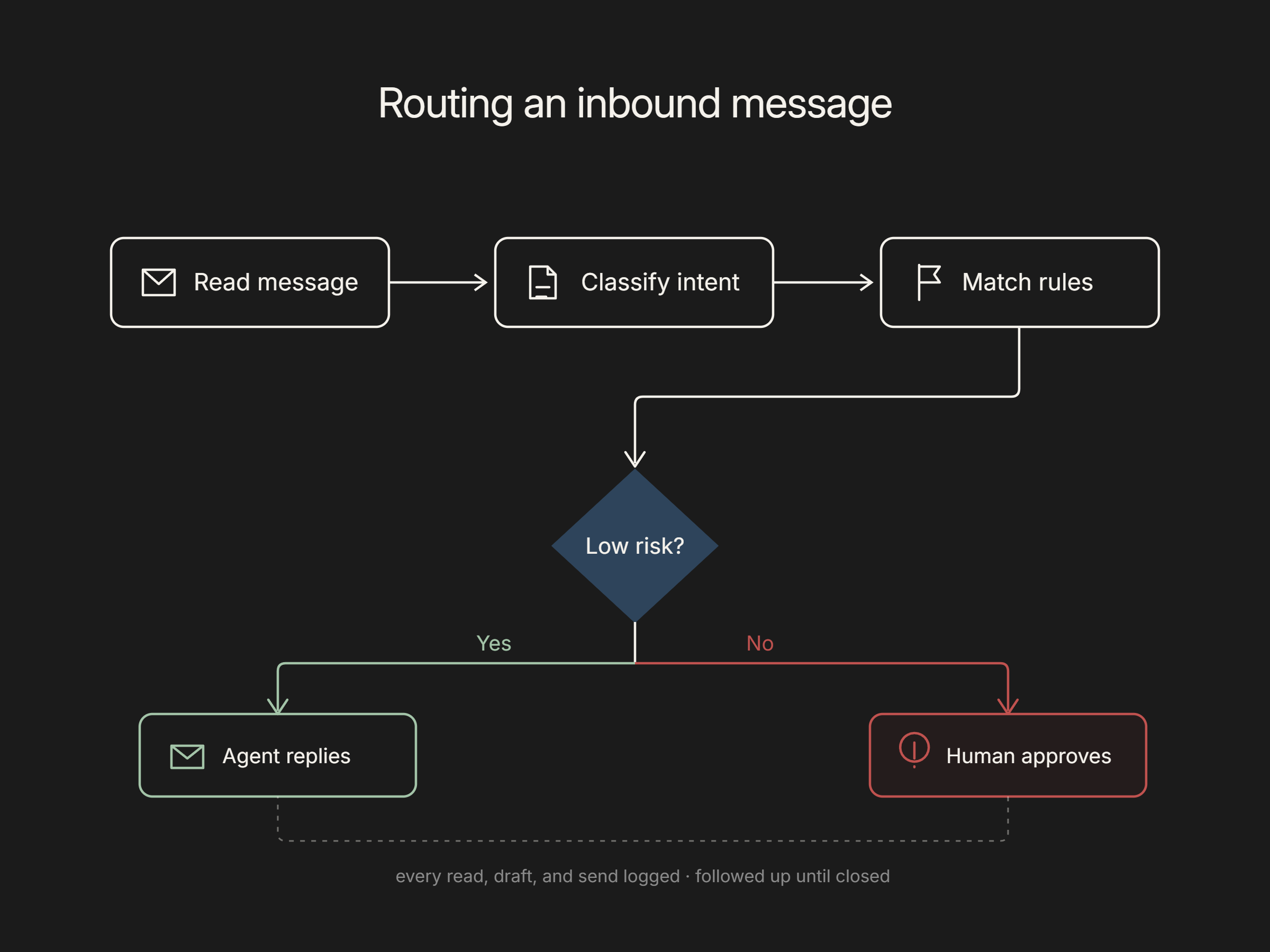
Automated routing works by classifying each message, then sending it to the queue, owner, or downstream process that matches. The agent reads the full message and any thread, infers the intent, checks it against your routing rules, and assigns it, escalating when the intent is unclear or high-stakes. Anthropic's building effective agents frames this as the routing workflow: a classification step feeds specialized handlers, which keeps each downstream path focused and lets you optimize accuracy per category. Good routing also carries context forward, so the receiving person or system gets the extracted fields and a short summary rather than a raw forward. The practical benefit is that mis-routes, the quiet tax on most shared inboxes, drop, because the agent reads intent instead of matching a subject-line keyword or a sender address.
Routing works when the categories come from real mail rather than a guess about it. Flexbone builds its document and inbox triage the same way, classifying a sample of actual items before writing any rules. See features.
See what AI can run at your facility. In a 30-minute audit we map the calls, eligibility, and follow-ups Flexbone can take off your team first.
Book an auditHow do drafting and follow-up work?
Drafting works by grounding a language model in your actual records, so the reply cites the case, order, or account rather than inventing details. The agent pulls the relevant data from connected systems, composes a reply that follows your policy and tone, and either sends it or presents it for approval. Follow-up works by tracking each open thread against a due date, sending reminders or a second touch, and closing the item when the loop completes. McKinsey's analysis of the economic potential of generative AI identifies customer operations as one of the highest-value functions for this technology, largely because drafting and resolution work is repetitive and text-heavy. The gain is real only when the draft is grounded and the follow-up is reliable, which is why measurement and human review sit alongside the automation from day one.
What guardrails keep it safe?
The core guardrails are human approval on outbound replies, scoped permissions, grounded drafting, and a complete audit log. An agent should send routine, low-risk replies on its own only after it has a measured track record; anything sensitive or customer-facing goes through a person first. Access should follow least privilege, so the agent reads only the mailboxes and systems a given workflow requires. The NIST AI Risk Management Framework describes trustworthy AI as valid, secure, accountable, transparent, and privacy-enhanced, and organizes governance into Govern, Map, Measure, and Manage functions that apply cleanly to an inbox. In practice, that means logging every read, draft, and send, escalating uncertainty instead of guessing, and reviewing the agent's accuracy on each intent before you widen its authority. A slow correct reply beats a fast wrong one.
How Flexbone automates operations inboxes
Flexbone builds audit-first AI agents, voice, browser, document, and desktop, that automate contact-center and back-office work, and the operations inbox is one of the places that work lands. In healthcare revenue cycle, a shared mailbox carries eligibility responses, claim correspondence, records requests, and patient messages, and each has a repeatable route, draft, and follow-up pattern an agent can learn. Because the platform is HIPAA compliant and SOC 2-aligned, teams can put an agent on protected data with least-privilege access, human approval on outbound replies, and a full audit trail. We start with an audit of your inbox mix, automate one high-volume intent end to end, and expand from measured results. See how the same approach handles healthcare calls.
Book a demo: https://www.flexbone.ai/contact