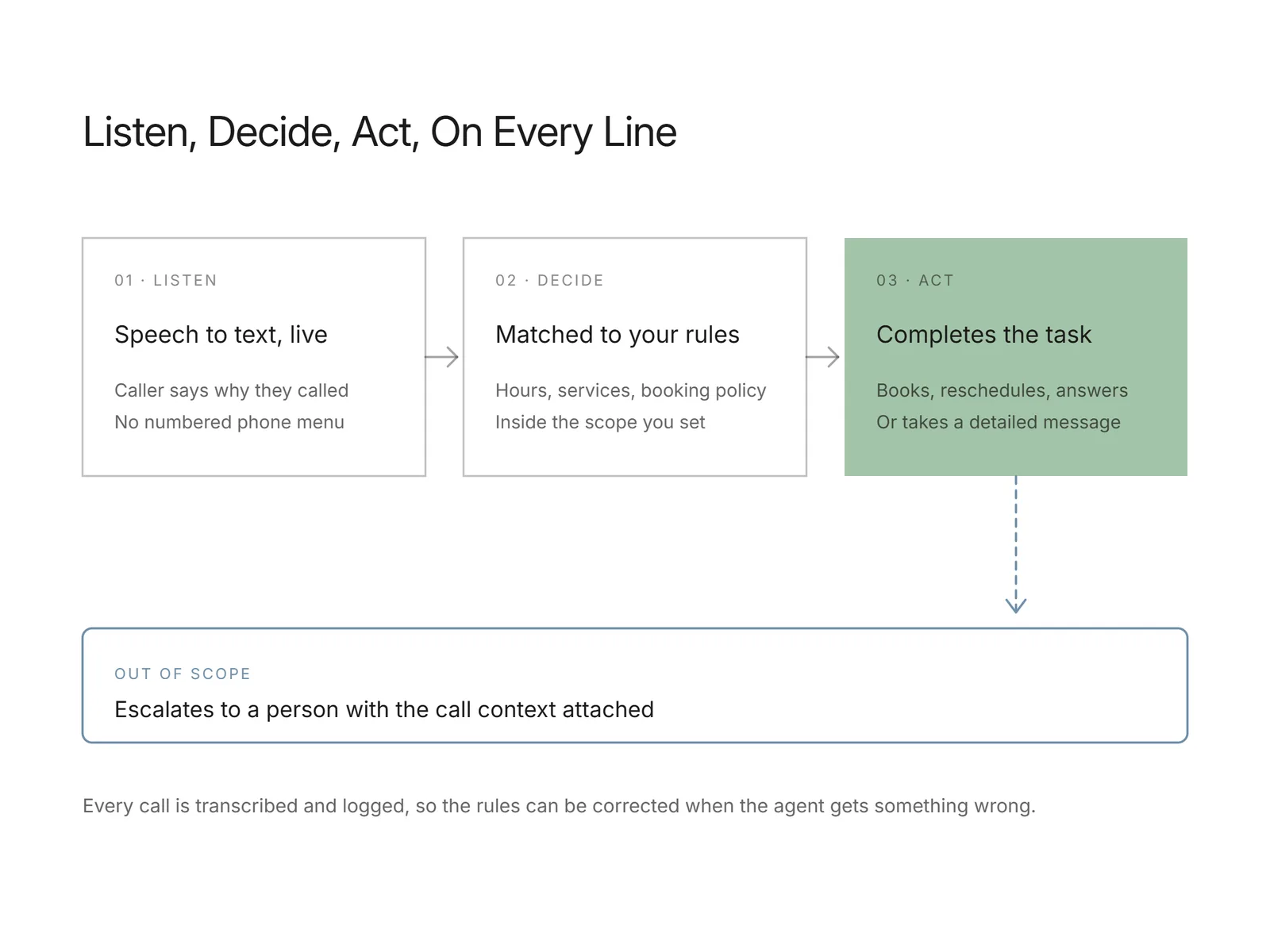
An AI receptionist for a small business is a voice agent that answers your phone, books appointments, answers common questions, takes messages, and routes or escalates calls to a person when needed. It runs on every line and after hours, so calls that used to reach voicemail get handled instead. The point is to keep the phone answered without paying for a full-time front desk just to catch overflow. On each call it runs a simple loop: it listens to what the caller says, decides which task they need based on rules you set, and then acts, whether that means booking a slot, answering a question, or taking a message. When a call falls outside its defined scope or the caller asks for a human, it escalates and passes along the context so no one has to start over.
What is an AI receptionist?
An AI receptionist is software that answers your business phone and handles routine front-desk work through natural conversation. It picks up in your business name, understands what the caller is asking in plain language, and completes the task it was set up to handle. Unlike a phone tree, it does not force callers through a menu of numbered options; the caller just says why they are calling, and the agent responds. Unlike voicemail, it does not simply record a message and leave the work for later. It can answer many callers at once rather than one at a time, so a second and third caller are not stuck on hold while the first is helped. The work stays inside a scope you define, and anything outside that scope goes to a person.
Want this mapped against your own call and claim volume? Book a 30-minute audit
How does an AI receptionist work?
An AI receptionist runs a listen, decide, act loop on each call it answers. First it listens: it converts the caller's speech to text in real time so it has an accurate record of the request. Then it decides: it matches the request against the rules and information you gave it, such as your hours, services, pricing basics, and booking policies, and picks the right next step. Then it acts: it books the appointment, answers the question, captures a message, or transfers the call. The agent works from the knowledge you load in, so its answers stay consistent with how your business actually operates. Each call is transcribed and logged, which gives you a record to review and a way to correct the rules when the agent gets something wrong. Because the loop is defined by your instructions, you control what the agent handles on its own and what it hands off.
What can an AI receptionist do?
An AI receptionist handles the repeatable phone work that fills a small business's day. The core jobs are answering inbound calls, booking and rescheduling appointments, answering common questions about hours, location, services, and pricing, taking detailed messages, and routing or escalating calls that need a person. It can also place outbound calls, such as confirming tomorrow's appointments or following up with a caller who left a request. Because it runs on every line and after hours, it catches the calls that come in while your team is with a customer, on another line, or closed for the day. It captures the caller's name, number, and reason for calling on every message, so the note your team picks up later has enough detail to act on. The specific tasks it takes on are the ones you configure; you can see the range of tasks an agent can run on the Flexbone features page.
See what AI can run at your facility. In a 30-minute audit we map the calls, eligibility, and follow-ups Flexbone can take off your team first.
Book an auditHow is an AI receptionist different from an answering service?
A traditional answering service uses human operators who answer in your business name, take a message, and route urgent calls to the right person. Their job is narrow: greet the caller, record the details, and decide whether the call is routine or urgent. An AI receptionist does more than record the call. Within the scope you set, it completes the task, so it can book the appointment, answer the question, or verify a detail rather than only noting that someone called. That difference matters because a message-only handoff still lands back on your team the next morning, while a completed booking does not. An answering service is a good fit when your after-hours need is mostly triage and messages. It reaches its limit when callers want to book, reschedule, or get an answer a message-taker cannot give. Many small businesses run a hybrid, letting the agent take the routine, high-volume calls and sending the rest to people.
How does an AI receptionist book appointments?
An AI receptionist books appointments by connecting to your scheduling system and working inside it the way a staff member would. When a caller asks for a time, the agent reads your live availability, offers open slots that fit the service and provider requested, confirms the details with the caller, and writes the booking back to your calendar. On later calls it can confirm, reschedule, or cancel the same appointment, keeping your calendar accurate without a person retyping anything. You set the rules that govern booking, such as which services can be booked by phone, how far out the calendar is open, and what buffer to leave between appointments. If a request does not fit those rules, the agent does not guess; it takes the caller's details and hands the booking to a staff member to finish. This mirrors how Flexbone runs voice agents for scheduling, where the agent reads availability, books into the correct slot, and writes the result back to the system of record.
Is an AI receptionist right for a small business?
An AI receptionist fits a small business best in a few clear situations. The first is missed calls: if calls go unanswered during busy hours or after you close, an agent that runs on every line and after hours catches them. The second is repetitive questions: if the same handful of questions about hours, services, and pricing come in all day, an agent can answer them consistently and free your team for the calls that need attention. The third is the cost of coverage: if hiring a full-time front desk just to handle overflow is hard to justify, an agent absorbs that routine load instead. It is a weaker fit when nearly all of your calls need human judgment, a sensitive conversation, or a decision the agent cannot be scoped to make. In the businesses we work with, owners use it to cover overflow, after-hours, and peak call times, and route the rest to people, rather than to remove staff.
An AI receptionist can answer your phone on every line, book and reschedule appointments, answer the questions that repeat all day, take detailed messages, and route the calls that need a person, all after hours as well as during them. If you want to see what an AI receptionist could do for your business, book a call with Flexbone and we will walk through your own call flows.