An AI voice agent and a human receptionist solve the same problem, answering the phone, in different ways. An AI voice agent answers multiple incoming lines at once, works after hours and on holidays, and applies the same script consistently without tiring or getting distracted. A human receptionist brings judgment, empathy, and the ability to handle complex, sensitive, or unusual calls that no script anticipates. Neither is strictly better; they are good at different things. In practice the answer is usually both. The agent resolves the routine, high-volume calls, such as hours, scheduling, and simple status questions, and escalates anything ambiguous or emotional to a person. That pairing gives a small team wide coverage while keeping human judgment where it matters.
What can an AI voice agent do better than a human receptionist?
An AI voice agent is strongest on volume, availability, and consistency. It can answer many calls at the same moment, so a rush of inbound calls does not produce a busy signal or a long hold. It works around the clock, which means calls that arrive at night, on a weekend, or during a lunch break still get answered rather than dropped. Because it follows a defined script, it asks the same intake questions and gives the same answers each time, which reduces the variation that creeps in when one person is tired and another is new. It also logs each call in a structured way, so the record of what was asked and what was said is captured automatically rather than written down after the fact. These are the repetitive, well-defined parts of reception work, and they are exactly where software holds up.
Want this mapped against your own call and claim volume? Book a 30-minute audit
What can a human receptionist do better?
A human receptionist is better at the work that requires judgment and reading a person. When a caller is upset, confused, or dealing with a sensitive situation, a person can hear it in their voice and adjust their tone, slow down, or simply listen. People handle ambiguity well: a request that does not match any script, a question with an unstated assumption, or a caller who is not sure what they need. They can make case-by-case decisions, weigh context that was never written into a rule, and take responsibility for an unusual call. They also build familiarity over time, recognizing a returning caller or the pattern behind a recurring issue. In the engagements we run, these are the calls we deliberately route to staff rather than trying to automate, because the value is in the human response.
See what AI can run at your facility. In a 30-minute audit we map the calls, eligibility, and follow-ups Flexbone can take off your team first.
Book an auditHow do cost and coverage compare?
The two models scale differently. Adding coverage with staff means adding people: more hours answered requires more shifts, and answering many calls at peak requires enough people to pick up at once. An AI voice agent changes that shape. One deployment can answer many concurrent calls and can stay available outside business hours without a separate overnight shift. That does not make a person unnecessary; it changes what the person spends time on. Instead of answering the routine calls, staff handle the smaller set of calls that need them. We avoid quoting a single number here because the real cost depends on call volume, how many calls need a human, and what the agent is asked to do. The useful comparison is not agent versus person on price, but how the combination covers demand: the agent absorbs the predictable, repetitive load, and staffing is sized for the calls that require judgment.
When should a call escalate to a person?
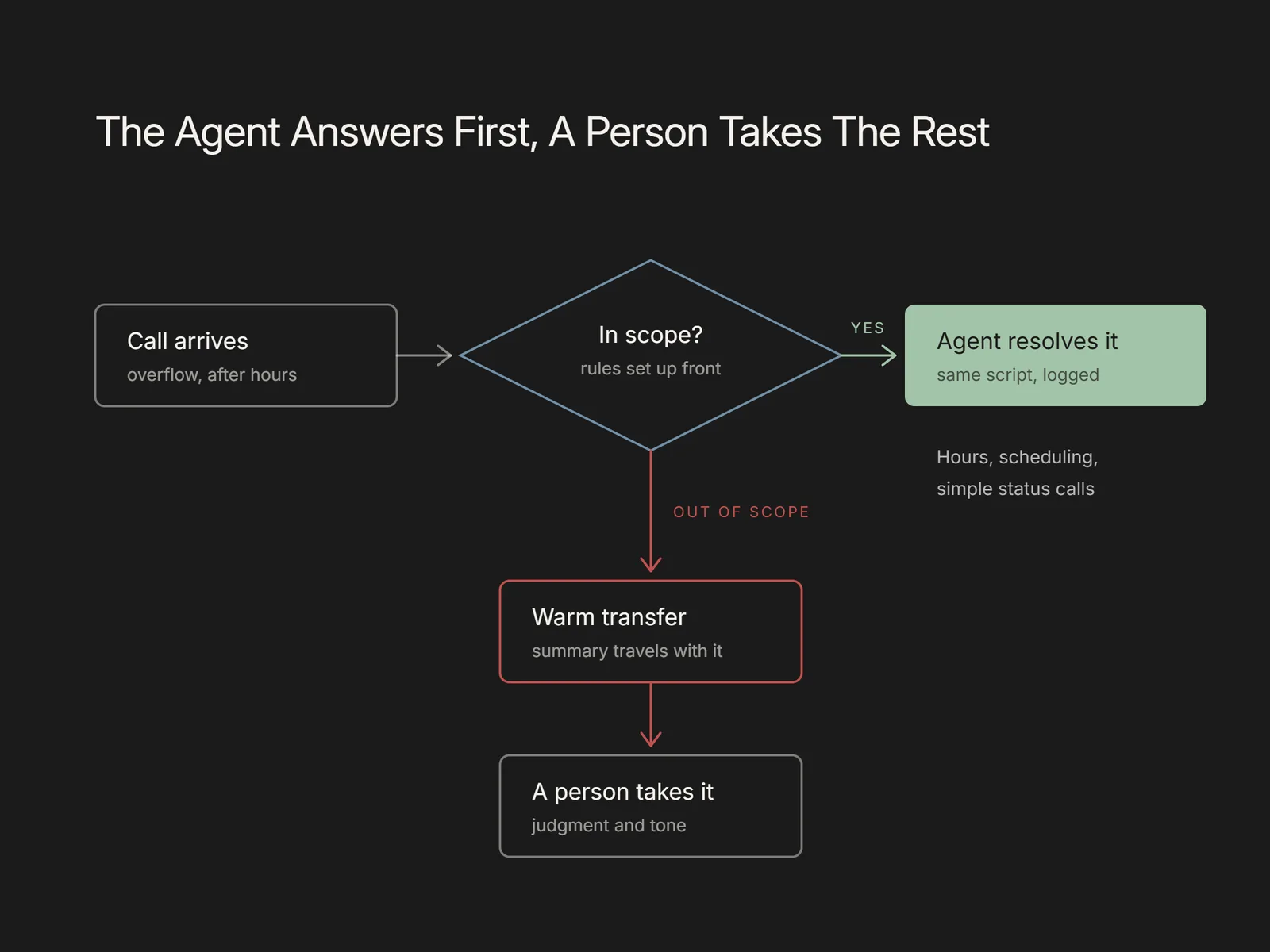
Escalation is the core design decision, and a good agent is built to recognize its own limits. A call should move to a person when it falls outside the agent's defined scope, when the caller is frustrated or distressed, when the request is sensitive, or when the agent lacks the information to answer accurately. The rules for these handoffs are set up front, so the boundary is explicit rather than left to chance. A well-configured transfer is warm: the agent passes along a short summary of what the caller has already said, so the person does not start from zero and the caller does not have to repeat themselves. The aim is not to keep each call inside the agent. It is to resolve what the agent handles well and route the rest quickly, so a caller who needs a person reaches one without a maze of prompts.
Can an AI voice agent and a human receptionist work together?
Yes, and the agent-plus-staff model is the arrangement we see work often. The agent answers first. It covers overflow when the lines are busy, after-hours calls when no one is at the desk, and the routine requests that make up much of the daily volume. Anything it cannot or should not handle, it escalates to the receptionist with context. This keeps two things true at once: no call goes unanswered, and the people on the team spend their time on the calls that actually need a person. You can read more about how Flexbone runs voice agents and see the Flexbone features that define scope, escalation, and call logging. The point of the pairing is coverage without overload: the agent takes the repetitive weight, and the staff keep the judgment.
The most durable setup is not agent or receptionist but agent and staff working from clear rules about who handles what. If you want to see what an AI voice agent could do alongside your team, book a call with Flexbone and we can walk through your call volume, where routine calls end, and where a person should take over.