
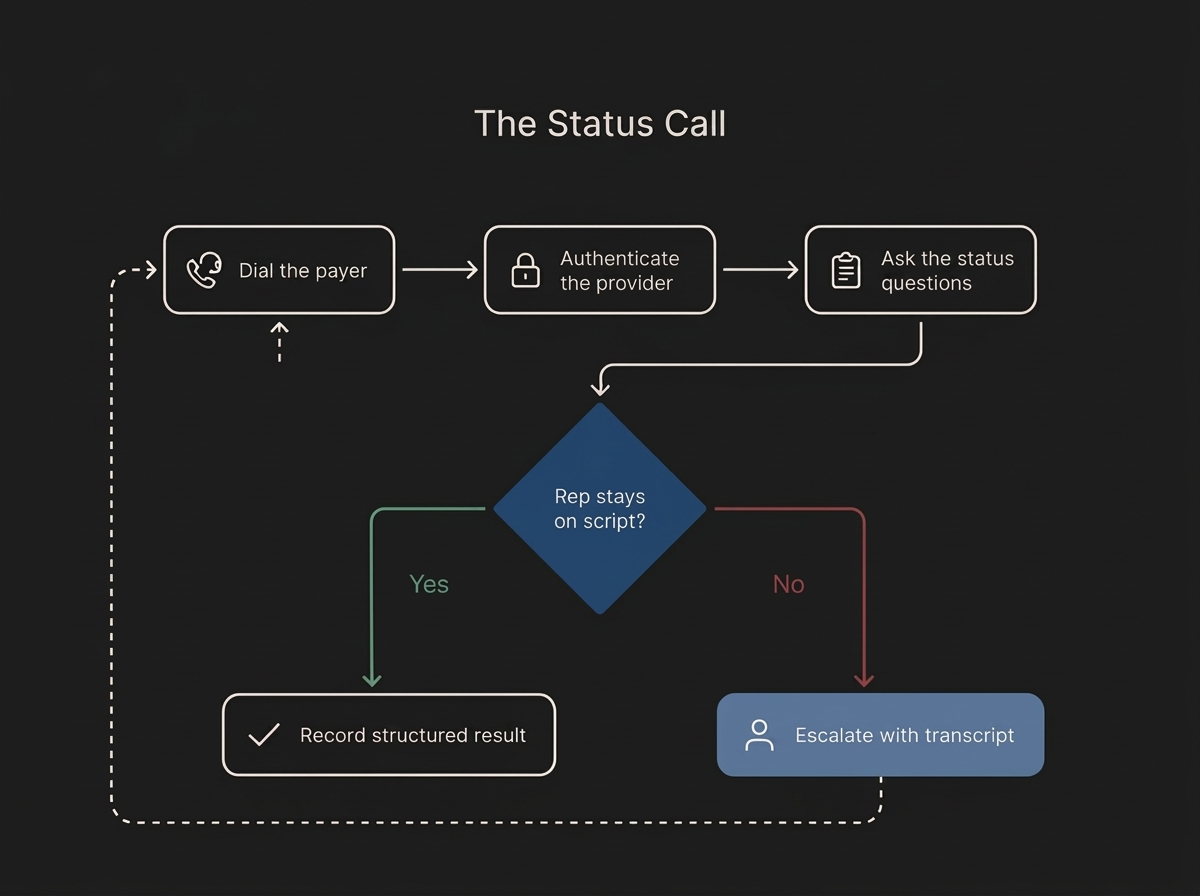
AI voice agents can automate the status-checking calls that credentialing and payer-enrollment work depends on. These are the repetitive calls to a payer to ask where an application stands, whether a provider is loaded to a panel, and what is still missing. The agent dials the payer, sits through the hold, navigates the phone tree, asks the status questions, and logs the answer to the system of record, freeing a credentialing specialist from an hour on hold for a two-minute answer. The volume is real because timelines are long: MGMA reports that payer credentialing timelines are growing and that "no communication from payers" is a top complaint. A voice agent that checks status persistently, without tying up a specialist, shortens the feedback loop on applications that would otherwise sit unattended.
Can AI automate credentialing and enrollment status calls?
Yes, for the status and follow-up calls that make up most of the phone burden. The agent handles a defined task: call the payer, authenticate with the provider and application details, ask the scripted status questions, and record the answer. It also fits the recurring maintenance that credentialing requires. The CAQH provider profile most payers pull from requires providers to reattest their information at least every 120 days or the profile goes inactive, and a lapsed profile can stall enrollment. An agent can track those deadlines and confirm profile status by phone or portal on a schedule. What AI does not replace is the judgment work: assembling the application, resolving a discrepancy a payer flags, or negotiating a closed panel. Those stay with a specialist. The agent removes the waiting, not the expertise.
Want this mapped against your own call and claim volume? Book a 30-minute audit
How does it handle long payer hold times?
Long holds are exactly what a voice agent is suited for, because it does not get impatient and does not occupy a paid specialist while it waits. The agent stays on the line, responds to the interactive voice menu, and only pulls in a human if the payer representative asks something outside the defined script. Hold time is a real cost in enrollment work, where slow and error-prone payer processes are documented: MGMA has reported that more than half of practices see credentialing-related denials rising, driven partly by processing delays. By absorbing the hold, the agent lets a practice check status on many applications in parallel rather than one specialist working one call at a time. If a call needs escalation, it transfers with the transcript so the human starts with context instead of redialing from scratch.
Hold time is the clearest case for an agent, since waiting in a queue produces nothing a person needs to be present for. Flexbone places the call, holds, asks the status question, and records the answer against the provider's enrollment file, and anything requiring a signature or a decision goes to credentialing staff. See healthcare call automation.
See what AI can run at your facility. In a 30-minute audit we map the calls, eligibility, and follow-ups Flexbone can take off your team first.
Book an auditHow are results written back into the system of record?
The agent records the outcome of each call as structured data and posts it to the credentialing system or tracker: application status, effective date, panel decision, missing documents, reference number, and a timestamp. That write-back is the difference between automation and a voicemail full of notes. It keeps the credentialing team working from current status rather than stale spreadsheets. Structured, written-back results are also what most revenue-cycle AI deployments are converging on; an HFMA poll on AI adoption found that most healthcare organizations are already using or piloting AI in the revenue cycle. Each call keeps its transcript, so a specialist can verify what the payer actually said. The result is an auditable trail: who was called, when, what the payer stated, and what changed in the record.
How mature is credentialing voice automation?
Credentialing voice automation is newer than eligibility automation but on the same trajectory, and in 2026 it is best deployed for the status and follow-up calls rather than the full enrollment lifecycle. A 2025 HFMA and AKASA survey found that about 80 percent of health systems are exploring, piloting, or implementing generative AI in the revenue cycle, and the status-call pattern maps closely to the eligibility calling that is already in production. In the engagements we run, the reliable slice is the repetitive, scriptable call: checking status, confirming a provider is loaded, chasing a missing document. The parts that still need a specialist are the ones that require judgment or negotiation with a payer representative. The mature posture is automation for the calls and the waiting, a human for the exceptions and the strategy, with an audit trail behind each call so nothing is taken on trust.
How Flexbone automates credentialing and enrollment calls
Flexbone deploys AI voice agents that sit on hold with payers, work through phone trees, ask credentialing and enrollment status questions, and log structured results back to your system of record. Exceptions and anything requiring judgment route to your specialists with the full transcript attached. The program is audit-first, HIPAA compliant, and SOC 2-aligned, so each call is logged, timestamped, and reviewable.
See it work your payer queue: book a demo, or read more about our AI patient coordinator.