AI voice agents place and answer the high-volume operational phone calls a logistics team runs every day. That includes carrier check calls, load status and track-and-trace requests, appointment scheduling with warehouses and docks, driver check-ins, and detention or dwell updates. On each call the agent listens to what the other party says, decides what to do based on the goal of the call and the load or shipment data it can reach, and then acts: it confirms a status, books a dock time, logs an update, or answers a question. It resolves the routine calls end to end and escalates the ones that need a person, handing a dispatcher the context it already captured. The result is that predictable, repetitive phone work moves to software while people stay on the exceptions.
What calls can AI voice agents handle in logistics?
AI voice agents handle the operational calls that follow a predictable script and pull from data the agent can reach. In a freight, brokerage, or 3PL setting, that usually covers carrier check calls, load status and track-and-trace, appointment and dock scheduling with warehouses, driver check-ins at pickup and delivery, and detention or dwell notifications. These calls share a shape: a clear goal, a small set of facts to confirm, and an update to record. The agent works both directions. It places outbound calls, such as calling a driver for a status update, and it answers inbound calls, such as a customer asking where a shipment is. When a call goes beyond what the agent was set up to do, it escalates to a person rather than guessing. Calls that require negotiation, judgment, or a decision the agent has no rule for are the ones a human still owns.
Want this mapped against your own call and claim volume? Book a 30-minute audit
How do AI voice agents do carrier check calls?
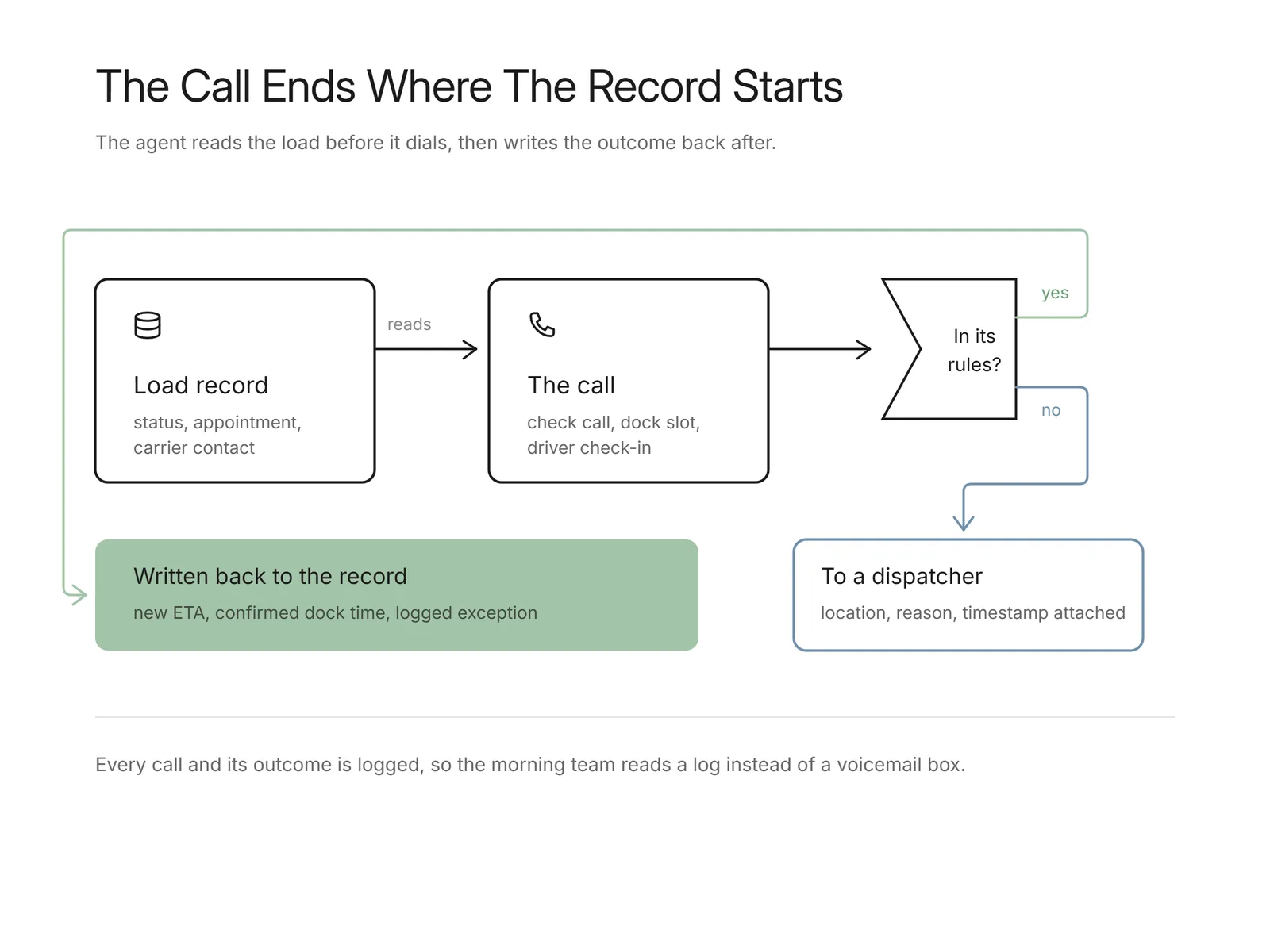
A carrier check call follows a listen, decide, act loop. The agent places the call to the driver or carrier and asks for current status, location, and estimated time of arrival. It listens to the answer, then decides what that answer means against the load record: is the truck on schedule, running late, or stopped. If the details line up, the agent confirms them, updates the ETA, and logs the check call so the record reflects the latest known state. If the driver reports something the agent cannot resolve on its own, such as a mechanical breakdown, a missed appointment, or a refused load, the agent escalates to a dispatcher with the location, the reason, and the timestamp already captured. The dispatcher picks up an informed situation instead of starting from a blank call. Running these checks consistently keeps status current without a person dialing every load.
How do AI voice agents help with dock and appointment scheduling?
Scheduling a delivery or pickup appointment is a back-and-forth call that fits an agent well. The agent calls the warehouse or receiving dock, states the load and the requested window, and works through the available slots the facility offers. It listens for what times are open, compares them against the load's constraints, and books a slot that fits, then writes the confirmed appointment back to the record so dispatch and the driver see the same time. On the inbound side, the agent can answer a facility calling to confirm or change an appointment and handle the reschedule directly. When a facility asks for something the agent has no authority to grant, such as a window that breaks a delivery commitment, it escalates so a person can make the call. Handling the routine scheduling this way reduces the phone tag that slows appointments down.
See what AI can run at your facility. In a 30-minute audit we map the calls, eligibility, and follow-ups Flexbone can take off your team first.
Book an auditHow do AI voice agents handle after-hours dispatch?
Logistics does not stop when the office closes, and inbound calls keep coming after hours. An AI voice agent answers those calls around the clock without a dedicated night shift on the phones. It can take a status request and read the current ETA, confirm or adjust an appointment, or capture the details of a problem and open a ticket for the day team. For anything outside its scope, the agent follows an escalation path you define. That might mean paging an on-call dispatcher for a service failure, or logging a lower-priority issue so it is waiting in the queue the next morning. Because the agent records each call and its outcome, the morning team starts with a clear log of what came in overnight rather than a set of missed calls and voicemails. Nothing sits unheard until someone happens to check the line.
Do AI voice agents replace dispatchers?
No. AI voice agents take the repetitive, high-volume calls off a dispatcher's plate so the dispatcher can spend time on the work that needs judgment. The agent runs the routine check calls, status lookups, and scheduling; the dispatcher owns reroutes, service recovery, rate conversations, and anything the agent escalates. The division of labor follows the same listen, decide, act loop the agent uses on the phone: if the situation matches a case the agent is set up for, it handles it, and if it does not, a person takes over with the context already in hand. In the deployments we run, the aim is to move predictable phone work to software and keep people on the decisions that actually require a person. Dispatchers end up managing exceptions and relationships rather than dialing the same status calls over and over.
What data and systems do AI voice agents connect to?
An AI voice agent is only as useful as the data it can reach on a call. To do its job it needs read access to the records the call is about, such as load and shipment details, appointment schedules, and carrier or facility contacts, typically through a transportation management system or a connected operational tool. During the call it reads the current state, and after the call it writes the result back, such as a new ETA, a confirmed dock time, or a logged exception. That write-back is what keeps the rest of the operation working from the same picture the agent just updated. For a sense of how this works in a live deployment, see how Flexbone runs voice agents, where the same listen, decide, act loop drives calls in a different industry, and see the full set of Flexbone features for what the agents and browser automation can do together.
AI voice agents can run the routine operational phone calls a logistics operation depends on: carrier check calls, track-and-trace, dock and appointment scheduling, driver check-ins, and after-hours dispatch, resolving the predictable ones and escalating the rest to your team with the context attached. If you want to see what AI voice agents could do for your operation, book a call with Flexbone and we will walk through the calls your team runs most and where an agent could take them.