
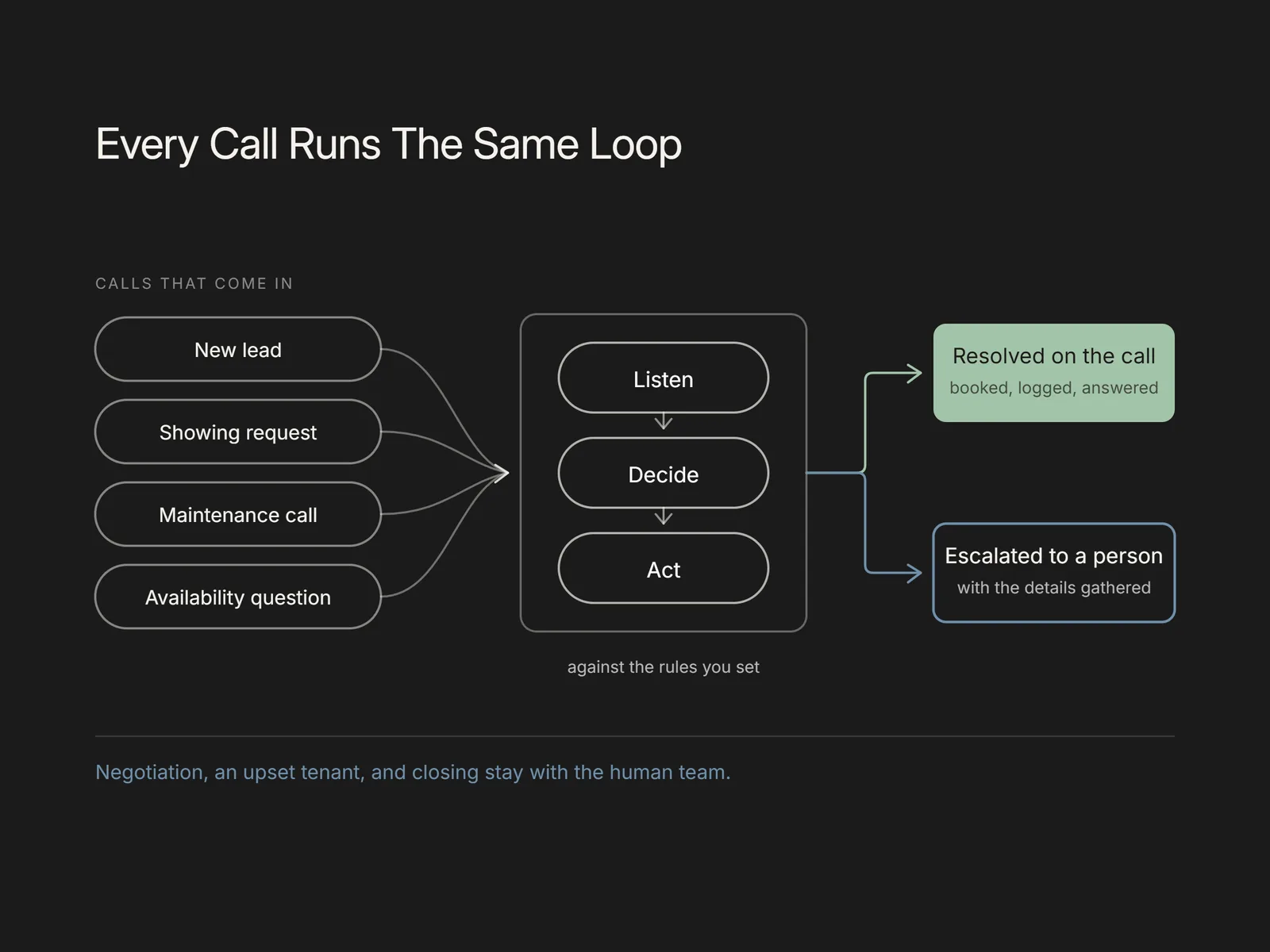
AI voice agents answer and place the calls real estate and property-management teams cannot get to. They handle new-lead response and qualification, showing and tour scheduling, tenant maintenance-request intake, leasing and availability questions, and after-hours coverage. On each call the agent listens to what the caller wants, decides what to do based on the rules you set, and acts: it captures a lead, books a showing, logs a repair request, or answers a routine question. When a call needs a person, it escalates to an agent or manager with the details already gathered. The result is that routine calls get resolved in the moment, missed calls and slow callbacks drop, and the human team spends its time on the conversations that need judgment rather than on phone triage.
What real estate calls can AI voice agents handle?
A large share of the phone traffic a real estate or property-management office handles is routine and repetitive, which is exactly the work an AI voice agent is built for. Inbound, it can field questions about which units or listings are available, price, pet policy, and application steps, respond to new-buyer and new-renter inquiries, qualify them, and take a maintenance request from a tenant. Outbound, it can return web-form leads, confirm upcoming showings, and follow up on applications. On each call the agent works through a listen, decide, act loop: it understands the request, matches it to the tasks it is allowed to handle, and either completes the task or, when the call falls outside those rules, escalates to an agent or manager with the context attached. The team keeps the calls that need a human and offloads the ones that do not.
Want this mapped against your own call and claim volume? Book a 30-minute audit
How do AI voice agents qualify and respond to leads?
When a prospect calls or submits a web form, an AI voice agent can respond quickly, often within moments, and start a real conversation instead of leaving a voicemail. It confirms what the person is looking for, then asks the qualifying questions a leasing or sales team would ask: budget or price range, timeline, desired location and unit type, and whether they are pre-approved or currently in a lease. Based on the answers, it books a showing, sends the next step, or routes a qualified lead to a human. The mechanism is the same listen, decide, act loop: the agent interprets each answer, decides the next question or action, and acts. Fast first contact matters here, because a prospect who reaches a real conversation right away is more likely to stay engaged than one who waits for a callback. Because the agent picks up inbound calls and returns inquiries consistently, fewer leads go cold while the team is busy or off the clock.
See what AI can run at your facility. In a 30-minute audit we map the calls, eligibility, and follow-ups Flexbone can take off your team first.
Book an auditHow do AI voice agents schedule showings and tours?
Scheduling is a well-defined task, which makes it a good fit for a voice agent. When a caller wants to see a property, the agent checks availability against the calendar or booking system the team already uses, offers open times, and confirms the appointment while the caller is still on the line. It collects the details the showing needs, such as the caller's name, contact information, and which unit or listing they want to see, and it can send a confirmation and later a reminder to reduce no-shows. If the request is more complex, for example a caller who needs a specific agent, a property that requires special access, or a time that is not open, the agent escalates to the right person rather than guessing. Because it answers around the clock, prospects can book a tour in the evening or on a weekend, when many people actually have time to look, instead of waiting for the office to reopen.
How do AI voice agents handle tenant maintenance requests?
Maintenance intake is one of the highest-volume, most repetitive call types in property management, and it is one an AI voice agent handles well. When a tenant calls to report an issue, the agent gathers the details a work order needs: the unit or property, the nature of the problem, when it started, and the best way to reach the tenant. It records the request in a consistent, structured form so nothing is lost in a voicemail, and it can route it to the right team or vendor. The listen, decide, act loop also handles urgency: the agent recognizes when a request is routine, like a slow drain, versus when it signals an emergency, like a gas smell, water leak, or no heat, and it escalates urgent situations to a person or an on-call line right away according to your rules. Non-urgent requests are logged for the team to schedule, so tenants get a response at any hour and the office starts the day with an organized queue instead of a full voicemail box.
Do AI voice agents replace a leasing agent?
No. An AI voice agent is built to take on the calls a busy leasing agent or property manager cannot get to, not to replace the person. It covers first contact, qualification, scheduling, routine availability and policy questions, and maintenance intake, and it works around the clock so calls do not go to voicemail. What it hands off is the work that needs a human: negotiating terms, handling a frustrated tenant, walking a nervous first-time buyer through a decision, and closing. The division follows the same escalation logic used throughout: the agent resolves the routine call and passes anything that needs judgment or a personal relationship to a person, with the details already gathered so the handoff is smooth. The point is to give the human team more time for the conversations that keep a tenant or move a deal.
How Flexbone runs voice agents for a real estate team
Flexbone builds AI voice and browser agents that place and answer calls and automate the operations behind them, and the technology that runs calls in other industries applies to real estate and property management. The agents work through the listen, decide, act loop on each call, handle the routine request end to end, and escalate anything outside their rules to a person with the context attached. You can see the range of what the agents do on the Flexbone features page, and how Flexbone runs voice agents shows the same call-handling and escalation model in practice.
For a real estate or property-management team, AI voice agents can answer and place the calls you cannot get to: responding to and qualifying new leads, scheduling showings and tours, taking tenant maintenance requests, answering leasing and availability questions, and covering the phones after hours, while escalating the calls that need a person. To see what AI voice agents could do for your business, book a call with Flexbone.