
A new ambulatory surgical center launching on Epic's revenue-cycle module (Resolute) can automate two phone-heavy workflows with AI voice systems: claim-status follow-up with payers and credentialing or enrollment calls. Voice systems integrate with Epic through its interoperability layer rather than a plug-in, so they read and write the same data your billing staff use. This matters because ASCs are growing fast. ASC News lists denials, staffing, and payer-contract pressure among its top ASC trends for 2026, and a de novo center feels those pressures hardest in its first two quarters. The practical question for a launch is not whether AI voice can call payers. It is which system fits Epic, what it can complete without a human, and how early in the launch you can turn it on.
Which voice systems integrate with Epic RCM?
Voice AI systems connect to Epic Resolute through Epic's published integration paths: HL7 and FHIR interfaces, and vendor programs like Epic's app marketplace and Vendor Services, rather than a direct database connection. A well-built agent reads the account, insurance, and claim data it needs and writes notes back into the work queue your billers already use. Quadax, an Epic integration partner, describes how a connected layer creates real-time visibility into claim status and denials inside Resolute. For an ASC, the questions to ask a voice vendor are concrete: does it write call outcomes back into the Epic work queue, does it respect your Epic security roles, and has it run against Resolute specifically rather than a generic EHR. Integration depth, not the demo script, decides how much work the system actually removes.
Want this mapped against your own call and claim volume? Book a 30-minute audit
How do they automate claim-status follow-up?
Claim-status follow-up is repetitive phone and portal work: a biller calls the payer, navigates the IVR, reads the claim number, and records the status. An AI voice agent does the same sequence at scale, calling or checking the portal, capturing the status and any denial reason, and writing it back to the Epic work queue so a human only touches exceptions. This is exactly the kind of transaction the industry has been automating to cut cost. The CAQH Index reports that automating common revenue-cycle transactions, claim status among them, contributes to billions in avoided administrative spend. For a launching ASC with a thin back office, moving claim-status calls to an agent frees the billing team to work denials and high-dollar surgical claims that need judgment.
Claim-status follow-up is one call repeated across payers: authenticate, ask about a claim, record the answer. Flexbone runs those calls for ASCs and writes each status back into Epic, and the payers it calls first are chosen from where the center's own claims stall. See healthcare call automation.
See what AI can run at your facility. In a 30-minute audit we map the calls, eligibility, and follow-ups Flexbone can take off your team first.
Book an auditHow do they handle credentialing calls?
Credentialing and payer-enrollment calls are the other phone burden, and for a new center they are the more urgent one. These are outbound follow-ups to payers and credentialing bodies to check application status, confirm receipt of documents, and chase missing items. The stakes are high: ASC News reports that credentialing delays in ASC settings average around 150 days, and a single physician waiting on credentials can cost a center close to $30,000 per week in lost case volume. A voice agent can call on a schedule, log each status, and escalate a stalled file to a human, so an application never sits untouched for a week. It does not replace the credentialing coordinator. It removes the repetitive status-chasing that lets files go quiet.
What does an ASC launch timeline look like?
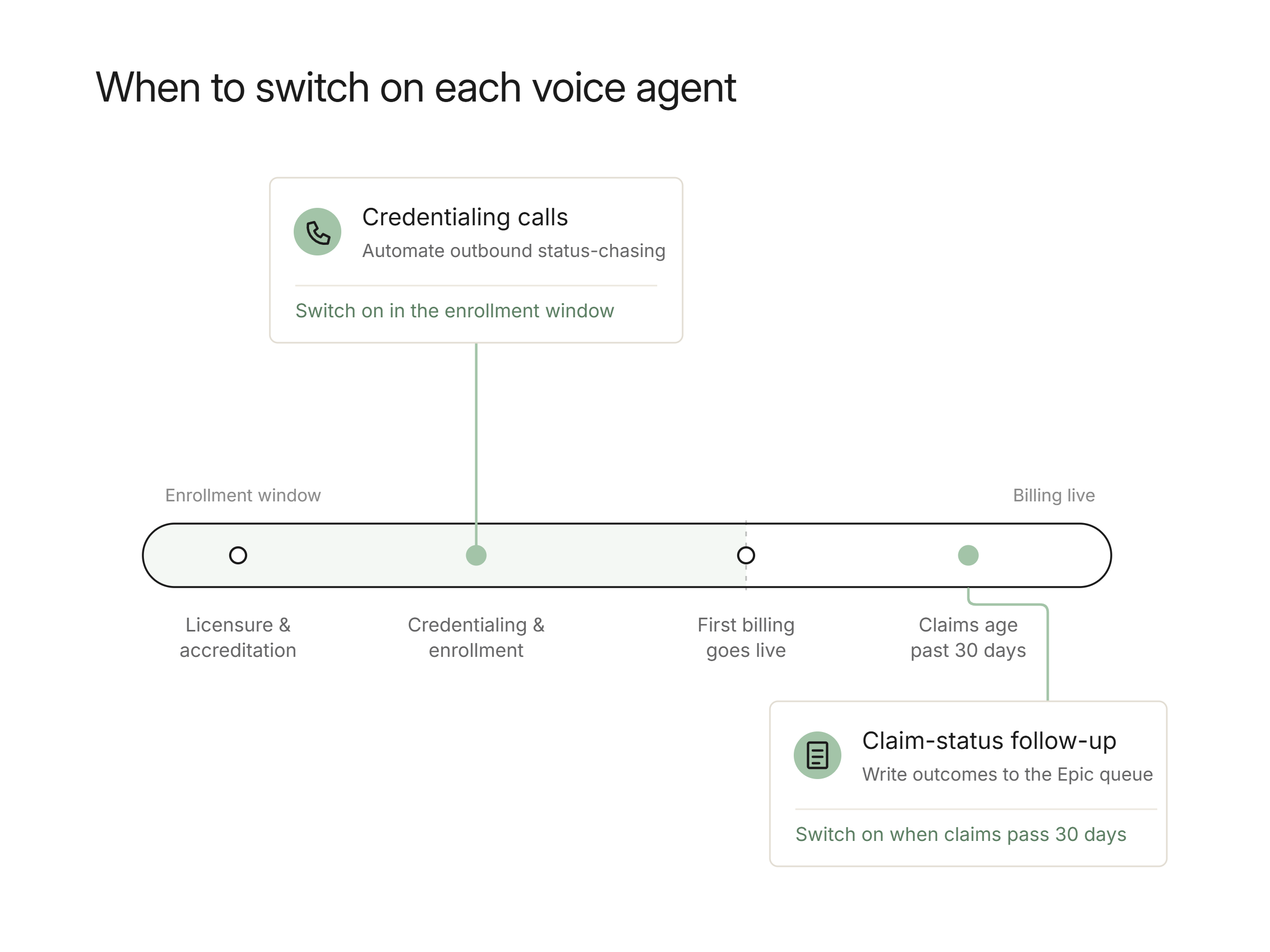
A de novo ASC typically spends months on licensure, accreditation, credentialing, and payer negotiations before it can bill, and the CMS Medicare enrollment process is one gate on that path, as described on the CMS ambulatory surgical centers page. Automation should follow the same phasing. Start credentialing-call automation early, during the enrollment window, because that is when status-chasing volume peaks and cash has not started. Turn on claim-status follow-up once you are billing and the first claims age past 30 days. Running an audit of your first few weeks of calls before you scale automation tells you which payers are slow and where the calls actually go, so you automate the real bottleneck rather than a guessed one.
How Flexbone helps ASCs launch on Epic RCM
Flexbone is audit-first, which fits a launch: we review your early call and claim patterns before automating, so the agents target your real payer bottlenecks. Our voice agents place claim-status and credentialing follow-up calls, work the payer IVRs and portals, and write outcomes back into your Epic work queues, while document and browser agents handle the paperwork behind each call. Everything runs inside your existing Epic environment and on payer portals, HIPAA compliant and SOC 2-aligned, with a human reviewing exceptions. You can see how the voice layer works on our healthcare calls page.
Start a pilot: https://www.flexbone.ai/contact