
Anthem prior authorization is the review that many Anthem Blue Cross Blue Shield plans, part of Elevance Health, require before they cover certain services. It commonly applies to advanced imaging such as MRI and CT, specialty and injectable drugs, some outpatient and inpatient procedures and surgeries, and durable medical equipment. The specific requirements vary by plan and by state, so the same service can need review under one Anthem plan and not another. The workflow runs in a set order. The ordering office confirms the member's eligibility and checks whether the service needs review, gathers the diagnosis and supporting clinical documentation, and submits the request, often through the Availity provider portal or a benefit manager. The reviewer checks the request against the plan's clinical criteria and returns an approval, a denial with a reason, or a request for more information.
What requires Anthem prior authorization?
Many Anthem plans commonly require prior authorization for advanced imaging, specialty and injectable drugs, some procedures and surgeries, and durable medical equipment. Advanced imaging like MRI, CT, PET, and nuclear cardiology is reviewed more often than plain X-rays or ultrasound. Specialty and injectable drugs, especially high-cost biologics, frequently need review, as do some elective surgeries, inpatient admissions, and certain outpatient procedures. The exact list varies by plan and by state, and it can differ between a commercial plan, a Medicare Advantage plan, and a Medicaid plan. Anthem publishes prior authorization requirements by plan, so the office should confirm the requirement against the member's specific plan rather than assume a service is covered without review. Checking a service before scheduling is the same first step described in our guide to how to check if a service needs prior authorization.
Want this mapped against your own call and claim volume? Book a 30-minute audit
How do you submit an Anthem prior authorization?
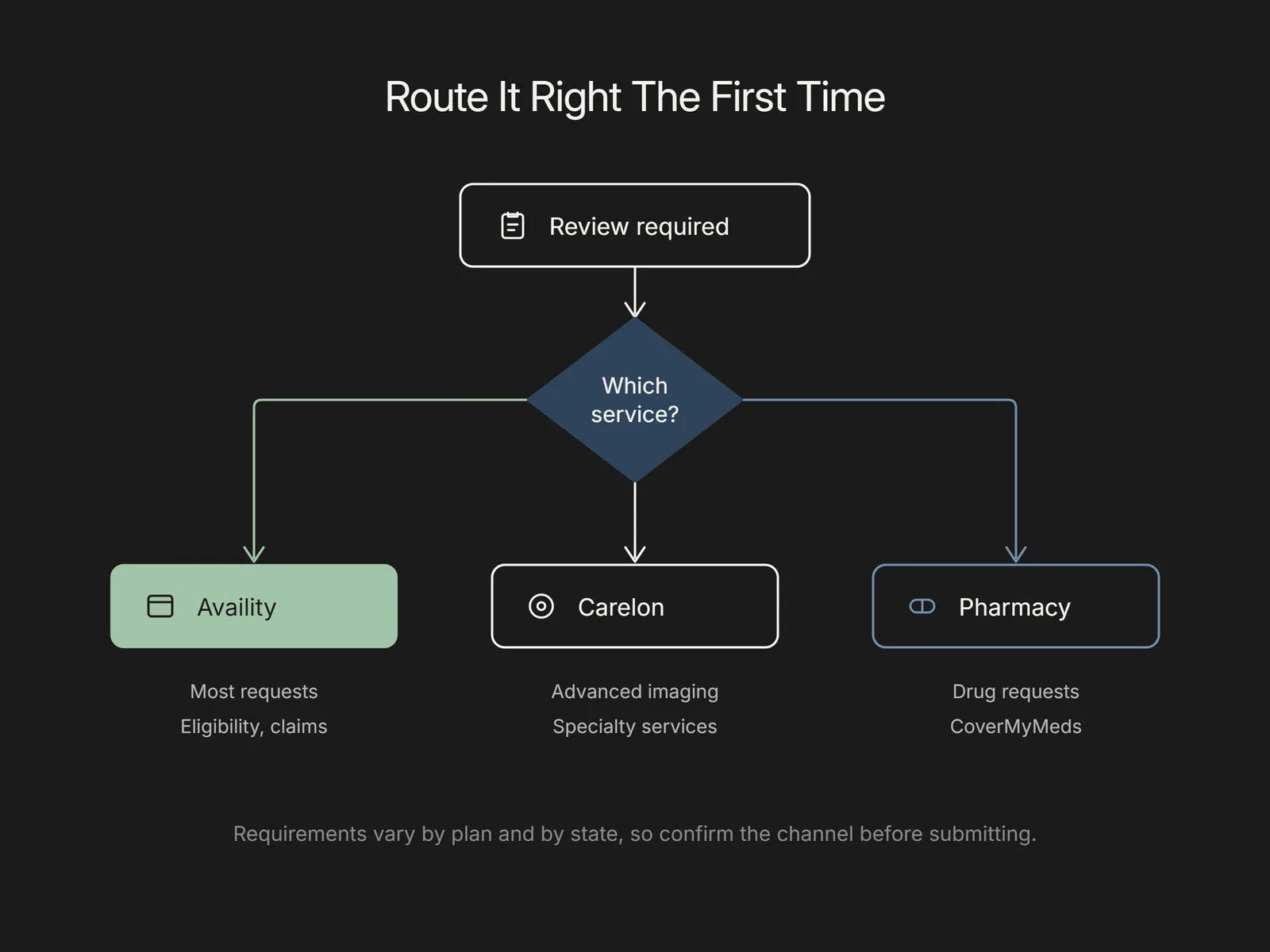
Most Anthem prior authorization requests go through the Availity provider portal, which Anthem uses as its main provider platform for eligibility, claims, and authorizations. The office submits the service or procedure code, the ordering diagnosis, and the supporting clinical documentation, then tracks the request to a decision. Some categories route elsewhere. Advanced imaging and certain specialty service requests are frequently sent to Carelon, Anthem's benefit manager, and medication prior authorizations often move through CoverMyMeds or the plan's pharmacy channel. Because the destination depends on the service, the office should confirm where a given request is reviewed before submitting. Verifying the member's benefits first is a related step; our guide to insurance eligibility verification covers how that check works and why the standard 270 and 271 eligibility transactions exist, as defined by CMS.
See what AI can run at your facility. In a 30-minute audit we map the calls, eligibility, and follow-ups Flexbone can take off your team first.
Book an auditWhat is Carelon and how does it relate to Anthem?
Carelon is a benefit manager affiliated with Elevance Health, Anthem's parent company, and it was formerly known as AIM Specialty Health. Many Anthem plans route advanced imaging and certain specialty service requests to Carelon rather than reviewing them in-house. The ordering office submits the study or service, the diagnosis, and the prior workup through Carelon's portal or phone line, and Carelon checks the request against its clinical criteria and returns an approval, a denial, or a request for more clinical detail on the plan's behalf. Because Carelon sits between the practice and the plan for those services, the office often works a separate portal and a separate set of criteria from the general Anthem authorization channel. Knowing which services Carelon reviews, versus which stay with Anthem or the pharmacy channel, tells the office where to send each request the first time.
Why do Anthem prior authorizations get denied?
Denials tend to cluster around a few causes. The most common are missing or incomplete clinical documentation, a service that does not match the documented diagnosis, a request submitted after the service was already rendered, or a service that does not meet the plan's medical policy. Each Anthem denial comes with a stated reason, which tells the office what a resubmission or appeal needs to address. Prior authorization is also a significant administrative load in its own right: the American Medical Association reports that physicians complete about 39 prior authorizations per physician per week, taking roughly 13 hours of practice time, per the AMA. Tracking the reason on every denial makes the pattern visible, and a repeated reason usually points to a fixable gap in the submission. Working denials systematically is the focus of our overview of AI denials management.
How do you reduce Anthem prior authorization delays?
Delays usually come from incomplete submissions and from time spent chasing status, not from the review itself. A few practices help. Confirm the member's eligibility and the plan's requirement before the service, so the office is not submitting a request that was never needed or missing one that was. Attach the diagnosis, prior treatment, and relevant notes on the first pass, because a request that triggers a documentation request restarts much of the clock. Route each request to the correct channel, whether that is Availity, Carelon, or the pharmacy path, so it does not bounce. Track every pending request so nothing stalls unnoticed. These steps also apply to other Blue plans; our guide to BCBS prior authorization covers the broader Blue Cross Blue Shield pattern that Anthem plans follow.
How does Flexbone help with Anthem prior authorization?
Flexbone runs voice and browser agents that carry the repetitive parts of the Anthem prior authorization process. An agent can submit an authorization through the Availity portal or a benefit manager such as Carelon, hold on the plan's phone queue to check or expedite a pending request, and write the authorization number and status back to the EHR so the scheduling and billing teams see it in one place. Each call and submission is logged, so a person can review what the agent did and why. We do not decide medical necessity or override a payer's clinical criteria; the agent gathers and moves information, and clinical judgment stays with the practice. Anthem's specific requirements vary by plan and state, so the office keeps control over policy while the agent handles the submission and follow-up. To map what AI can take off your Anthem prior authorization workload, book a call with Flexbone.