Average speed of answer (ASA) is the average time a caller waits in queue before an agent picks up. You calculate it by dividing the total wait time of answered calls by the number of answered calls. It is a direct read on how accessible your center is: the lower the ASA, the faster callers reach a person. According to Observe.AI, the typical industry ASA runs around 28 seconds, and a low ASA usually tracks with higher customer satisfaction because callers connect quickly. ASA is measured only across calls that were actually answered, so it does not count abandons, which is why you read it alongside abandonment rate and service level rather than on its own. Treat it as an average that can hide painful peaks, and look at the distribution, not just the single number.
What is the ASA formula?
ASA = total wait time of answered calls / total number of answered calls. The wait time is the time each caller spent in queue before an agent connected, usually including any time in the automated menu depending on how you define it. Calabrio frames ASA as the average delay before a call is answered and stresses being consistent about what counts as the start of the wait. A worked example: if 500 answered calls waited a combined 12,500 seconds in queue, ASA is 12,500 / 500, or 25 seconds. Because ASA only includes answered calls, it says nothing about the callers who gave up, so a center that abandons its longest waiters can post a deceptively low ASA. Pair it with abandonment to keep the picture honest.
Want this mapped against your own call and claim volume? Book a 30-minute audit
What is a good ASA benchmark?
A commonly cited target is answering within about 20 to 30 seconds, near the 28-second industry average. CallCentreHelper discusses ASA as a core accessibility metric and notes it is often paired with the 80/20 service-level standard of answering 80 percent of calls in 20 seconds. A useful rule of thumb some operators apply is keeping ASA to roughly a quarter of average handle time, which scales the target to how long your calls actually run. As with any average, the right benchmark depends on caller urgency and channel: an emergency line targets seconds, while a routine inquiry queue can run longer without hurting the experience. Set the target against your callers' tolerance, then measure whether abandonment rises before you hit it.
ASA rises when repetitive calls queue ahead of the ones that need a person. Flexbone answers those repetitive calls with voice agents, chosen from the center's recordings, which shortens the wait for everyone else. See contact center automation.
See what AI can run at your facility. In a 30-minute audit we map the calls, eligibility, and follow-ups Flexbone can take off your team first.
Book an auditHow does ASA relate to service level?
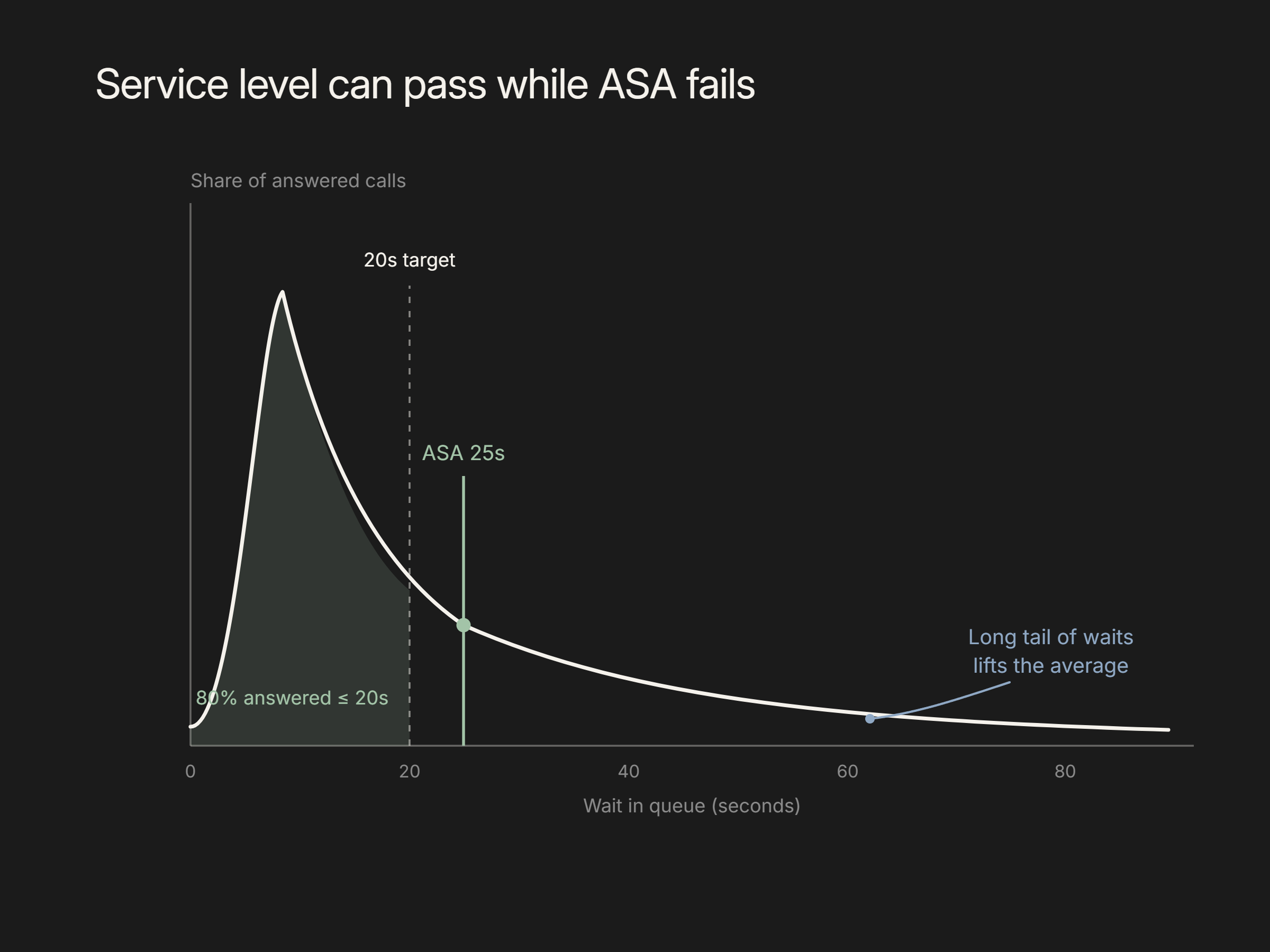
ASA and service level are two views of the same queue, and they move together. Service level is the percentage of calls answered within a threshold, while ASA is the average wait across answered calls. Talkdesk describes ASA as a measure of how quickly a center responds and connects it to overall accessibility and satisfaction. They can disagree in a revealing way: a center can hit 80/20 on service level yet post a high ASA if a small group of callers waits a very long time while most are answered fast. That long tail lifts the average without breaking the threshold. So read them as a pair. Service level shows how the bulk of callers fare, and ASA exposes the outliers, the long waits that drive your worst abandons and complaints.
How do you reduce ASA?
Cutting ASA means clearing callers out of the queue faster, which comes down to capacity and call flow. Dialpad points to accurate forecasting, smart routing, and adequate staffing as the core levers, since ASA climbs the moment demand outruns available agents. The practical steps: staff to the intraday peaks instead of the daily average, route callers to the right skill on the first pass so they are not re-queued, and trim handle time on routine calls so agents free up sooner. Callbacks help by pulling waiting callers out of the live queue while holding their place. Deflecting simple, repeatable requests to self-service shortens the line for everyone who remains. Watch ASA intraday, because a clean daily figure can still mask a brutal morning peak.
How Flexbone collapses ASA
ASA rises when calls arrive faster than agents can answer them, and human capacity is fixed in the short term. Flexbone's AI voice agents answer first-tier calls at high concurrency with effectively no wait, so the routine volume that inflates ASA is handled the instant it arrives rather than stacking in a queue. A Medicare or Medicaid coverage question, a 270/271 eligibility check against a payer portal like Availity, or a refill request gets answered on the first ring instead of waiting for a free agent. Calls that need a person are routed with context, and callbacks keep anyone else out of the hold line. Across a BPO, an insurance operation, a health system, or a public-sector office, that high-concurrency answering pulls ASA down toward the accessibility benchmarks that matter, and holds it there on surge days. Because the voice agents run in a HIPAA-compliant environment, that automated tier is safe on regulated lines. Flexbone audits your interaction mix first, so you can see which call types are safe to answer automatically and what the ASA improvement looks like before anything changes. Book a demo to run it against your own queue.