
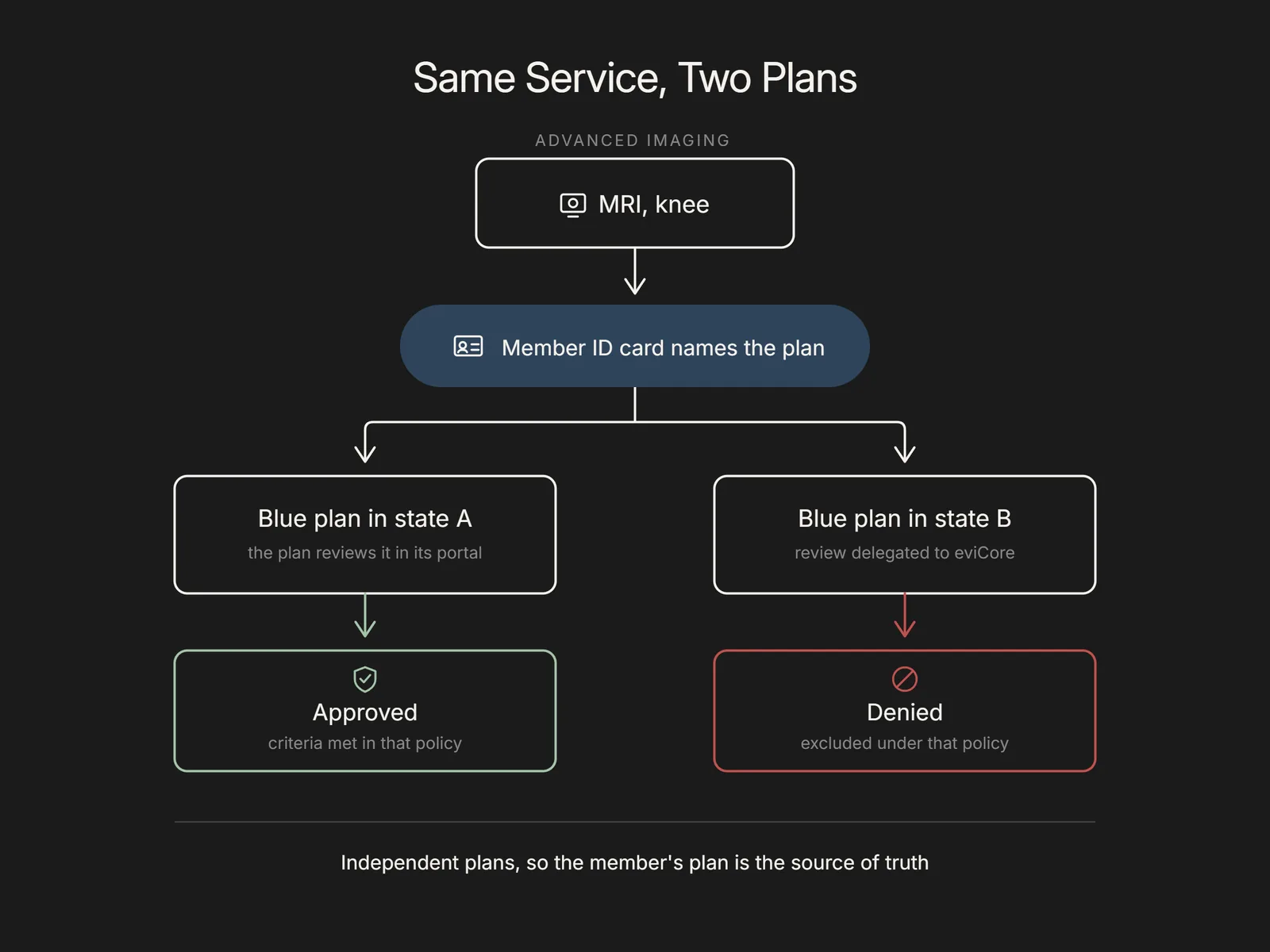
Blue Cross Blue Shield prior authorization is a coverage review in which a Blue plan approves certain services before they are provided. The most important nuance is that Blue Cross Blue Shield is not one insurer but a federation of independent, locally operated plans (for example Anthem, Highmark, Blue Cross Blue Shield of Michigan, Horizon, and others), so requirements, portals, and processes vary by the specific Blue plan and by the member's plan type. Categories that commonly require prior authorization include advanced imaging, specialty and injectable drugs, some procedures and surgeries, and durable medical equipment (DME). Because policies differ across Blue plans, the member's specific plan is the source of truth. The practical starting point is to identify the plan from the member ID card and check that plan's own prior authorization list before scheduling or submitting.
Does Blue Cross Blue Shield require prior authorization?
Many Blue plans require prior authorization for specific services, but there is no single Blue Cross Blue Shield list that applies everywhere. Each local Blue plan operates independently and publishes its own requirements, so the accurate answer for a given patient depends on that patient's plan. In practice, the categories that commonly trigger a review across Blue plans are advanced imaging (such as MRI, CT, and PET), specialty and injectable drugs, certain elective procedures and surgeries, and durable medical equipment. Whether a specific service needs authorization, and under what criteria, is defined by the member's plan documents and medical policy, not by a general rule. When staff treat the member's specific Blue plan as the source of truth, they avoid assuming a requirement carries over from one Blue plan to another.
Want this mapped against your own call and claim volume? Book a 30-minute audit
How do you check Blue Cross Blue Shield prior authorization requirements?
Start with the member ID card, because it identifies the specific Blue plan and the member's plan type. From there, look up that plan's prior authorization list or its online prior authorization tool, which states which services need review and what criteria apply. Many Blue plans expose these functions through a provider portal, and a number of them use Availity as that portal, so a practice can often check requirements and eligibility in one place. Verifying eligibility and benefits first is worth the step; the standardized 270/271 eligibility transaction exists precisely to let providers confirm coverage before care, per CMS. Our guide to insurance eligibility verification covers that step in more detail. For a plan-specific walkthrough, see our page on BCBS prior authorization.
How do you submit a BCBS prior authorization?
Submission has three parts: identify the correct Blue plan, assemble the documentation its policy requires, and send the request through the channel that plan designates. The channel varies by service. Many Blue plans accept requests through a provider portal, and Availity is a common one. For advanced imaging, some Blue plans delegate the review to a benefit manager such as eviCore or Carelon, so the imaging request goes to that entity rather than to the plan directly. For medications, requests frequently move through CoverMyMeds or the plan's pharmacy benefit manager. Because these paths differ by plan and by service type, the practical rule is to confirm which entity owns the review before you submit, then send the clinical justification (diagnosis, prior treatments, and supporting records) to that owner. Submitting to the wrong entity is a common cause of delay.
See what AI can run at your facility. In a 30-minute audit we map the calls, eligibility, and follow-ups Flexbone can take off your team first.
Book an auditWhy do BCBS prior authorizations get denied?
Denials usually trace to one of a few causes. The most common is documentation: a request that arrives without the clinical evidence the plan's policy requires, or with incomplete records, cannot be approved as submitted. A second is medical necessity: the service did not meet the criteria in that plan's medical policy. A third is routing: the request went to the plan when a benefit manager owned the review, or to the wrong Blue plan entirely. A fourth is coverage: the service is excluded under the member's specific plan. Because each Blue plan writes its own coverage policy, a service approved under one Blue plan can be denied under another, which is why the member's plan governs. Every denial notice states the reason and the appeal path, and reading that reason first tells you what an appeal needs. For how to work denials and appeals systematically, see our guide to AI denials management.
How can a practice reduce BCBS prior authorization delays?
The reliable levers are front-loading and accurate routing. Confirm the member's specific Blue plan and its requirements before scheduling, so a needed authorization is not discovered on the day of service. Verify eligibility and benefits up front to catch coverage issues early. Submit complete clinical documentation on the first attempt, since incomplete requests generate the back-and-forth that stretches timelines. Route each request to the correct owner, whether that is the plan's portal or a benefit manager such as eviCore or Carelon, because a misrouted request loses days. Finally, track pending cases and follow up on schedule rather than waiting for the plan to respond. These steps matter because the administrative load is real: physicians report completing about 39 prior authorizations each per week and spending roughly 13 hours on them, according to the AMA.
How does Flexbone handle BCBS prior authorization?
Flexbone builds AI voice and browser agents that work the operational steps of a prior authorization so staff spend less time in portals and on phones. For Blue plans, that starts with identifying the member's specific Blue plan and its requirements, then verifying eligibility, gathering the clinical criteria the policy asks for, submitting the request through the correct channel (whether a plan portal or a delegated benefit manager), following up on pending cases, and writing status back to the system of record. The approach is audit-first: every action an agent takes is logged and reviewable, and any case that falls outside defined criteria is escalated to a person rather than guessed at. Flexbone is HIPAA compliant and SOC 2 aligned. The agents handle the repetitive submission and follow-up work, while a clinician still owns the medical-necessity judgment and any peer-to-peer conversation.
Getting started
If Blue Cross Blue Shield prior authorization is consuming staff time across imaging, drugs, procedures, and DME, the first step is mapping which Blue plans and service types drive the most requests, and where the manual work sits. To see what AI can take off that workload, book a call with Flexbone.