
Behavioral health billing works like the rest of medical billing, but a few features make it distinct. Much of it uses time-based psychotherapy codes and add-on codes, so the documented length of a session determines which code you submit, and recurring visits mean the same patient generates claims week after week. Coverage sits under mental-health benefit rules and the federal parity framework, which shapes copays, visit limits, and authorization. Several services need prior authorization, including psychological testing, transcranial magnetic stimulation (TMS), and higher levels of care such as intensive outpatient and inpatient treatment. Many practices also carry a mix of insurance and self-pay clients. Together these traits put a premium on verifying benefits, holding valid authorizations, and matching each claim to its documentation before it goes out.
What is different about behavioral health billing?
Behavioral health billing differs from general medical billing in four practical ways. First, it is time-based. Instead of a single fixed code for a visit, therapy claims often use timed psychotherapy codes tied to session length, plus add-on codes for extra services during the same encounter, so a 30-minute and a 60-minute session are billed differently. Second, care is recurring. A patient in weekly therapy produces a steady stream of claims, which means a small, repeated error compounds fast. Third, coverage lives under mental-health benefit rules and the parity framework described below, which affect cost sharing and authorization. Fourth, the payer mix is mixed: many practices bill commercial and public insurance while also serving self-pay clients, so the front office has to know which track each visit is on before it collects. An intake or diagnostic evaluation, a timed individual therapy session, and family or group therapy each map to their own code category, and the biller has to select the right one from the clinical note rather than a fixed template.
Want this mapped against your own call and claim volume? Book a 30-minute audit
How does mental health parity affect billing?
Mental health parity affects billing by constraining how a plan can treat behavioral benefits relative to medical ones. The federal Mental Health Parity and Addiction Equity Act (MHPAEA) generally requires that group health plans and issuers offering mental health and substance use disorder benefits not impose financial requirements, such as copays and coinsurance, or treatment limits, such as visit caps, that are more restrictive than the predominant requirements applied to comparable medical and surgical benefits. It also addresses non-quantitative limits like prior-authorization and medical-necessity standards, so a plan generally cannot single out behavioral care for tougher review than it applies to medical care of a similar level. For a biller, that framework is the backdrop, not a guarantee: parity governs how benefits compare, but it does not require a plan to cover behavioral health at all, and the specific copay, deductible, coinsurance, and visit limits still vary by plan. That is why you verify each patient's actual benefits before care rather than assuming parity delivers a particular result.
What behavioral health services need prior authorization?
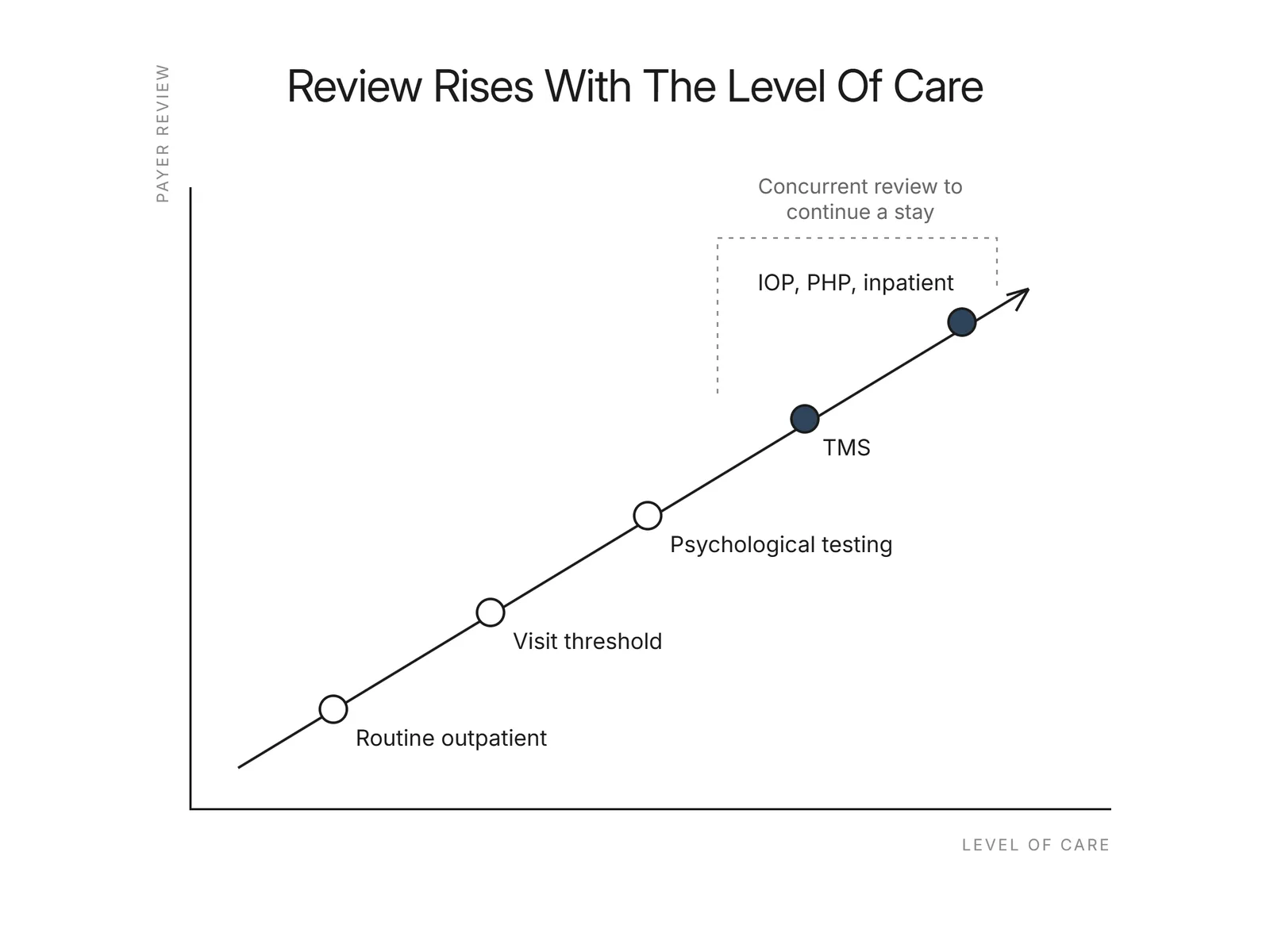
Prior authorization requirements depend on the plan, but they cluster around a recognizable set of services. Psychological and neuropsychological testing frequently requires authorization because it is a defined, billable evaluation rather than a routine visit. TMS, an in-office treatment for certain conditions, commonly requires authorization and documentation of prior treatment history. Higher levels of care, including intensive outpatient programs, partial hospitalization, and inpatient or residential treatment, are the most authorization-heavy, often with concurrent review to continue a stay. Routine outpatient therapy is frequently exempt, though some plans set a visit threshold after which they begin reviewing continued care. The burden here is real across specialties: the American Medical Association reports that physicians complete about 39 prior authorizations per physician per week, taking roughly 13 hours of staff and physician time. Because the rules differ by plan and by service, the safe practice is to confirm the specific requirement with the patient's plan before delivering care, not to generalize from one payer to another.
See what AI can run at your facility. In a 30-minute audit we map the calls, eligibility, and follow-ups Flexbone can take off your team first.
Book an auditWhy do behavioral health claims get denied?
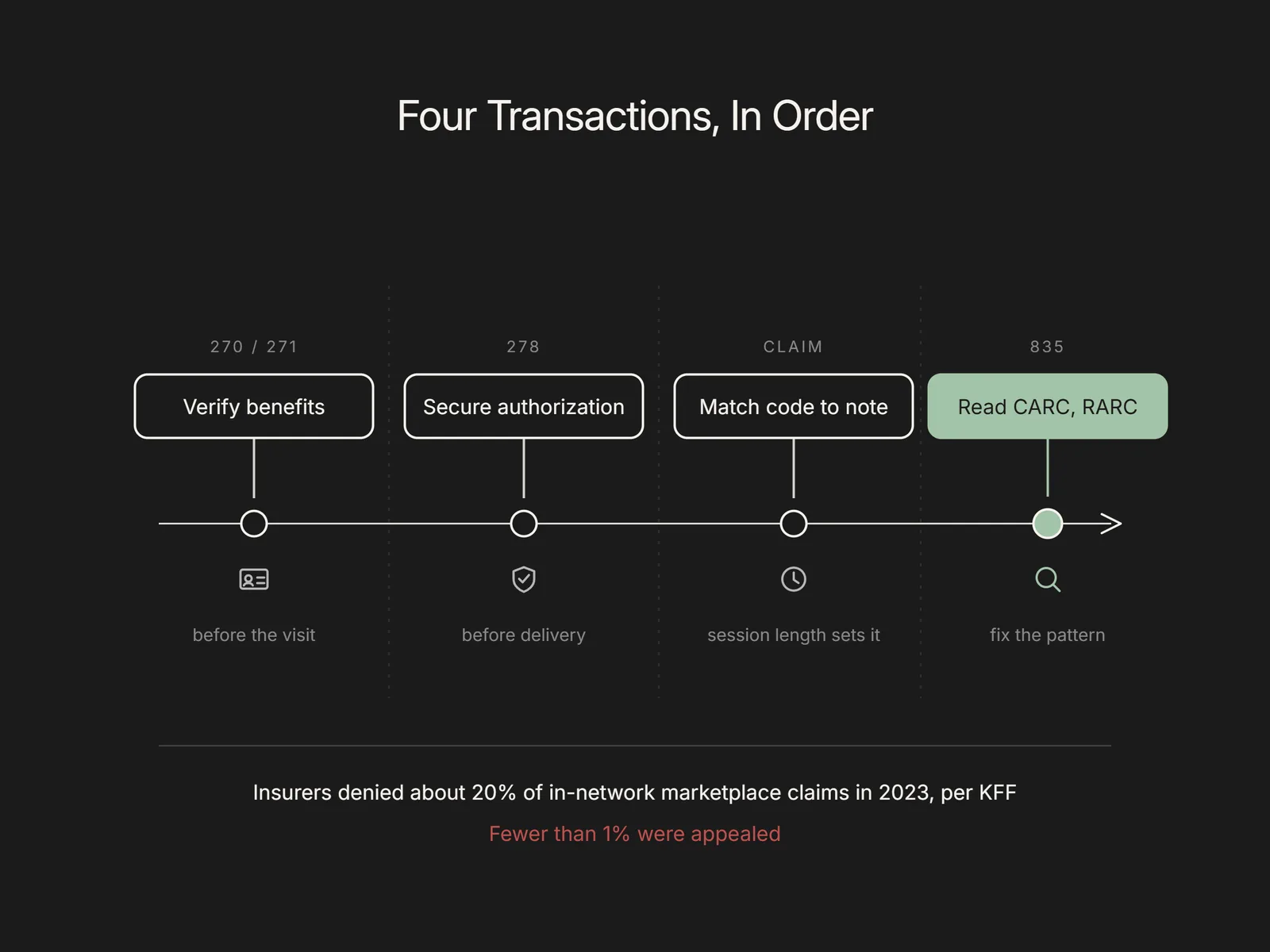
Behavioral health claims get denied for a handful of recurring reasons, and most trace back to coverage, authorization, or coding-to-documentation mismatches. An eligibility or benefit error, such as an inactive plan or a service the plan does not cover, produces a denial no clinical detail can fix. A missing or expired prior authorization denies services that required one, which is why testing, TMS, and higher levels of care are frequent culprits. A time-based code that does not match the documented session length can be denied or down-coded. Exhausted visit limits deny once a patient passes the covered count, and coordination-of-benefits problems deny when the plan on file is not primary. Denials are common enough across payers to plan for: KFF found that insurers denied about 20 percent of in-network claims on HealthCare.gov marketplace plans in 2023, and consumers appealed fewer than 1 percent of them. The specific cause is written on the electronic remittance in a standardized reason code, so the denial itself tells you which of these to correct.
How do you reduce behavioral health denials?
You reduce behavioral health denials by moving the fixes upstream and tying each step to a transaction, not a phone call. Start before the visit: verify mental-health benefits and any visit limit through the standardized X12 270/271 eligibility transaction, which is the electronic inquiry and response the federal government adopted under HIPAA Administrative Simplification. The CMS reference for the 270/271 eligibility inquiry and response describes the standard those checks run on. Next, secure authorization for services that require it, using the X12 278 request where the plan supports it, so testing, TMS, and higher levels of care are covered before delivery. At the point of billing, match every claim's time-based code to the documented session length, since the code follows the note. Finally, read denials on the X12 835 electronic remittance by their Claim Adjustment Reason Code (CARC) and Remittance Advice Remark Code (RARC), which name the exact cause and let you fix the root pattern instead of reworking one claim at a time. For the authorization piece specifically, see our guide to behavioral and therapy prior authorization, and for the coverage piece, our walkthrough of insurance eligibility verification. For how eligibility, authorization, and intake calls run together in a behavioral health practice, see AI for behavioral health practices.
How does this fit the systems behavioral practices already use?
Most behavioral health practices run their clinical and billing work in a practice-management or EHR platform such as SimplePractice or TherapyNotes, and the billing workflow above has to fit those tools rather than replace them. Eligibility results, authorization numbers, and denial reasons all need to land back in the system the front office and billers already open every day, as structured fields they can filter, not free text a person has to re-read. In the engagements we run, the highest-value automation is the repetitive, rules-driven work around a recurring caseload: checking benefits and visit limits before standing weekly appointments, tracking which authorizations are approaching their limit, and triaging denials by reason code so a person spends time on the judgment calls rather than the lookups. Software agents can send the 270 inquiry, submit a 278 authorization request, and read the 835 remittance the same way a staff member would, then write the structured result back. For the denial-management side of that loop, our overview of AI denials management walks through how remittance codes drive the rework queue.
If you want to see what AI can take off your behavioral health billing, from eligibility and authorization checks to reading denials by reason code, book a call with Flexbone and we will map it against your own payer mix and platform.