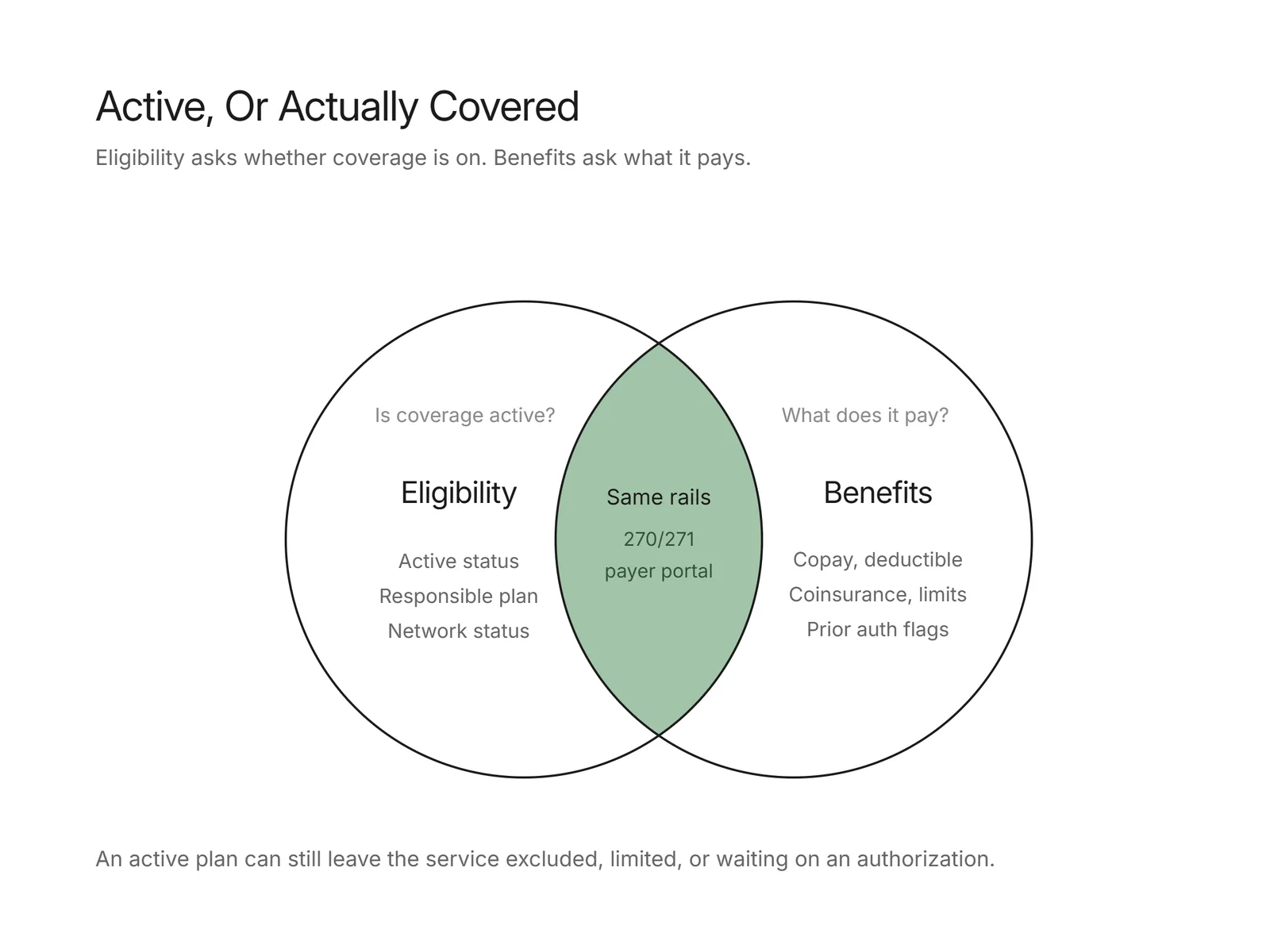
Benefit verification vs eligibility verification comes down to a single distinction: eligibility verification confirms that a patient's insurance is active, while benefit verification confirms what that plan actually covers and what the patient will owe. Eligibility checks the date of service, the responsible plan, and network status. Benefit verification goes further, returning the copay, deductible, coinsurance, visit limits, and any prior-authorization requirement for the scheduled service. Put simply, eligibility answers whether the coverage is on, and benefits answer what it will pay and what the patient owes. Both run on the same X12 270/271 electronic transaction and payer portals, and both matter before a visit, because an active plan can still leave a service uncovered or a patient with a large balance. Running only one leaves a gap that shows up later as a denial or a surprise bill.
What is the difference between benefit verification vs eligibility verification?
The two checks answer different questions about the same patient. Eligibility verification is the yes-or-no question: is the coverage active, which plan pays, and is the provider in network on the date of service? Benefit verification is the how-much question: for this specific service, what is the copay, how much deductible remains, what is the coinsurance, are there visit limits, and does the plan require prior authorization? People often use "eligibility vs benefits" loosely, but the split matters because the two checks fail in different ways. An eligibility check can come back active while the benefit detail shows the service is excluded or subject to a limit the patient has already used.
The distinction matters operationally, because the two checks automate differently. Eligibility is a single structured question with a structured answer. Benefit detail often means reading a plan document or working a portal, which is slower and more variable. Flexbone automates both but treats them as separate workflows, because classifying them together is what makes an agent unreliable.
| Attribute | Eligibility verification | Benefit verification |
|---|---|---|
| Core question | Is coverage active? | What is covered, and what does the patient owe? |
| Confirms | Active status, responsible plan, network status | Copay, deductible, coinsurance, visit limits, prior-auth flags |
| Scope | The plan as a whole | The specific scheduled service |
| Primary risk it prevents | Billing an inactive or wrong plan | Denials and inaccurate patient responsibility |
| Typical data source | X12 270/271 transaction | 270/271 plus payer portal detail |
Both checks share the same plumbing. The federally adopted CAQH CORE operating rules for eligibility and claim status require health plans to respond in real time and to return patient financial responsibility such as deductibles, copays, and coinsurance. The gap is that the electronic response often omits service-specific benefit detail, which is why benefit verification frequently still requires a portal lookup.
Want this mapped against your own call and claim volume? Book a 30-minute audit
What is eligibility verification?
Eligibility verification confirms that a patient's insurance is active and identifies the plan responsible for the date of service. It answers whether the member ID is valid, whether the policy is in force, which payer and plan apply, and whether the rendering provider is in or out of network. This is the first gate in patient access, because billing an inactive or incorrect plan produces a denial no downstream benefit detail can fix. Practices commonly run eligibility electronically through the X12 270 inquiry and the 271 response. In 2023, 96 percent of medical eligibility verification transactions were fully electronic, according to the CAQH Index report, yet a large share of the associated cost persists where checks route through payer portals or phone. For a deeper walkthrough of the electronic workflow, see our guide to insurance eligibility verification.
See what AI can run at your facility. In a 30-minute audit we map the calls, eligibility, and follow-ups Flexbone can take off your team first.
Book an auditWhat is insurance benefit verification?
Insurance benefit verification confirms what a plan covers for a specific scheduled service and what the patient will be responsible for paying. It returns the copay, the remaining deductible, the coinsurance percentage, any visit or dollar limits on the benefit, and whether the service requires prior authorization. Where eligibility asks whether coverage exists, benefit verification asks what that coverage means for this appointment. The detail matters for the front desk and the biller: it drives the point-of-service collection estimate and flags authorization requirements before the visit rather than after a claim is denied. Because a 271 response often lacks service-level granularity, benefit verification commonly combines the electronic transaction with a payer-portal lookup to retrieve visit limits and authorization rules the standardized response does not include.
Why do both matter before a visit?
Running both checks before the visit closes the gap that either one alone leaves open. Eligibility can confirm an active plan while the benefit detail shows the service is excluded, subject to a limit the patient has exhausted, or dependent on a prior authorization no one has requested. In each case, the claim is at risk even though eligibility passed. Verifying both at scheduling, and again shortly before the date of service since coverage can change, gives staff time to collect an accurate patient responsibility, correct the plan on file, or start an authorization. It also reduces avoidable denials and the patient-facing surprise bills that follow when a covered-looking visit turns out to carry a large out-of-pocket balance. The two checks are complementary, not interchangeable, and the practices that treat them as one step are the ones most likely to miss a benefit exclusion.
How does Flexbone run eligibility and benefit verification?
Flexbone runs both checks with software agents that work the same channels a staff member would, then write structured results back to the systems your team already uses. The agents send X12 270 eligibility inquiries and read the 271 responses through electronic data interchange, and for the benefit detail those responses omit, they log into payer portals and, where a portal is unavailable, place a phone call to the plan. The agents reconcile all three sources into one structured record: active status, responsible plan, network status, copay, deductible, coinsurance, visit limits, and prior-authorization flags for the scheduled service. The approach is audit-first, so every check carries a trail showing which source returned which value, and cases the agent is unsure about, such as conflicting portal and electronic data, route to a staff member rather than being posted blind. This human-in-the-loop design aligns with how federal and state rules are tightening oversight of automated decisions in coverage workflows. The platform is HIPAA compliant and SOC 2 aligned. We do not claim perfect accuracy on every payer and benefit; we automate the routine volume and keep a person on the judgment calls.
How do you start automating both checks?
Start by mapping which of your payers return usable benefit detail on the 271 and which require a portal or phone check, because that mix determines where automation saves the most manual effort. From there, decide how verified results should post: as structured fields your billers can filter, not free text a person has to re-read. For a fuller evaluation framework, including integration and accuracy questions to ask a vendor, read our AI insurance eligibility verification guide. When you want to see both eligibility and benefit checks run across EDI, portals, and phone against your own payer mix, book a demo.