A bilingual medical answering service is phone coverage that answers a patient's call in more than one language, most often English and Spanish, so callers who prefer another language can schedule appointments, ask questions, and reach the right person without waiting for a translator. It can be staffed by bilingual operators, run by an AI voice agent, or a combination of both. The reason practices invest in it is straightforward: a large share of patients speak a language other than English at home. In 2021, KFF reported that 25.7 million people, or 8% of those ages five and older, had limited English proficiency, and Spanish accounted for 63% of that group. A workable bilingual setup resolves the routine call in the caller's own language and escalates clinical questions to a person.
What is a bilingual medical answering service?
A bilingual medical answering service answers incoming patient calls in at least two languages and completes the same work an English-only line would: appointment requests, cancellations, refill questions, billing questions, and routing for urgent clinical concerns. The difference is that the caller does not have to switch to English or wait for a translator to be conferenced in. In practice, most demand in the United States is for Spanish, which is why the category is often described as a Spanish medical answering service, though some practices also cover Chinese, Vietnamese, Arabic, or Tagalog depending on their patient mix. The service is only useful if it resolves the request rather than just recording a message, so the test is whether a Spanish-speaking caller can book an appointment or get an answer in the same call that an English-speaking caller would.
Want this mapped against your own call and claim volume? Book a 30-minute audit
Why does language access matter in healthcare?
Language access matters because a missed or misunderstood call can delay care, and federal rules require practices to address it. Under Section 1557 of the Affordable Care Act, HHS explains that covered entities must take reasonable steps to provide meaningful access for individuals with limited English proficiency, including posting taglines in the top languages spoken in the state and using qualified interpreters rather than unqualified staff. The patient-facing gap is real: in a KFF survey, about half of adults with limited English proficiency reported at least one language barrier in a health care setting over three years, and 25% specifically reported difficulty scheduling appointments. The phone is often where that barrier first shows up, so bilingual coverage is one of the earliest places a practice can meet its language-access duty.
Language coverage is a staffing constraint for a human team and a configuration choice for a voice agent. Flexbone runs scheduling and information calls in more than one language and routes clinical questions to qualified staff, with the languages chosen from the practice's own call mix. See healthcare call automation.
See what AI can run at your facility. In a 30-minute audit we map the calls, eligibility, and follow-ups Flexbone can take off your team first.
Book an auditHow does a Spanish medical answering service handle calls?
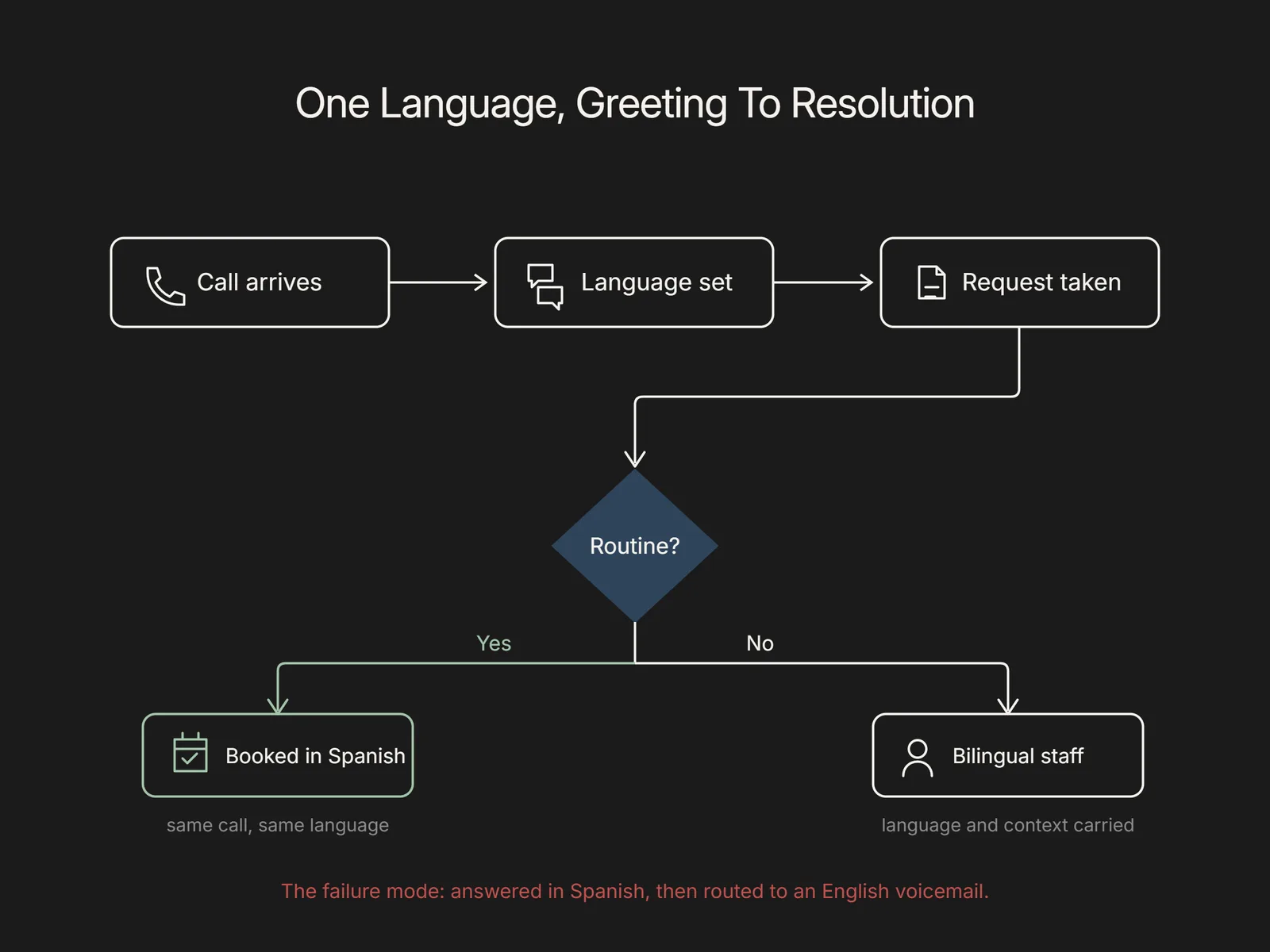
A Spanish medical answering service works by identifying the caller's preferred language at the start of the call and then completing the request in that language. A bilingual operator or an AI voice agent greets the caller, confirms who they are, and handles the routine task directly, whether that is booking an appointment, taking a refill request, or answering a common question about hours or location. When the call turns clinical or complex, the service hands it to a bilingual clinician or staff member with the details already gathered, rather than starting over. The mechanism that makes this work is language continuity: the caller stays in one language from greeting to resolution, and any escalation preserves both the language and the context. That continuity is what separates real bilingual coverage from a line that answers in Spanish but then routes every caller to an English voicemail.
What languages should a bilingual answering service cover?
A bilingual answering service should cover the languages its patients actually speak, which starts with the practice's own registration data and the demographics of its service area. Spanish is the practical baseline for most United States practices because it is by far the most common language among people with limited English proficiency, at 63% of that group per KFF's 2021 figures. Beyond Spanish, Section 1557's tagline requirement points to the top 15 languages spoken by people with limited English proficiency in each state, which is a useful reference list for deciding what else to support. The right answer is specific to the practice: a clinic in a Vietnamese-heavy neighborhood has different needs than one serving a largely Spanish-speaking population, so match coverage to the panel rather than defaulting to a fixed list.
Is a bilingual answering service HIPAA compliant?
A bilingual answering service handles protected health information the moment it takes a patient's name, callback number, and reason for calling, so HIPAA applies to it in any language. A service that creates, receives, or transmits protected health information on the practice's behalf is a business associate, which means the practice needs a signed business associate agreement before any calls are handled, as HHS explains in its guidance on business associates. Language does not change the requirement, because a Spanish-language call carries the same protected information as an English one. When you evaluate a vendor, confirm it will sign the business associate agreement, ask how call data and any recordings are stored and delivered, and check whether it can support additional standards such as SOC 2. A vendor that will not commit to a business associate agreement should not handle patient calls in any language.
How Flexbone runs bilingual answering
Flexbone deploys an AI voice agent that answers a practice's healthcare calls in more than one language, detects the caller's preferred language, and continues the conversation in that language. For routine requests the agent completes the work directly, booking and rescheduling inside the practice's system, answering common questions, and documenting each call. When a call turns clinical or complex, or when a caller needs a person, the agent escalates to a bilingual staff member with the language and context already carried over, so the patient does not have to repeat themselves. The build is audit-first, HIPAA compliant, and SOC 2 aligned, and we start by reviewing a practice's own call recordings to see which languages and call types actually come in before configuring coverage. It pairs with an automated healthcare receptionist so the same experience carries across English and Spanish callers during and after business hours.
Hear it handle a Spanish-language call from your practice: book a demo.