Call abandonment rate is the percentage of callers who hang up before reaching an agent. You calculate it by dividing abandoned calls by total incoming calls, then multiplying by 100. It is one of the clearest signals of queue health, because callers vote with the disconnect button when the wait outruns their patience. According to Geckoboard, a low abandonment rate usually means calls are being answered promptly, while a rising rate points to wait times that have crept past what callers will tolerate. The metric is tied directly to staffing and speed of answer: when average speed of answer climbs, abandonment tends to follow. It also carries a cost most centers underweight, since an abandoned sales or service call can mean lost revenue or a caller who tries a different channel and arrives frustrated.
How do you calculate abandonment rate?
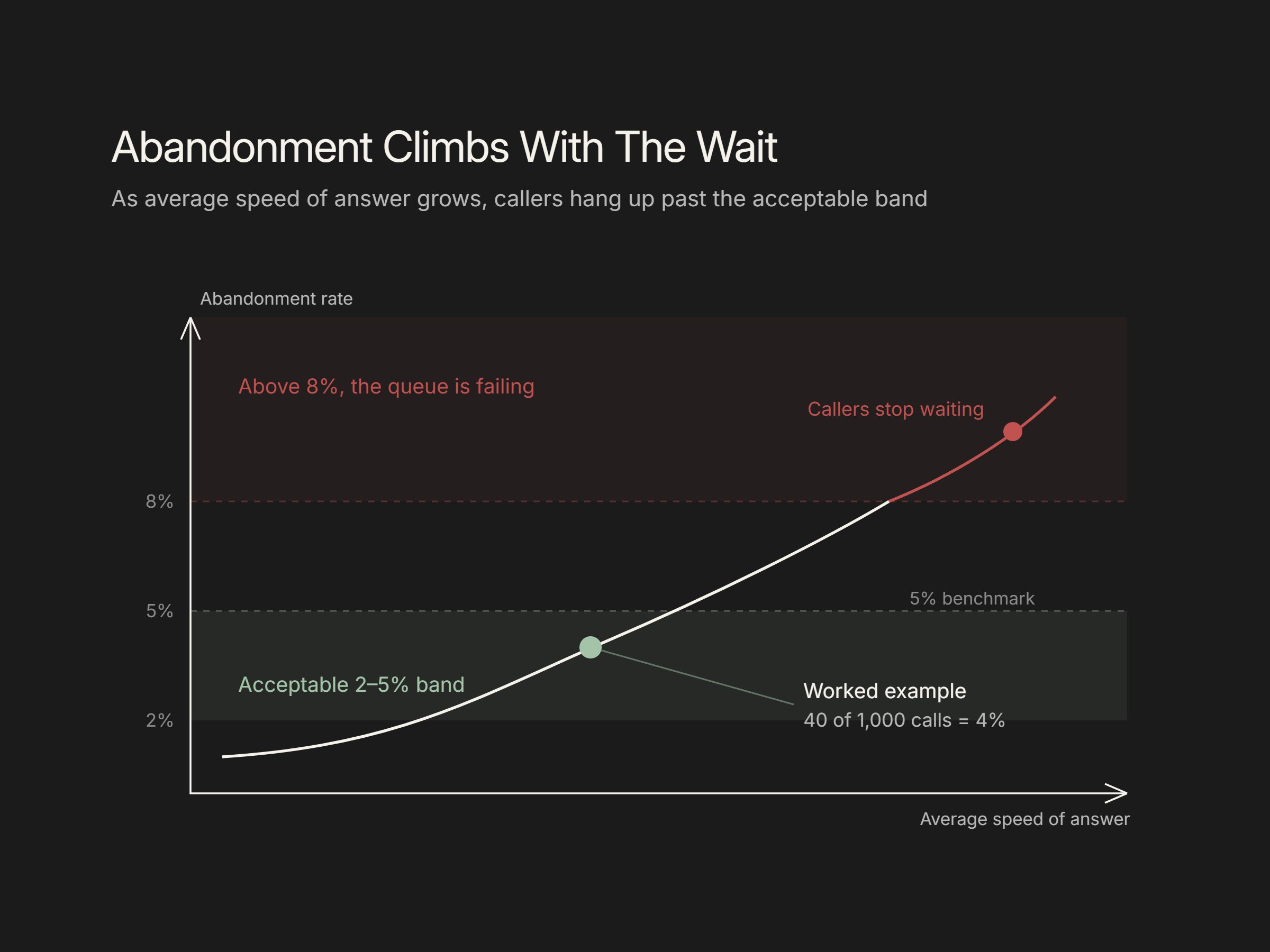
The formula is: abandonment rate = (abandoned calls / total incoming calls) x 100. An abandoned call is one where the caller disconnects while waiting in queue, before an agent picks up. VCC Live walks through this calculation and flags a common mistake: deciding whether to count very short abandons, the callers who hang up in the first few seconds by accident or change of mind. A worked example: if 1,000 calls came in and 40 callers hung up before connecting, abandonment is (40 / 1,000) x 100, or 4 percent. Many centers exclude abandons under 5 or 10 seconds so the number reflects genuine wait-driven drop-off rather than misdials. Whatever rule you choose, apply it consistently, because changing the cutoff mid-quarter makes trend lines meaningless.
Want this mapped against your own call and claim volume? Book a 30-minute audit
What is an acceptable abandonment rate?
The widely cited benchmark for call centers is around 5 percent, with anything under that generally considered good. SQM Group places an acceptable range at roughly 2 to 5 percent, a band that suggests the center is managing call flow and wait times well. Other operators describe a comfort zone closer to 4 to 8 percent depending on call type and caller urgency. Context matters: a caller with an urgent billing problem holds longer than someone with a routine question, so the same wait produces different abandonment across queues. Rather than chase a single universal figure, set your target against your callers' urgency and your service-level promise. If abandonment sits well below your target with occupancy also low, you may simply be overstaffed for the demand.
Abandonment is a capacity problem at peak, which makes it one of the metrics automation moves most directly. Flexbone answers the repetitive calls that cluster in those peaks so the queue stays short for the ones that need a person, and it identifies which calls those are from the center's recordings. See contact center automation.
See what AI can run at your facility. In a 30-minute audit we map the calls, eligibility, and follow-ups Flexbone can take off your team first.
Book an auditWhat causes abandonment?
Abandonment is usually a symptom of waiting. Balto ties it directly to long hold times and understaffed queues, where callers run out of patience before an agent is free. The usual drivers stack up: forecasts that miss a volume spike, schedules that leave the mid-morning peak thin, high handle time that keeps agents tied up, and routing that bounces callers between the wrong skills. Time-of-day and seasonality matter too, since a queue that is calm at 3 p.m. can overflow at 9 a.m. when everyone calls at once. Poor queue experience adds to it: dead air, no position updates, and no estimated wait push callers to give up sooner. Diagnose abandonment by looking at when in the day and where in the queue callers drop, not just the daily total.
How do you reduce it?
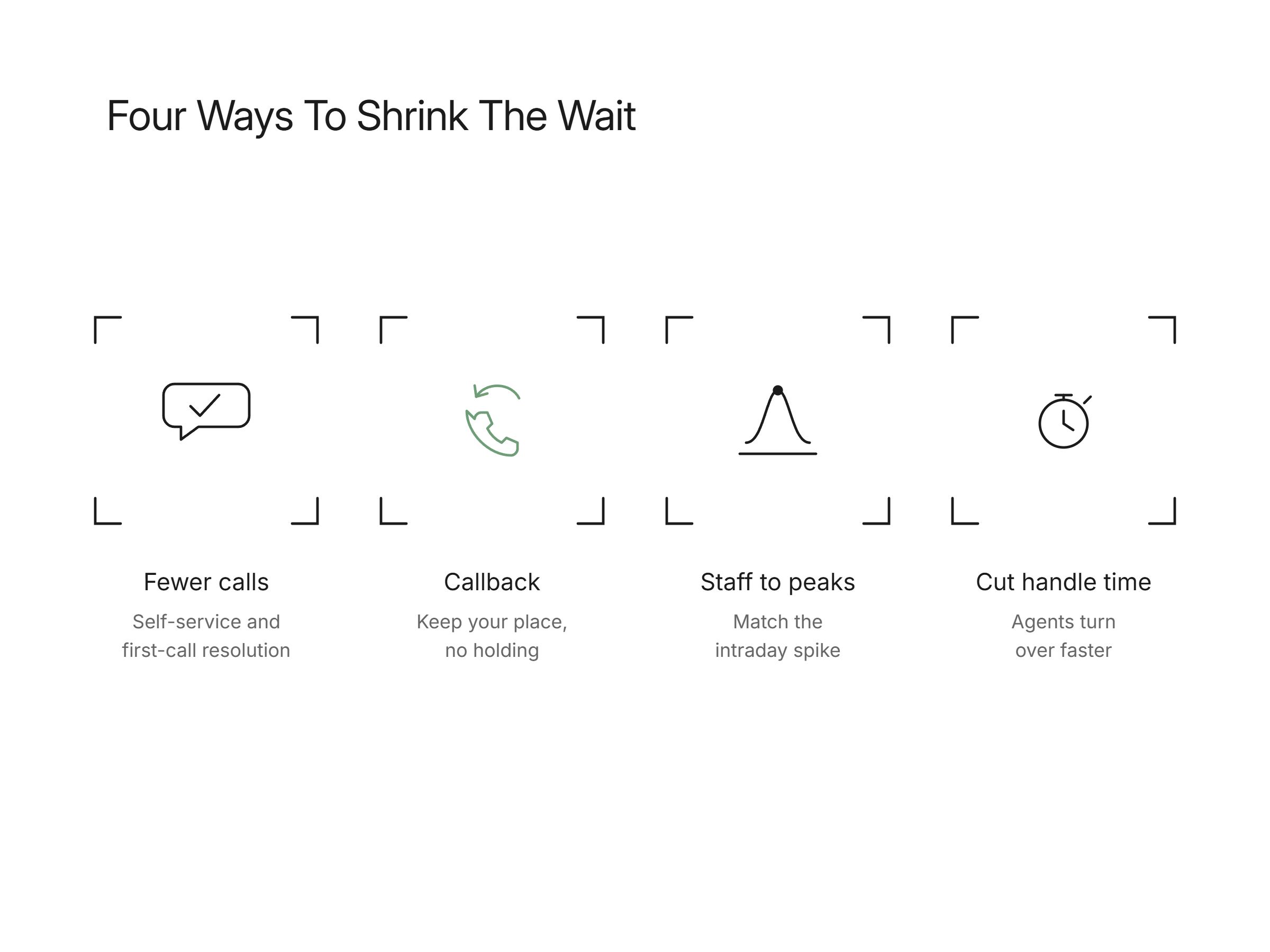
Reducing abandonment means shrinking the wait or removing it. Invoca recommends cutting the number of calls that reach the queue in the first place, through self-service and better first-call resolution so fewer callers need to hold. The practical playbook: forecast and staff to the intraday peaks rather than the daily average, offer a callback so callers keep their place without holding the line, and trim handle time on routine calls so agents turn over faster. Better queue communication helps at the margin, since position and estimated-wait messages keep more callers on the line. Track the change intraday, because a strong daily average can still hide a peak window where most of your abandons happen.
How Flexbone removes the wait that drives abandonment
Callers abandon because they are stuck in a queue, so the most direct fix is to answer with no queue at all. Flexbone's AI voice agents pick up first-tier calls immediately, at high concurrency, whether volume is flat or spiking. Calls that would have waited get handled the moment they arrive, and anything that needs a human is warm-transferred with context or offered an automated callback so the caller never holds. In a BPO, an insurance line, a health system, or a public-sector office, that zero-queue answering plus callback pulls abandonment toward the low end of the acceptable band on the exact days it usually blows out. Flexbone audits your call mix first, so you can see which call types are safe to answer automatically before anything changes. Book a demo to model it on your queue.