
A call center QA scorecard is a structured evaluation form that turns a subjective judgment about a call into a repeatable score. Most scorecards group criteria into three areas: compliance and risk (verification, required disclosures, script adherence), customer experience and communication (greeting, tone, empathy, clarity), and resolution and effectiveness (did the agent solve the issue, and how efficiently). Each item is scored, weighted, and rolled up into a percentage. According to Zendesk, an effective scorecard pulls from these core categories so feedback is specific and measurable rather than a general impression. The sections below cover what goes on the scorecard, how to score a call, what sample size is defensible, and how to move from sampling to scoring 100 percent of calls.
What goes on a QA scorecard?
A QA scorecard lists the specific, observable behaviors you want to measure on each call, grouped into categories and weighted by importance. A simple structure you can copy:
- Compliance and risk: identity verification completed, required disclosures given (a HIPAA notice, a Medicare or Medicaid script), regulatory language followed, sensitive data handled correctly.
- Communication: professional greeting, clear speech, active listening, appropriate tone and empathy.
- Resolution: correct information given (for example, a 270/271 eligibility result quoted accurately), issue resolved or properly escalated, first-contact resolution achieved, accurate wrap-up notes in the EHR such as Epic.
According to Zendesk, compliance items are often scored as pass or fail (an auto-fail if a required disclosure is skipped), while experience items use a graded scale. Weight the categories to match your risk: a healthcare or financial line should weight compliance heavily, while a sales support line might weight resolution and communication more. Keep the form short enough that an evaluator can complete it consistently.
Want this mapped against your own call and claim volume? Book a 30-minute audit
How do you score a call?
Scoring a call means listening to (or reading a transcript of) the interaction and marking each scorecard item, then rolling the marks into a single number. Most teams use a weighted percentage: each item carries a point value, the evaluator awards full, partial, or no credit, and the total is divided by the maximum possible and multiplied by 100.
Scoring by hand limits a team to a small sample, which is why a QA program usually grades a fraction of its calls. Flexbone scores the full call set against the scorecard automatically in Voice Room, which leaves reviewers to calibrate the criteria and coach on what the scores reveal.
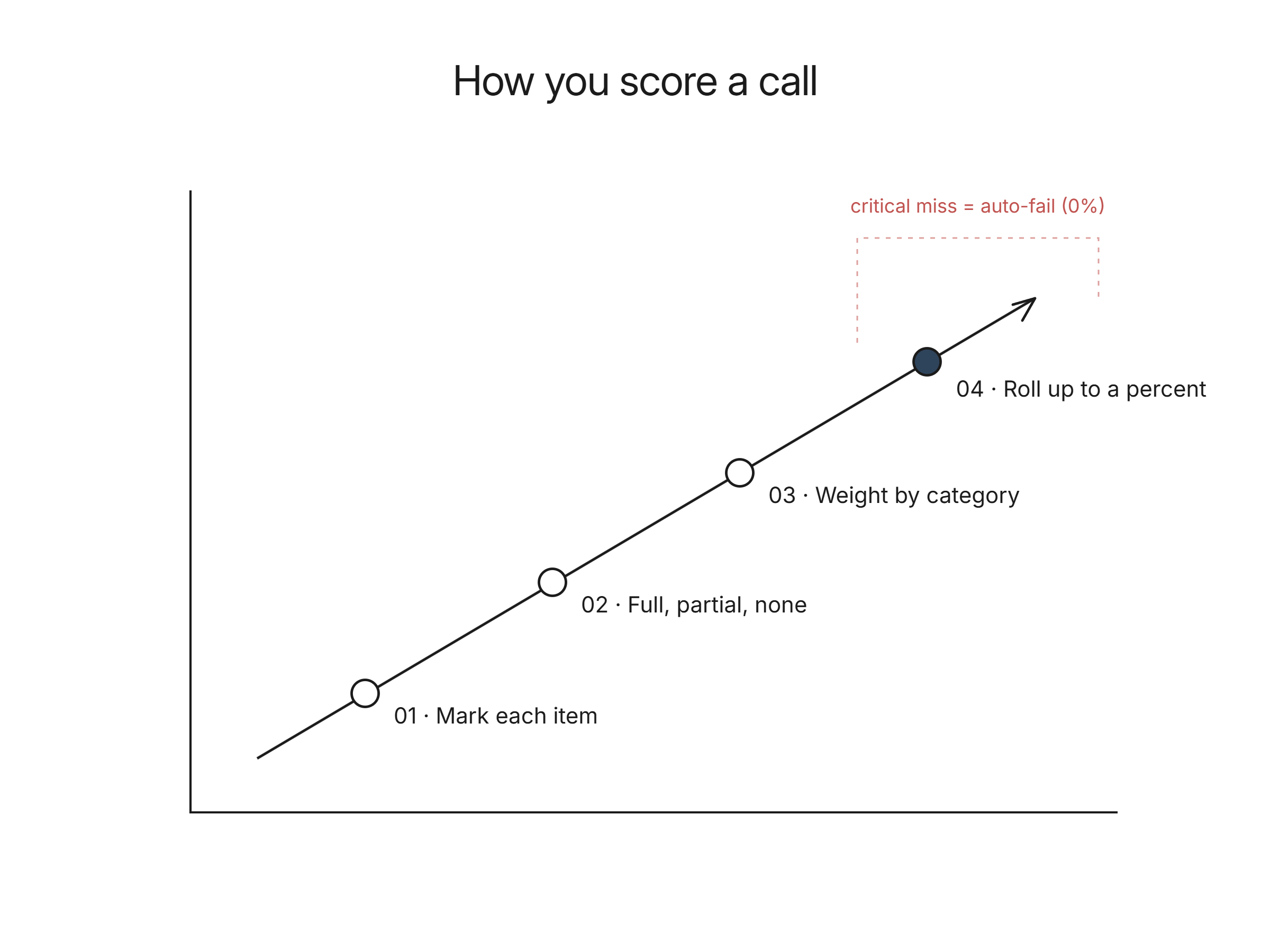
According to Calabrio, the most useful scorecards separate critical compliance failures from graded quality items, so a single missed disclosure can zero out a call regardless of how polished the rest was. To keep scoring consistent across evaluators, run regular calibration sessions: have several reviewers score the same call independently, then reconcile the differences. Consistency is what makes the score coachable. If two evaluators grade the same call 20 points apart, agents cannot trust the feedback, and the scorecard loses its authority.
See what AI can run at your facility. In a 30-minute audit we map the calls, eligibility, and follow-ups Flexbone can take off your team first.
Book an auditWhat sample size is enough?
Most contact centers review a small fraction of calls. According to CallCentreHelper, it is common for roughly 1 percent of calls to be evaluated, and many centers land between a handful of calls per agent per month. That volume is enough to spot individual coaching moments, but it is thin for drawing conclusions about an agent or a process.
The statistical problem is real: with only 4 to 8 calls per agent each month, the margin of error on any individual score is wide, so a single bad sampled call can distort a rating that is not representative. Sampling also introduces selection bias, because the calls that get pulled are rarely random. The practical takeaway is that a small manual sample is a coaching tool, not a measurement of your true quality baseline. To measure the operation as a whole, you need far more coverage than a 1 to 2 percent sample can give.
How do you score 100% of calls?
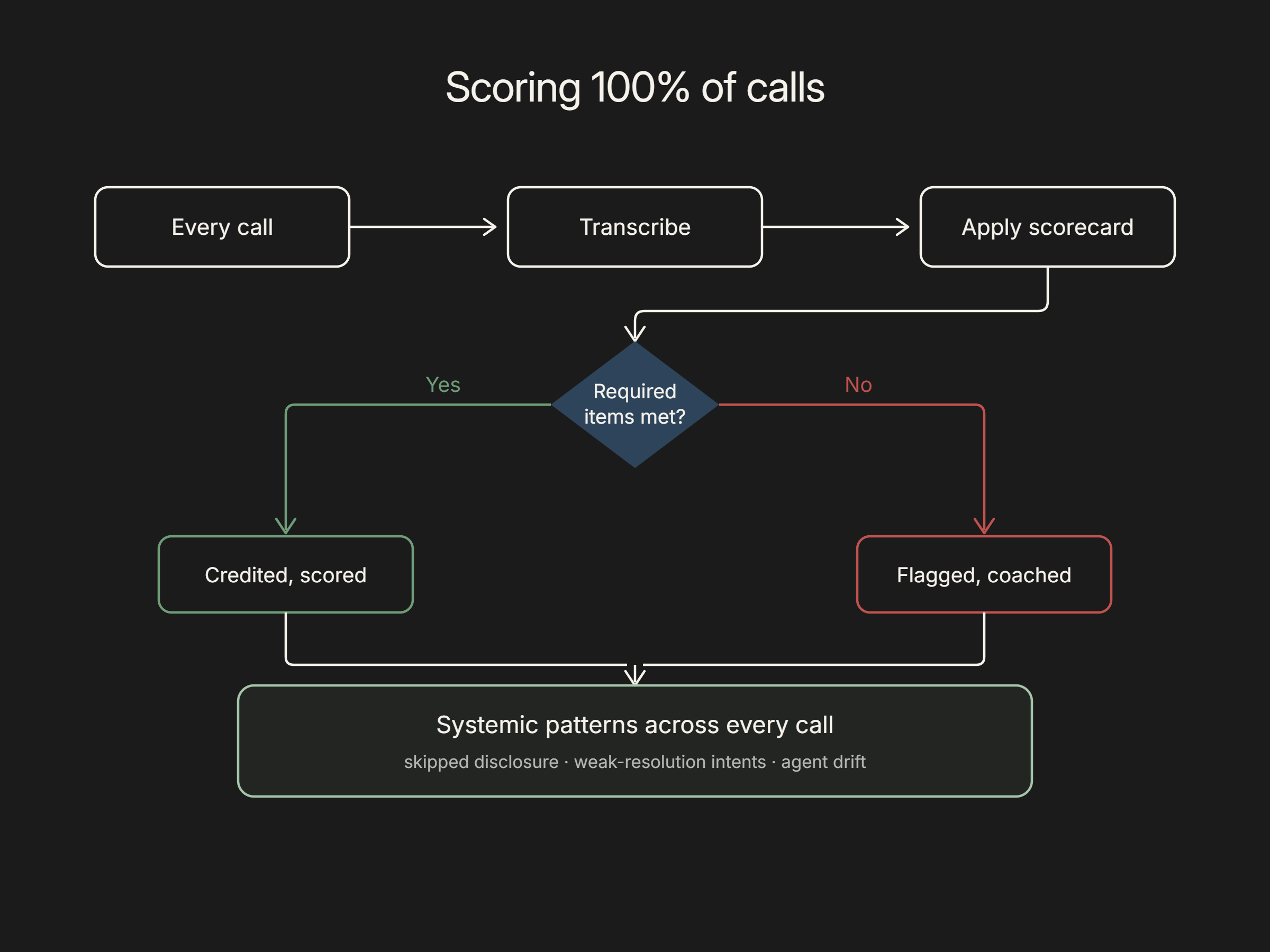
Scoring 100 percent of calls requires automating the evaluation, because no human team can listen to all of them. The mechanism is straightforward: transcribe each call, then apply your scorecard rules to the transcript with an automated system that checks for the same items a human evaluator would, such as whether verification happened, whether required disclosures were read, and whether the issue was resolved.
According to Happitu, most centers monitor only 2 to 5 percent of interactions, leaving the large majority with no quality review at all. Full-coverage scoring closes that gap and changes what QA can find. Instead of coaching one flagged call, you can see which compliance step is skipped most often across thousands of calls, which intents produce the lowest resolution scores, and which agents drift on a specific behavior. The small manual sample stays useful for nuanced human judgment; the automated layer handles coverage and pattern detection.
How Flexbone helps you score 100% of calls
Flexbone builds AI agents (voice, browser, document, and desktop) for secure, regulated contact-center and back-office work, including a document agent that can auto-score calls against your own QA scorecard. Instead of grading 1 to 2 percent of calls by hand, the document agent applies your compliance and quality rules to each transcript, so you see systemic patterns (a disclosure that gets skipped, an intent with weak resolution) rather than a handful of sampled examples. Because we audit before we automate, the scorecard we run reflects your actual criteria and risk profile across BPO, insurance, healthcare, and public-sector lines. Your human QA team keeps doing the nuanced coaching; the agent handles the coverage. To see full-call scoring on your own data, book a demo at flexbone.ai/contact.