
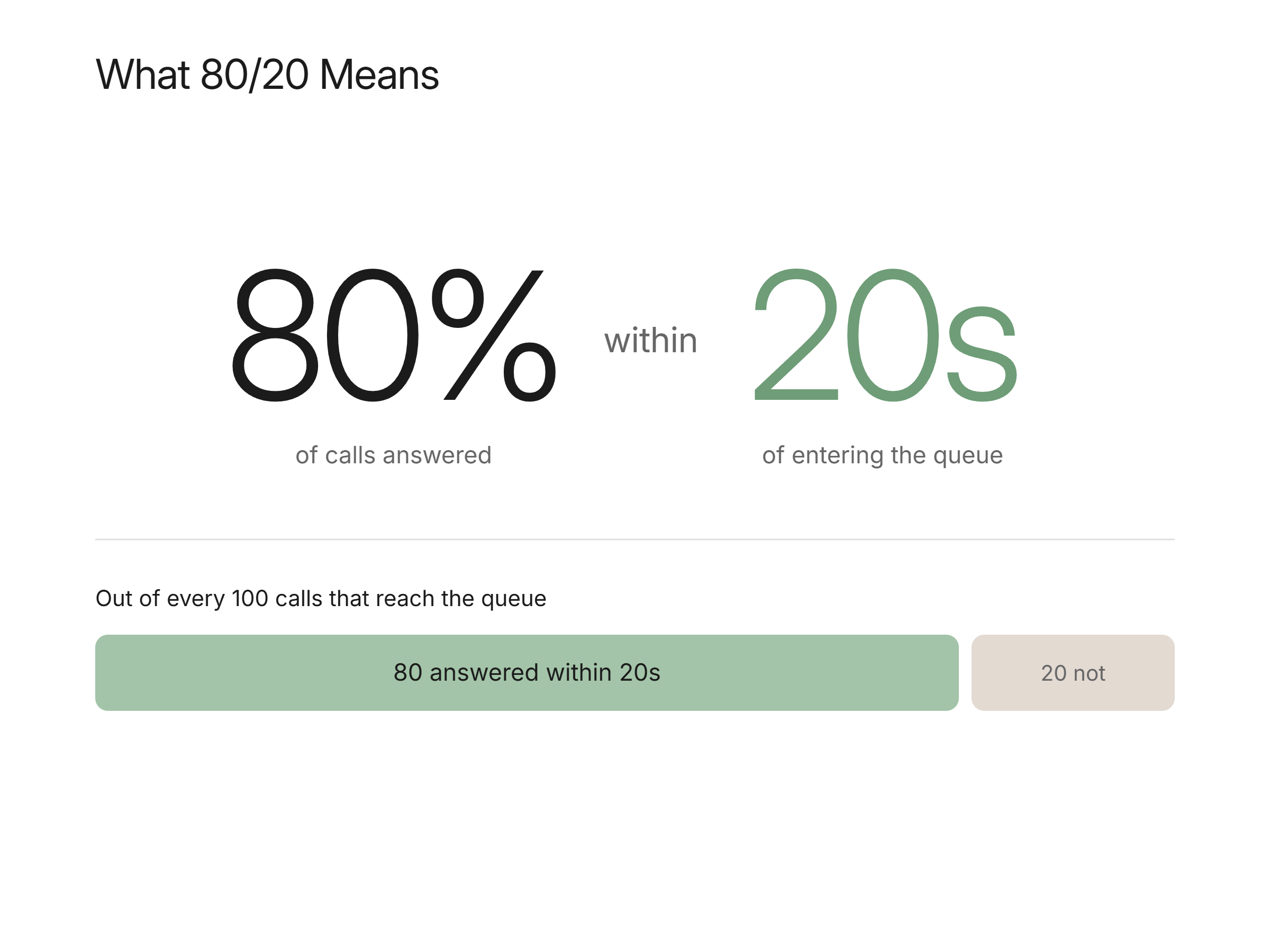
Call center service level measures the share of inbound calls answered within a set time threshold. The most common target, the 80/20 rule, means answering 80 percent of calls within 20 seconds. You calculate it by dividing the calls answered inside the threshold by the total calls offered, then multiplying by 100. As Verint describes it, service level is a commitment to a particular speed of answer that operations teams use to size staffing and set contractual targets. A center that consistently hits 80/20 keeps queues short and abandonment low. Missing it repeatedly points to understaffing, forecasting gaps, or volume spikes the schedule did not anticipate. Service level pairs closely with average speed of answer and abandonment rate, so read the three together rather than judging any one in isolation.
What is the service-level formula?
Service level uses one equation: service level = (calls answered within the threshold / total calls offered) x 100. The threshold is the number of seconds you promise to answer within, and total calls offered is each call that reached the queue, answered or not. Balto lays out this calculation and notes that the threshold you pick shapes the result as much as your staffing does. A worked example: if 900 of 1,000 offered calls were answered within 20 seconds, service level is (900 / 1,000) x 100, or 90 percent. Decide up front whether abandoned calls count against you. Counting short abandons as failures makes the number stricter, so document the rule and keep it consistent across reporting periods.
Want this mapped against your own call and claim volume? Book a 30-minute audit
What does 80/20 mean?
The 80/20 rule means 80 percent of inbound calls are answered within 20 seconds. It is a service-level target, not a description of workload. According to Voiso, the standard's origin is disputed: some trace it to Rockwell call center platforms built in the 1970s, others to an early AT&T study suggesting callers tended to hang up after about 20 seconds in queue. Either way, it was chosen because operations needed a target that was simple, measurable, and easy to write into contracts. Over time that simplicity hardened into an industry default. The rule says nothing about call quality or resolution, so treat it as one input to accessibility, not a complete picture of how the center is performing.
Service level is set by how many repetitive calls sit in the queue at the busiest hour. Flexbone takes those calls off the queue with voice agents, which changes the staffing arithmetic without adding seats, and it identifies them from the center's own recordings. See contact center automation.
See what AI can run at your facility. In a 30-minute audit we map the calls, eligibility, and follow-ups Flexbone can take off your team first.
Book an auditIs 80/20 still the right target?
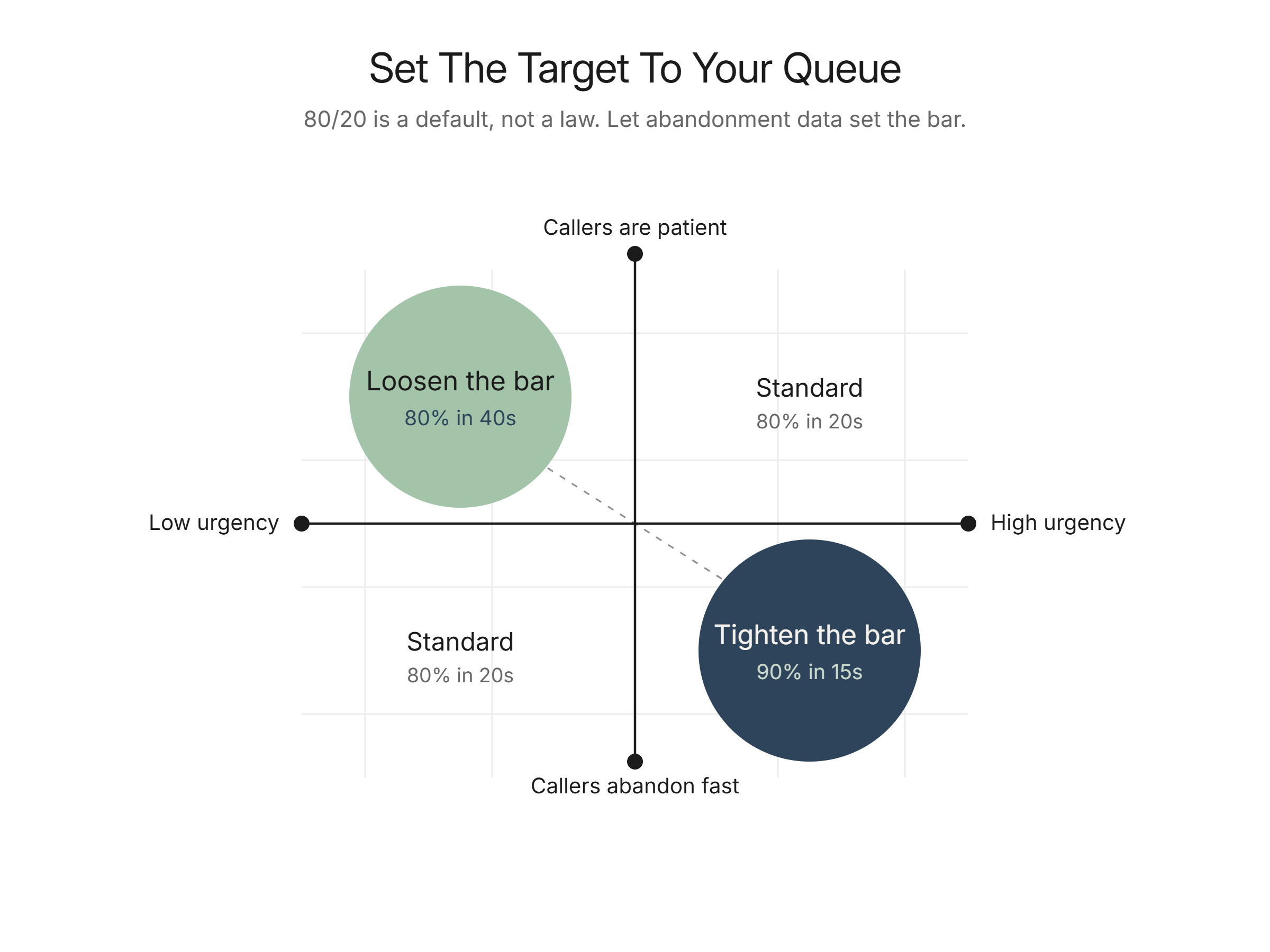
Not automatically. CallCentreHelper argues that 80/20 was set arbitrarily in the early days of the industry and does not fit every operation. A premium support line may need 90 percent within 15 seconds, while a low-urgency queue can run looser without hurting the experience. The better approach is to set the threshold against what your callers actually expect and what each channel can support, then check it against abandonment data. If callers routinely wait past your threshold yet rarely abandon, the target may be stricter than it needs to be. If abandons climb well before you miss 80/20, the threshold is too loose. Let the numbers, not tradition, set the bar.
How do you improve service level?
Improving service level comes down to matching capacity to demand at the moment calls arrive. Invoca points to accurate forecasting and scheduling as the foundation, since even strong agents cannot cover a queue that was staffed for half the volume. Beyond staffing, three levers help. First, cut handle time on routine calls so agents free up faster between contacts. Second, offer callbacks during peaks so callers keep their place without holding the line. Third, move simple, repeatable requests to self-service so fewer calls reach the queue at all. Track service level intraday rather than only as a daily average, because a strong daily number can hide a painful 10 a.m. spike that drove your worst abandons.
How Flexbone holds service level through spikes
Service level breaks down when arrival volume outruns the schedule, and that gap is exactly where AI agents help. Flexbone's voice agents answer first-tier calls with no queue, so routine requests get handled the moment they arrive whether one call comes in or three hundred do at once. In a BPO, an insurance line, a health system, or a public-sector office, that concurrency holds answered-in-threshold rates near 100 percent during the spikes that normally wreck the average, while your human agents take the complex work that needs judgment. Because Flexbone audits your call mix before automating anything, you can see which call types are safe to shift and what the service-level lift looks like first. Book a demo to see it against your own queue.