
Call center shrinkage is the percentage of paid agent time that is not available for handling contacts, lost to breaks, meetings, training, coaching, absenteeism, and system downtime. The formula is shrinkage % = (unproductive hours / total paid hours) x 100. If agents are paid for 4,000 hours in a week but only 2,800 are spent available for or handling contacts, shrinkage is 30 percent. Most contact-center professionals put a normal range at 30 to 35 percent, and Dimension Data's global benchmarking has reported an average near 35 percent Call Centre Helper. Shrinkage is not waste to eliminate; much of it is necessary. The goal is to forecast it accurately so it does not silently break your service level. This page covers the formula, benchmarks, the planned-versus-unplanned split, and how to reduce the harmful part.
How do you calculate shrinkage?
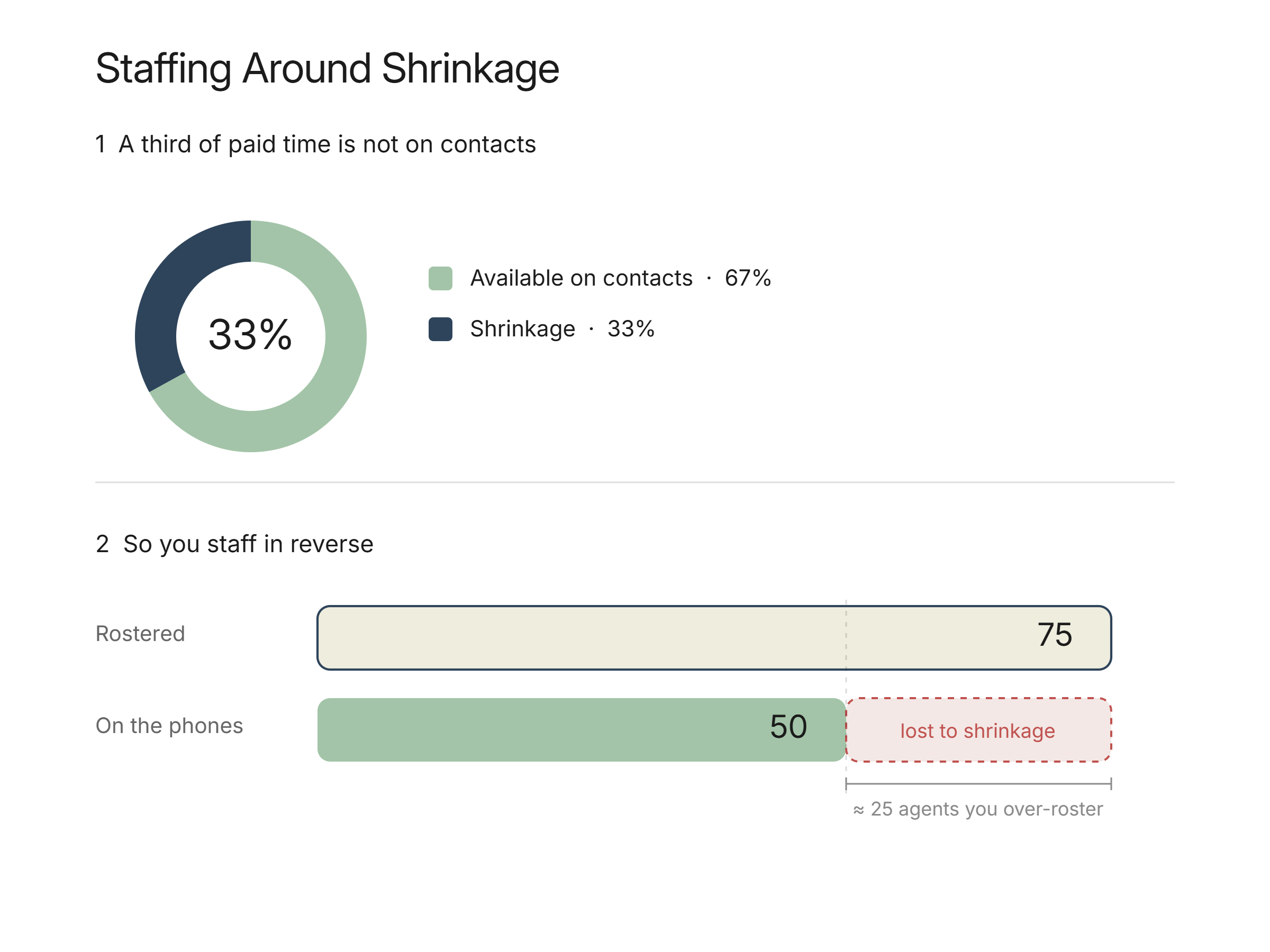
Shrinkage = (total unproductive hours / total paid hours) x 100 over a defined period. Total paid hours are every hour you pay agents for. Unproductive hours are every hour they are paid but not available to handle contacts: paid breaks, team meetings, one-to-ones, training, coaching, system outages, and absence. For a worked example, 100 agents paid 40 hours each is 4,000 paid hours; if 1,300 hours go to those non-handling activities, shrinkage is 32.5 percent Giva. Build the number bottom-up by category so you can see where the time goes, then apply it in reverse when staffing: if Erlang C says you need 50 agents on the phones and shrinkage is 33 percent, you must roster roughly 75 to have 50 actually available. Measuring shrinkage without applying it to rosters is the common mistake.
Want this mapped against your own call and claim volume? Book a 30-minute audit
What is a healthy shrinkage benchmark?
A healthy shrinkage figure for most contact centers sits around 30 to 35 percent, though the right number depends on how much training, coaching, and back-office work your operation carries. A center investing heavily in agent development will legitimately run higher planned shrinkage; a lean transactional BPO may run lower. Benchmark against your own trend and composition rather than a single external target Level AI. What matters more than the headline percentage is stability. Shrinkage that swings week to week is a forecasting problem, because your rosters were built on an assumption that no longer holds. Track shrinkage by category and by interval, so you can tell the difference between a planned training week and a spike in unplanned absence that is about to miss your service level.
Shrinkage matters because every lost hour has to be covered by someone else at peak. Automation changes that equation from the other side: Flexbone absorbs repetitive volume with voice agents, so the same shrinkage costs less coverage. See contact center automation.
See what AI can run at your facility. In a 30-minute audit we map the calls, eligibility, and follow-ups Flexbone can take off your team first.
Book an auditPlanned vs unplanned shrinkage?
Shrinkage splits into planned and unplanned, and the split is what makes the number actionable. Planned shrinkage is scheduled and forecastable: breaks, team meetings, training, coaching, and approved leave. You know it is coming, so you can staff around it. Unplanned shrinkage is the disruptive kind: unscheduled absence, lateness, no-shows, and system outages. It is the part that wrecks service level, because it removes agents you were counting on with no time to backfill Genesys. Absence is the hardest piece to predict: the Bureau of Labor Statistics tracks the absence rate, the share of full-time workers who miss work in a given week, which gives you a baseline for the unplanned loss to plan around. A center can run 33 percent total shrinkage comfortably if most of it is planned, and struggle at the same 33 percent if a large share is absence. So do not manage the total in isolation. Separate the two, protect the planned development time, and attack the unplanned absence that shows up as abandoned calls.
How do you reduce shrinkage?
You reduce harmful shrinkage by shrinking the unplanned part and forecasting the planned part, not by cutting breaks or training. The proven levers are accurate forecasting of known events, clear absence policies, flexible scheduling that fits agent lives, and real-time intraday management that reshuffles activities when volume spikes Talkdesk. Move coaching and training into forecast-low intervals so development does not collide with peak demand. Address chronic absenteeism directly, since a small group often drives much of the unplanned loss. The structural limit is that human coverage has gaps: people take breaks, get sick, and go home at night. That is why the most durable move is to reduce the volume that a thinned roster has to cover, so a shrinkage spike stops translating directly into missed service level.
How Flexbone keeps shrinkage from breaking service level
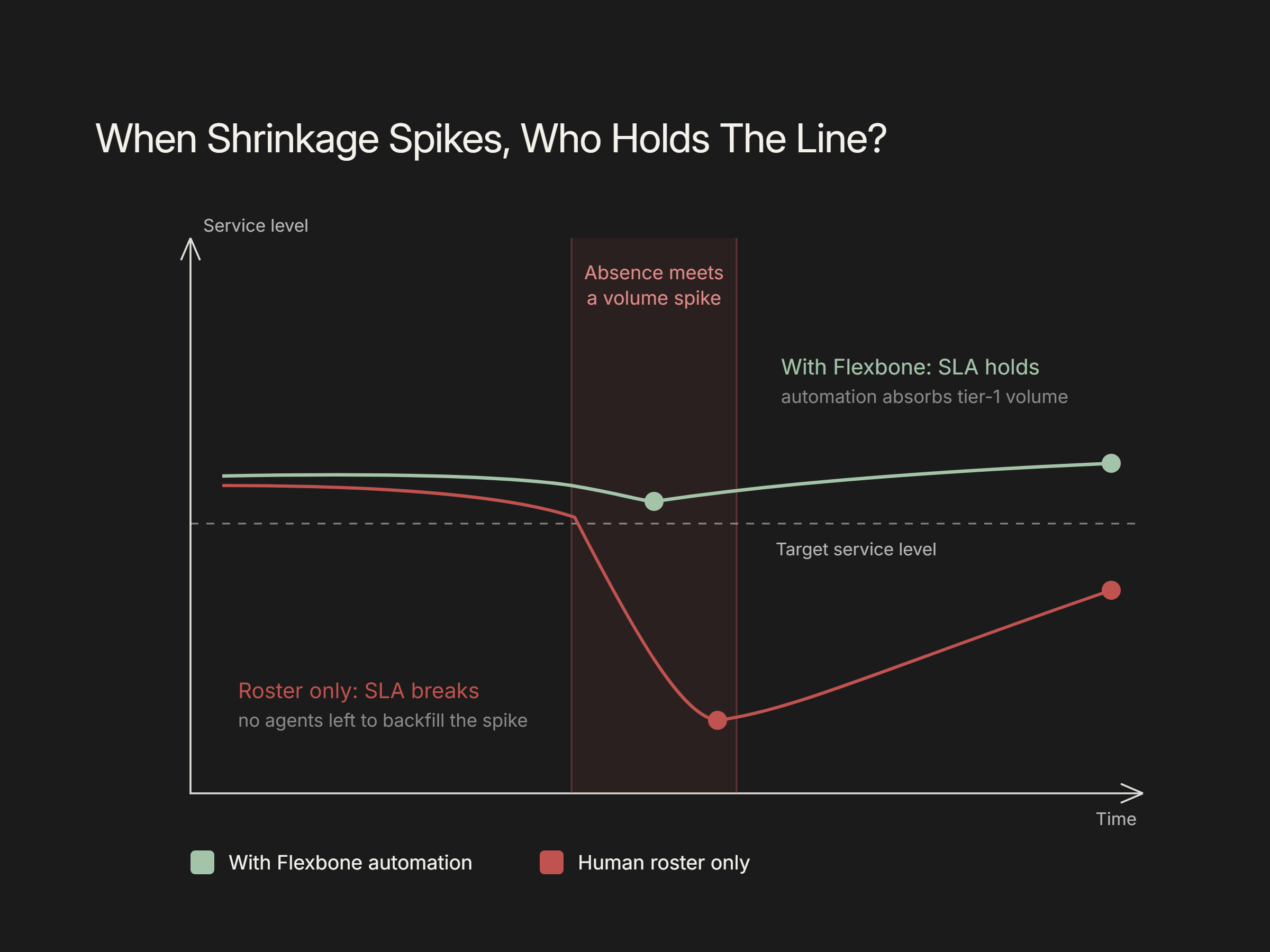
You can forecast shrinkage precisely and still miss service level on the day a training block collides with a volume spike, because human coverage has gaps. Flexbone adds an automation layer that is available around the clock and does not take breaks, call in sick, or clock out at 6 pm. We audit your contact reasons, then deploy AI voice, chat, and document agents that resolve tier-1 volume around the clock in a HIPAA-compliant environment, so when unplanned shrinkage thins the roster, the automated layer absorbs the simple contacts (a Medicare or Medicaid coverage question, a 270/271 eligibility check on a payer portal like Availity) and your agents stay focused on the work that needs them. The result is a service level that is less hostage to absence and coverage gaps, across BPO, insurance, healthcare, and public-sector queues. We measure it as service level held through shrinkage peaks, not just a lower shrinkage number.
See how around-the-clock coverage protects your service level: book a demo.