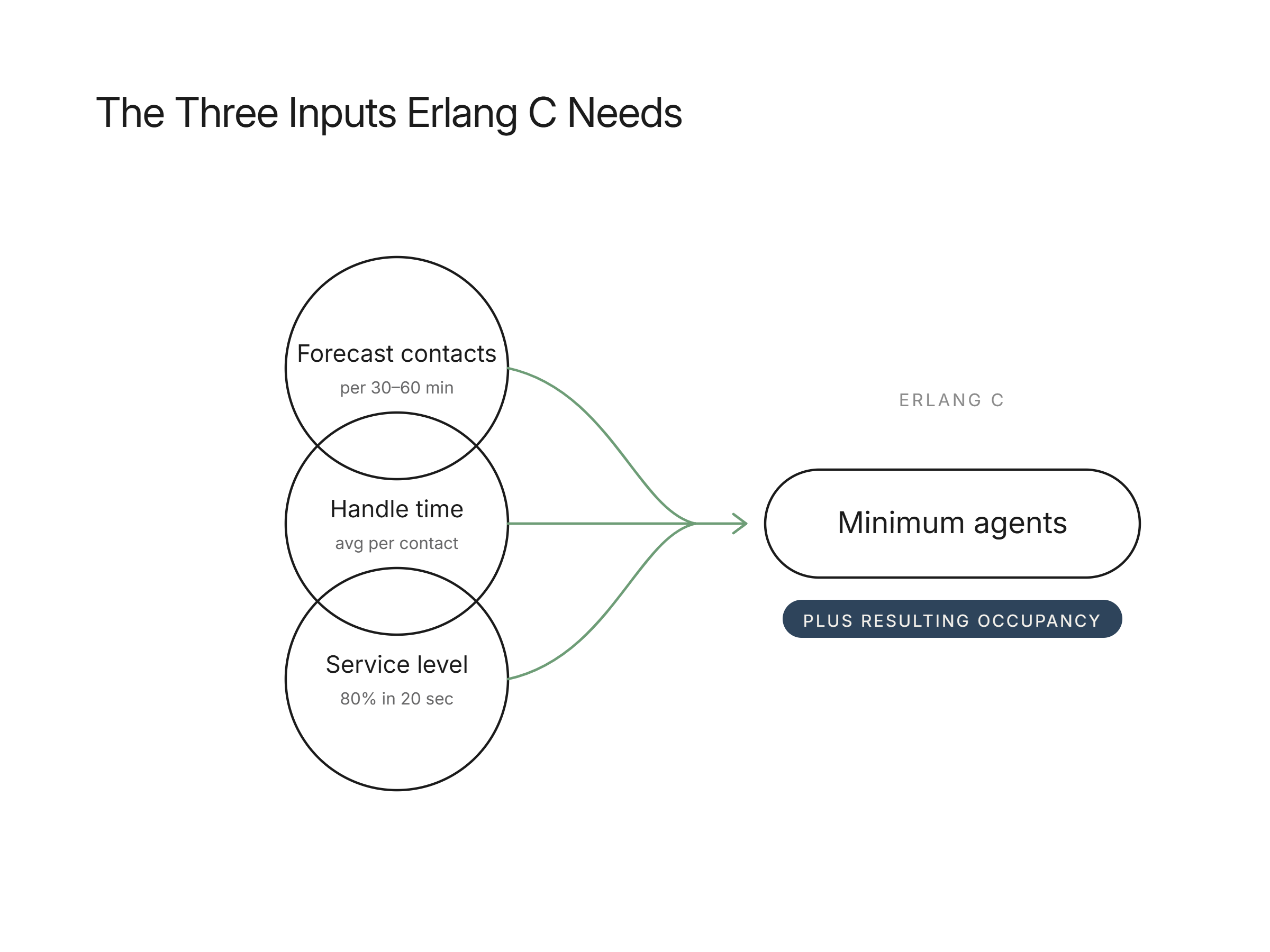
A call center staffing calculator uses the Erlang C formula to estimate how many agents you need to hit a service-level target for a given call volume and average handle time. You feed it three inputs: forecast contacts per interval (usually 30 or 60 minutes), average handle time, and your service-level goal such as 80 percent of calls answered in 20 seconds. Erlang C then returns the minimum agents required and the resulting occupancy. Because call arrivals are random, you need more agents than a simple "calls times handle time" division suggests, which is the whole point of the model Call Centre Helper. This page explains the Erlang C inputs, how handle time and service level move the number, why you should not staff above 85 percent occupancy, and how automation changes the math.
What is the Erlang C formula?
Erlang C is a queuing formula, named after Danish mathematician A.K. Erlang, that estimates the probability an arriving call has to wait, given a number of agents and an offered traffic load. Traffic load, measured in erlangs, is calls per hour multiplied by average handle time in hours. From the wait probability, the formula derives the share of calls answered within your threshold, so you increase agents until the answer meets your service-level target. You do not compute it by hand in practice; an Erlang calculator does the iteration for you Call Centre Tools. The important intuition is that Erlang C assumes callers wait in queue rather than abandon, which makes it slightly conservative, and it treats arrivals as random, which is why raw volume divided by capacity understaffs the floor.
Want this mapped against your own call and claim volume? Book a 30-minute audit
How do AHT and service level change staffing?
Average handle time and service level both push required headcount up, but not in the same way. Handle time scales the traffic load directly: a 20 percent rise in AHT is roughly a 20 percent rise in offered erlangs, so it moves staffing almost proportionally. Service level moves it non-linearly. Going from 80 percent answered in 20 seconds to 90 percent in 10 seconds can add agents out of proportion to the change, because chasing the tail of the queue gets expensive fast. As practical staffing guides note, the last few points of service level cost the most agents ViciStack. This is why small AHT reductions are so valuable: shaving handle time lowers the traffic load itself, which lowers required agents at every service-level target you might set.
Erlang C makes the effect visible: removing a slice of short, repetitive calls reduces required staff by more than that slice's share of minutes, because queues behave nonlinearly near capacity. Flexbone targets exactly that slice, chosen from the center's own call recordings. See contact center automation.
See what AI can run at your facility. In a 30-minute audit we map the calls, eligibility, and follow-ups Flexbone can take off your team first.
Book an auditWhy not staff above 85% occupancy?
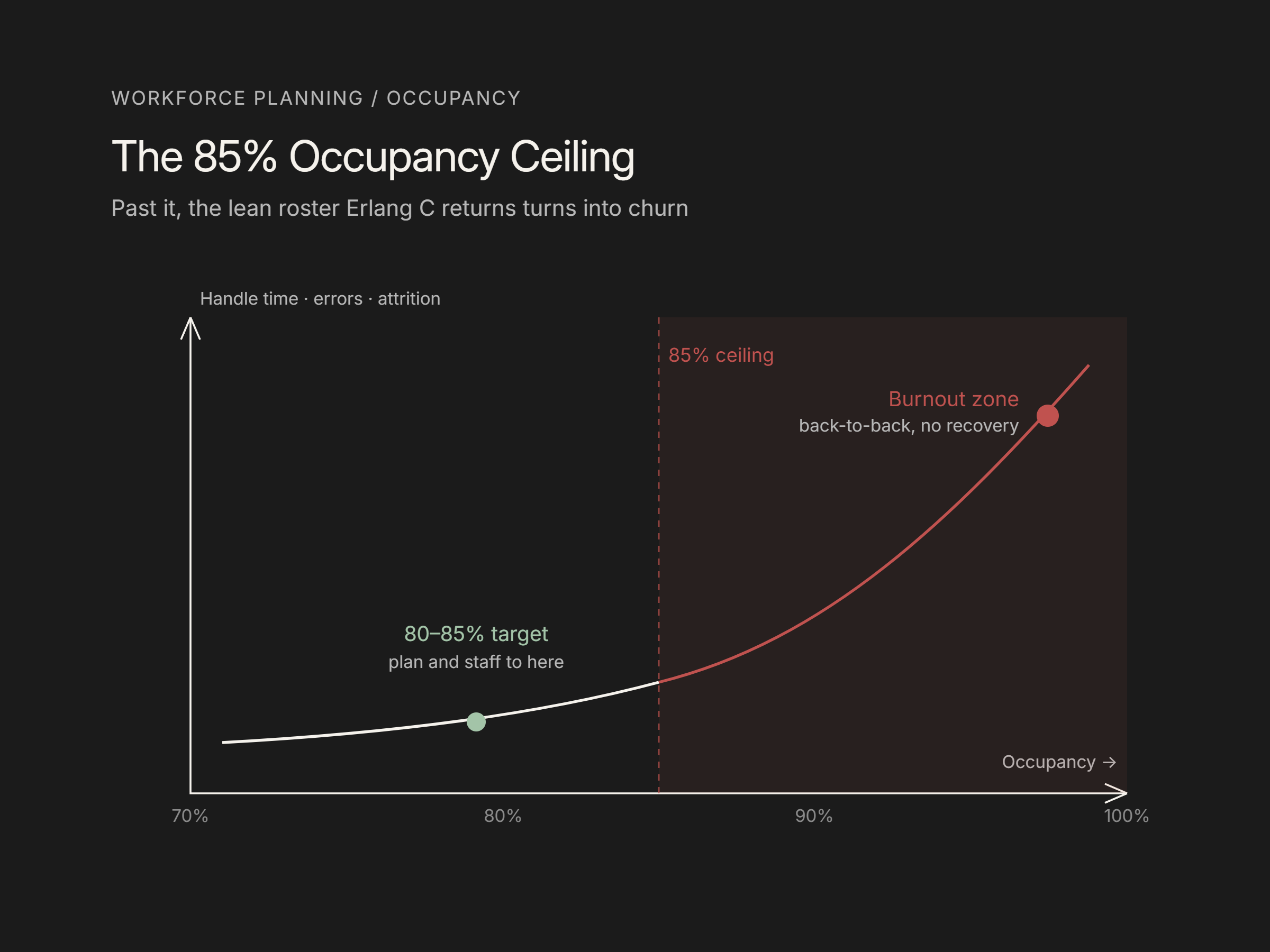
Occupancy is the share of logged-in time agents spend handling contacts rather than waiting. It is tempting to treat 95 percent occupancy as efficient, but sustained high occupancy backfires. Above roughly 85 percent, agents get back-to-back contacts with no recovery time, and the documented result is rising handle time, more errors, and higher attrition Call Centre Helper. Erlang C will happily return a lean headcount that runs the floor at 90 percent or more, so workforce planners cap occupancy as a constraint on the model rather than accepting the raw minimum. A practical rule many centers use is to target 80 to 85 percent occupancy and staff to it. The cost of ignoring this shows up later as burnout-driven turnover, which is far more expensive than the extra seats.
How does automation change the math?
Automation changes the staffing math by lowering the volume Erlang C has to staff for. If an AI agent contains a share of contacts end to end, only the remainder becomes offered traffic for your live queue, and required headcount falls at the same service level. The effect compounds with occupancy limits: fewer required agents at a safe occupancy means you are not forced to choose between service level and burnout. As deflection analyses show, containing even a third of volume removes a meaningful block of staffing cost Balto. Run the calculator twice: once on full volume, once on the residual after containment, and the difference is the automation dividend. The math holds across BPO, insurance, healthcare, and public-sector queues, because Erlang C does not care what the calls are about, only how many arrive.
How Flexbone changes your staffing math
Erlang C tells you how many agents a given volume needs. Flexbone reduces the volume that reaches the agent queue in the first place. We audit your call reasons and handle-time drivers, then deploy AI voice and document agents that resolve tier-1 contacts end to end, so the traffic load your Erlang C model has to cover shrinks. Fewer offered contacts means fewer required seats at your target service level, and it means you can run a healthy 80 to 85 percent occupancy instead of over-driving a thin roster. We measure the before and after: required agents on full volume versus required agents on the residual after containment. The approach applies across BPO, insurance, healthcare, and public-sector lines.
See what containment does to your staffing model: book a demo.