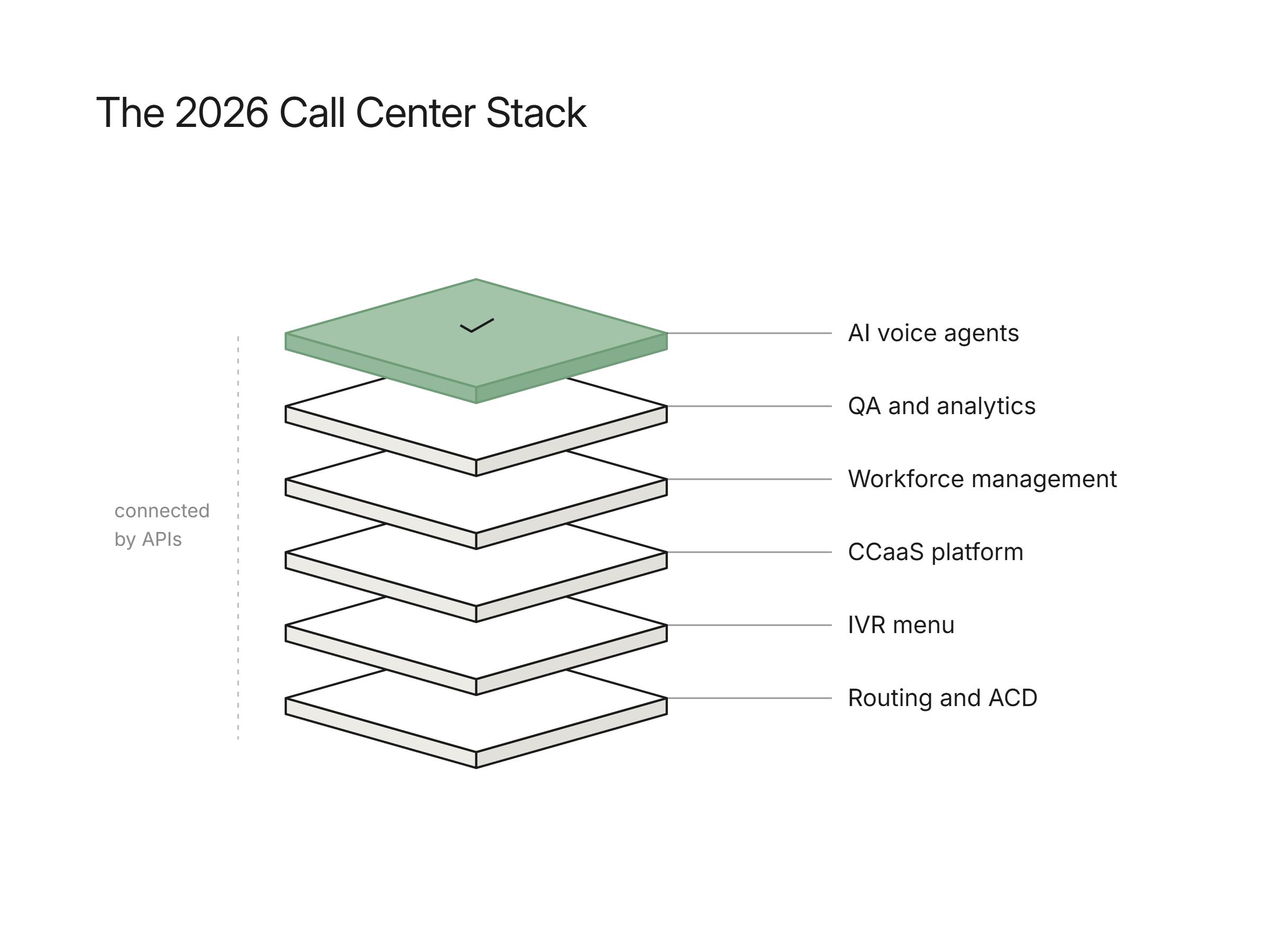
Call center technology is the set of systems that route, handle, and measure customer phone and digital interactions, from the moment a call arrives to the note written after it ends. A modern stack has a few layers. At the base sits automatic call distribution and routing, which decides where each contact goes, paired with an interactive voice response (IVR) menu that greets and directs callers. Above that runs the contact center platform, usually delivered as call center software in the cloud (CCaaS), which ties channels, agents, and reporting together. Workforce management forecasts volume and schedules staff, while quality assurance and analytics score interactions and surface trends. The newest layer is AI voice agents that answer and work calls directly. Contact center technology now assumes these layers connect through APIs rather than sitting in separate silos.
What is call center technology?
Call center technology is the software and infrastructure a team uses to receive, distribute, resolve, and analyze customer contacts at volume. The category started as telephone hardware and grew to cover the full path of an interaction: how it arrives, who or what handles it, and what is recorded afterward. Two terms get used loosely here. Call center software tends to describe the voice-handling core that queues and routes phone calls, while contact center technology is the wider term for handling voice alongside chat, email, SMS, and messaging in one place. Most current platforms ship the broader feature set by default, so the distinction is now more about which channels a given team turns on than about two separate products.
Want this mapped against your own call and claim volume? Book a 30-minute audit
What are the core components of a modern call center technology stack?
Flexbone sits on top of that stack rather than replacing it: voice agents take calls through the existing telephony, and results are written to the systems already in place. See AI voice agents.
A modern stack has six components that each own one job. Automatic call distribution and routing decides where a contact goes based on skills, priority, and availability. The IVR menu greets callers and gathers intent before a human is involved. The contact center platform, the CCaaS layer, holds the channels, the agent desktop, and the reporting together. Workforce management forecasts volume and builds schedules so staffing matches demand. Quality assurance and analytics score a sample of interactions, transcribe calls, and surface recurring themes. The newest component is AI voice agents that answer and resolve contacts on their own. These pieces are useful in isolation, but the value comes from integration, which is also the theme of our contact center automation guide. When routing, the desktop, and analytics share the same data, an agent sees context on screen pop and a manager sees one report instead of six.
What is CCaaS, and how does cloud compare to on-premise?
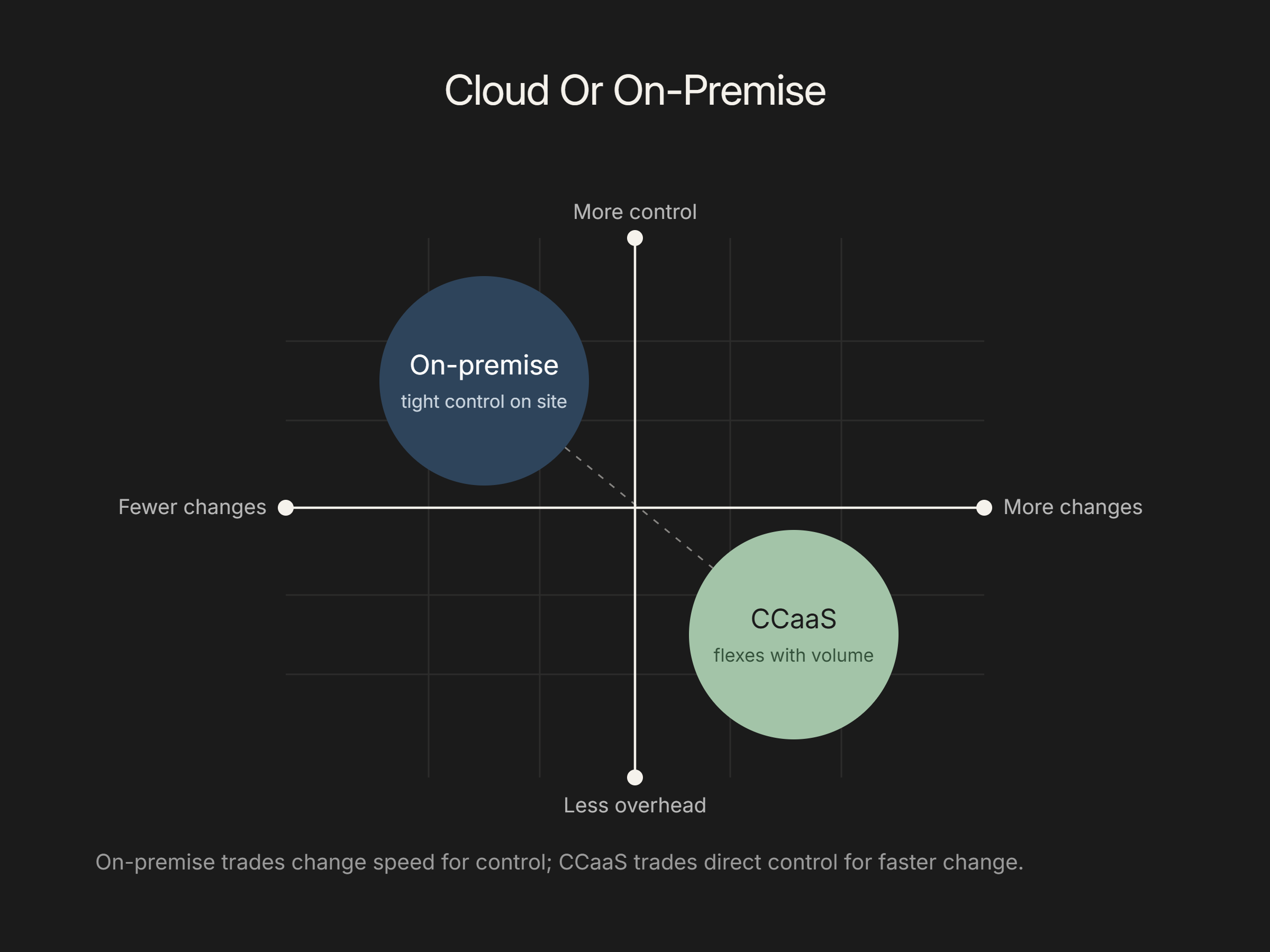
CCaaS means contact center as a service: the platform runs in a vendor's cloud and you reach it over the internet rather than from servers in your own building. The older model, on-premise, put the hardware and software on site, which gave a team direct control but also made every upgrade, capacity change, and failover its own project. Cloud delivery moves that maintenance to the provider and lets capacity flex with call volume, which matters for seasonal peaks and for adding remote agents. The trade is real: on-premise gives tighter control over data location and network paths, while CCaaS gives faster change at the cost of depending on a vendor's uptime and roadmap. For regulated work, the deciding questions are usually where data is stored, how it is encrypted, and whether the vendor will sign the agreements your compliance team requires.
See what AI can run at your facility. In a 30-minute audit we map the calls, eligibility, and follow-ups Flexbone can take off your team first.
Book an auditWhere do AI voice agents fit in the stack?
AI voice agents sit at the front of the stack, in front of or in place of the IVR menu, and they change what the first layer can do. A traditional IVR routes a caller by collecting digits against a fixed tree. A voice agent listens to a spoken request, understands the intent, and can either answer it or complete the task by acting in a connected system. That is the shift from routing to resolution. In practice, teams deploy the agent on a narrow set of high-volume, repetitive call types first, keep a human fallback for low-confidence cases, and expand as the results hold up. The agent also feeds the analytics layer, since the calls it handles are already transcribed and categorized. For a deeper treatment of voice agents in a clinical setting, see our page on the AI call center.
What do healthcare call centers need beyond standard call center software?
Healthcare call centers carry two requirements that general contact centers do not: regulatory scope over patient data, and the need to finish work inside a clinical system. Because calls, recordings, transcripts, and any AI component can touch protected health information, they fall under the HIPAA Security Rule, which requires administrative, physical, and technical safeguards to protect electronic protected health information, as described by HHS. That turns access controls, encryption, and audit logging from nice-to-have into baseline. The second requirement is write-back. A resolved eligibility check or scheduling request only counts when the result lands in the EHR or practice management system, so integration with those records is part of the technology decision rather than an afterthought. Performance expectations are also concrete in this sector: for Medicare Part C and Part D lines, CMS monitors call centers against standards including an average hold time of two minutes or less and a disconnect rate at or below five percent.
How does Flexbone fit into the call center technology stack?
Flexbone adds an AI voice and browser agent layer that resolves calls end to end inside the systems a healthcare team already uses, rather than only routing them. Instead of handing a caller to a queue, the agent handles the request, then acts in the EHR or payer portal through a browser the same way a person would, so eligibility, status, and records tasks finish in the record. We start audit-first: we review a sample of your current call and correspondence mix, identify the repetitive, single-answer contact types, and put the agent on one of them with human review before widening scope. The platform is HIPAA compliant and SOC 2 aligned, with least-privilege access and a complete audit trail on every action, so a team can put an agent on protected health information without accepting new compliance exposure. Flexbone sits alongside an existing CCaaS platform and call center software rather than replacing them, which keeps the routing, workforce, and analytics investments a team has already made.
How do you choose the right call center technology?
Start from the work, not the feature list. Map your highest-volume call types, the systems each one touches, and where interactions currently break down, then match those needs against the six stack layers. Weigh cloud against on-premise on data location, control, and how often you need to change the configuration. For regulated work, put compliance early: confirm the vendor will sign the agreements you need, and check how recordings and AI components are secured. Treat AI voice agents as an addition to the stack you can test on a narrow scope, not a wholesale rebuild. If your calls end in an EHR or practice management system, the ability to write results back should carry real weight, because a contact that does not update the record is not actually resolved.
If you want to see an agent handle real call types inside your systems, book a demo.