Call deflection is the practice of resolving customer inquiries through channels other than a live phone agent, such as chatbots, IVR, knowledge bases, or AI voice agents, so fewer contacts reach the queue. You measure it with deflection rate: the share of inquiries resolved without a live agent, calculated as (self-service resolutions / total inquiries) x 100. According to Balto, a good deflection rate for most contact centers falls between 20 and 40 percent, with advanced self-service operations reaching 50 percent or higher. The point is not to block callers but to route the inquiries that do not need a human away from the queue, so agents spend their time on the ones that do. The sections below cover the definition, the formula, which calls to deflect, and how far to take automation.
What is call deflection?
Call deflection redirects inquiries that would otherwise go to a live agent toward a self-service or automated channel that can resolve them. According to TELUS Digital, it is the rate at which non-agent channels handle queries that would normally hit the call center directly. Done well, the customer gets a faster answer and the center carries less load.
The important word is "resolved." Pushing a caller into an IVR menu that dead-ends and forces a callback is not deflection; it is a deferred call, and it usually comes back angrier. True deflection means the alternate channel actually completed the request, whether that is checking an order status, resetting a password, confirming an appointment, or answering a benefits question. The goal is to remove work from the queue, not to hide it, which is why measuring real resolution (not just channel diversion) is central to doing deflection right.
Want this mapped against your own call and claim volume? Book a 30-minute audit
How do you calculate deflection rate?
Deflection rate is the percentage of total inquiries resolved without a live agent. The basic formula is:
Deflection only counts when the caller's need was met; a call that ends in a callback request moved the work rather than removing it. Flexbone measures resolution rather than containment for that reason, and picks which call types to automate from recorded calls. See AI voice agents.
Deflection rate (%) = (Self-service resolutions / Total inquiries) x 100
According to Balto, if your center handles 10,000 inquiries and 3,500 are resolved through self-service, your deflection rate is 35 percent. The trap in the basic formula is that it counts a resolution even if the customer comes back a day later with the same problem. A more honest version subtracts short-window re-contacts: ((self-service resolutions minus 48-hour re-contacts) / total inquiries) x 100. That adjustment separates real resolutions from ones that only looked resolved. Track the adjusted number if you can, because a headline deflection rate that ignores re-contacts overstates how much load you actually removed and hides a frustrating customer experience underneath.
See what AI can run at your facility. In a 30-minute audit we map the calls, eligibility, and follow-ups Flexbone can take off your team first.
Book an auditWhich calls can be deflected?
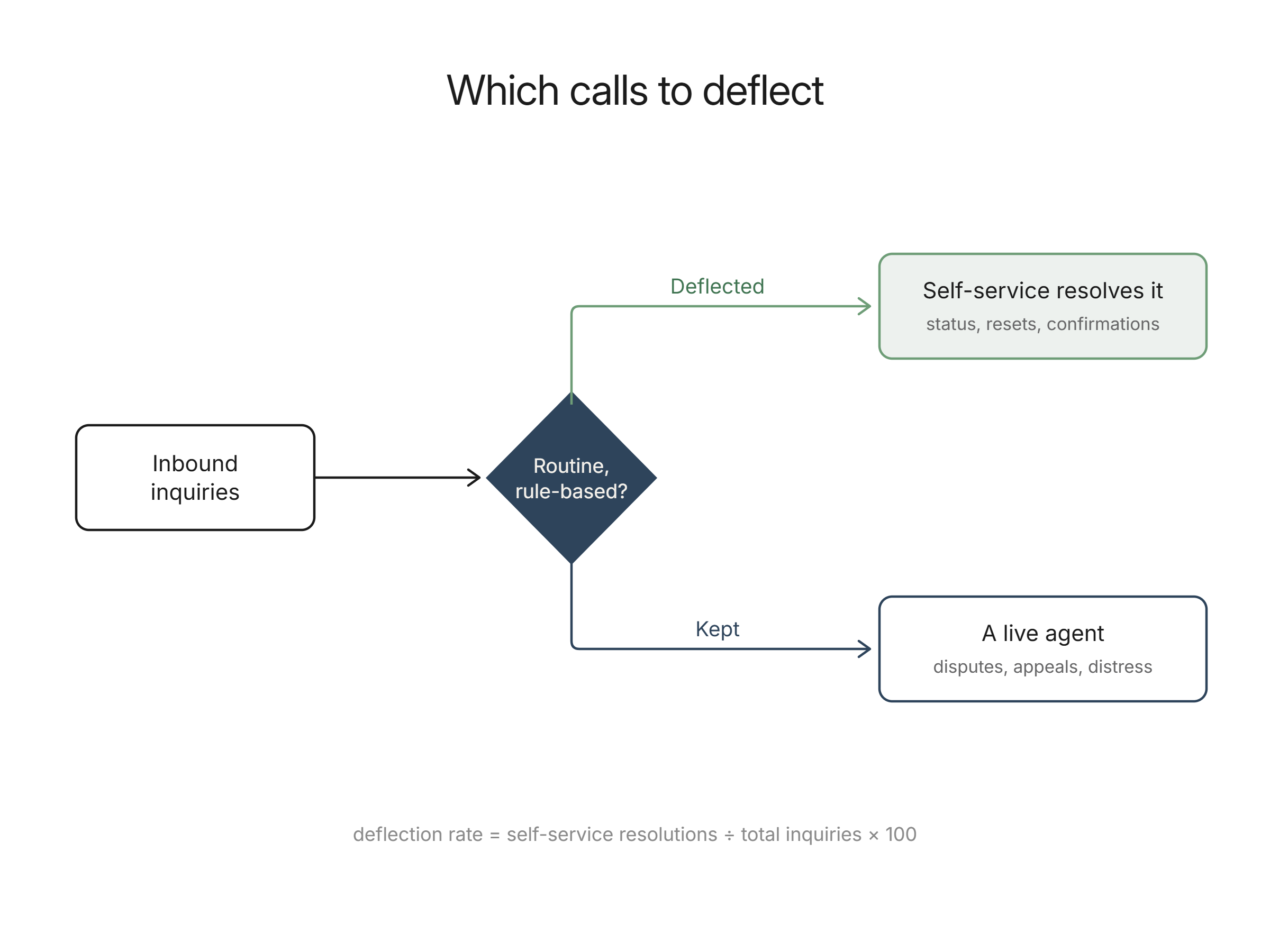
The calls that deflect well are high-volume, low-complexity, and rule-based: the request has a clear answer that does not depend on judgment or sensitive negotiation. Order and claim status, appointment confirmations and reminders, password resets, balance checks, hours and location questions, and simple eligibility lookups are common candidates across BPO, insurance, healthcare, and public-sector lines.
The calls to keep with humans are the emotional, complex, or high-stakes ones: a distressed patient, a disputed bill, a nuanced coverage appeal, anything requiring empathy or discretion. According to CustomerGauge, many customers actually prefer self-service for routine questions and try to solve simple issues on their own before contacting a representative, so deflecting the routine tier often matches what customers want. The mapping exercise is worth doing intent by intent: list your top call reasons by volume, mark which are rule-based, and start deflection there.
How much should you automate?
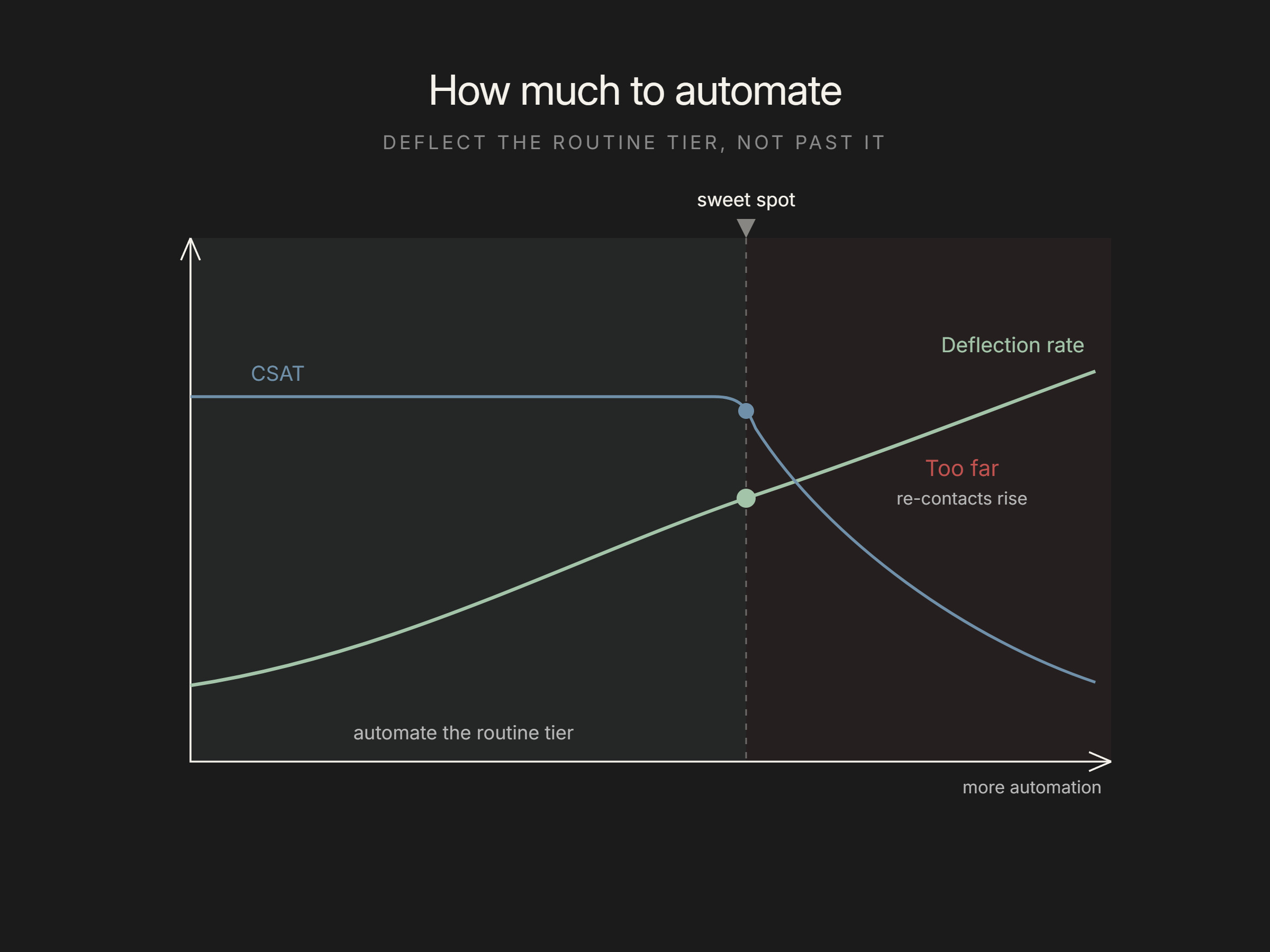
The right amount of automation is set by intent, not by a target percentage. Chasing a deflection number in the abstract pushes teams to divert calls that should reach a human, which lifts the metric while hurting satisfaction and generating re-contacts. Start from the intent map: automate the routine, rule-based tier fully, and leave the complex tier with people.
According to Gartner data reported alongside self-service research, self-service resolution success varies widely by how well the channel is built, so poorly designed automation can resolve very little while frustrating callers. That is the argument for scoping automation to intents an agent can actually own end to end, with a clean handoff to a human the moment the request falls outside that scope. Measure the adjusted deflection rate (net of 48-hour re-contacts) and CSAT together. If deflection rises while satisfaction holds, you have automated the right tier. If satisfaction drops, you have automated too far.
How Flexbone helps you deflect the right calls
Flexbone builds AI agents (voice, browser, document, and desktop) that own specific intents end to end in secure, regulated environments, which is the safe way to deflect. Rather than a blanket automation target, we audit your call data first and map which intents an AI agent can fully resolve (status, eligibility, confirmations, intake) and which should route straight to a person. Across BPO, insurance, healthcare, and public-sector operations, that means the routine tier gets answered instantly while your agents keep the calls that need judgment and empathy, with a clean handoff between them. The result is a higher deflection rate that does not come at the cost of re-contacts or CSAT. To map which of your intents an AI agent can own, start a pilot at flexbone.ai/contact.