Yes, AI can verify insurance eligibility, and it does the work on the channels a biller already uses. For many national payers it sends a 270 eligibility inquiry through a clearinghouse and reads the 271 response back in real time, parsing active or inactive coverage, plan, copay, deductible, and prior-authorization flags into structured fields. For the payers that do not return usable benefits electronically, an AI agent logs into the payer portal, or works an IVR phone line, to read the same detail a person would. It writes the result back into the EHR, whether that is eClinicalWorks, Epic, or another system, and routes the ambiguous cases to a human. It operates under HIPAA safeguards on protected health information. What AI does not do is decide medical necessity or invent benefit detail a payer did not return.
Can AI verify insurance eligibility?
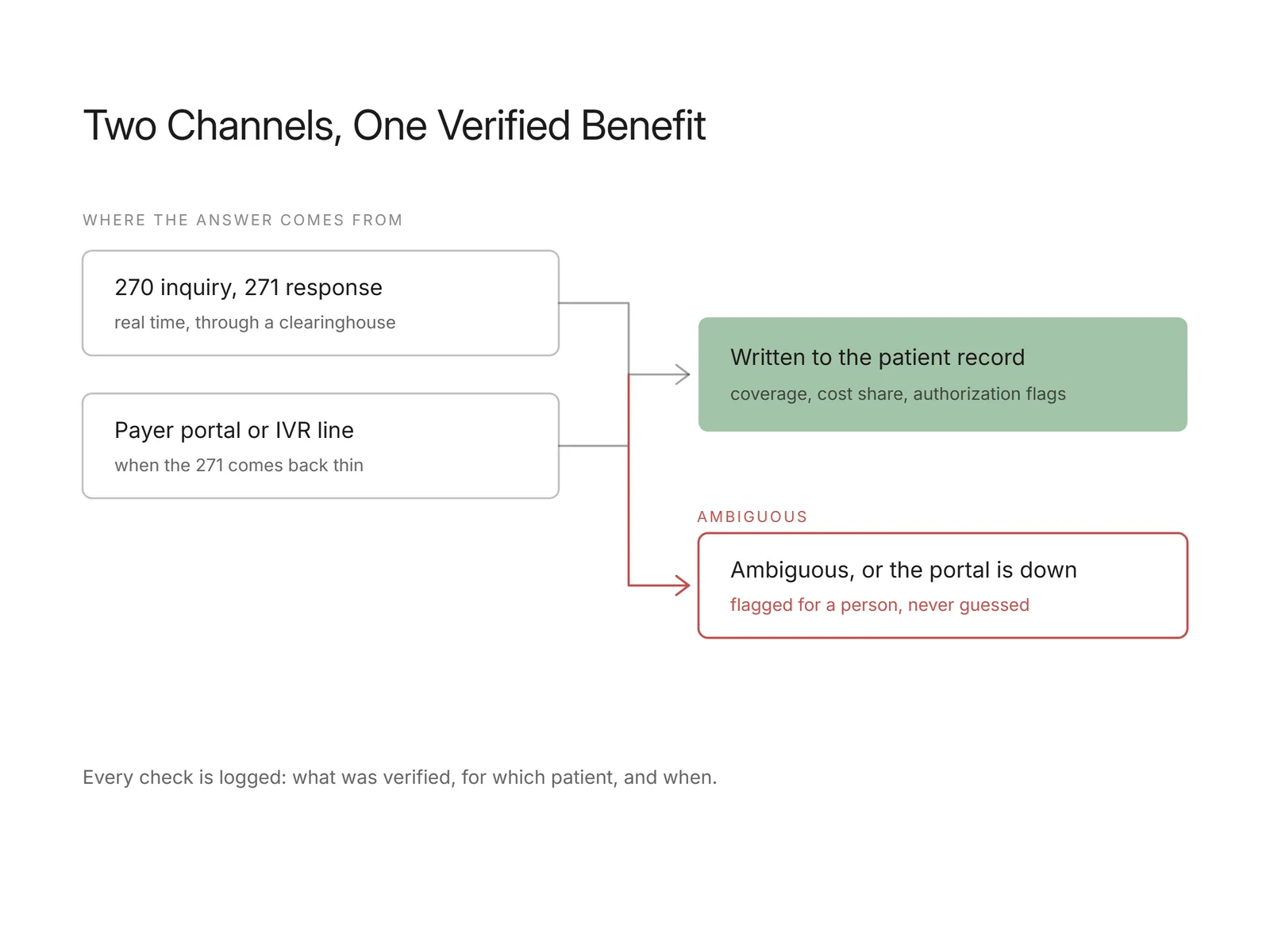
Yes. AI verifies insurance eligibility by confirming a patient's active coverage and benefits before the visit, across the same two channels a biller uses: standardized EDI and payer portals. On the EDI side it sends a 270 inquiry and reads the 271 response, capturing coverage status, plan, cost share, and authorization flags into structured fields. For payers that return a thin or unusable 271, it operates the payer's web portal or an IVR phone line to read visit limits, service-specific copays, and authorization rules directly. The value is not that a machine can read one benefit page; it is that the same check runs against the patients on tomorrow's schedule and surfaces only the cases a person needs to look at. This upstream check is the first line of defense against denials, which is why we cover it in depth on our insurance eligibility verification page.
Want this mapped against your own call and claim volume? Book a 30-minute audit
How does AI run a 270/271 eligibility check?
AI runs a 270/271 check by sending a standardized electronic inquiry and parsing the standardized response. The 270 is the Health Care Eligibility Benefit Inquiry, carrying the patient, plan, and service in question; the 271 is the payer's answer, carrying coverage status and benefit detail. These are X12 EDI transactions, usually routed through a clearinghouse, and they exist as an adopted HIPAA standard transaction as defined by CMS. Because the format is standardized, an AI system can send thousands of 270s at once and read each 271 into the same structured fields: active or inactive, plan, copay, deductible, and prior-authorization flags. The AI's real job is the reconciliation and triage on top of that, deciding which responses are complete enough to trust and which need a portal check or a human, so the standardized transaction becomes a reliable answer on the record.
The honest version of the answer is that AI verifies eligibility well where the work is mechanical and poorly where it is not. Flexbone separates the two before building: the transaction, the portal lookup, and the write-back go to agents, while a plan document that has to be interpreted goes to a person. That split is derived from the practice's own transcripts.
See what AI can run at your facility. In a 30-minute audit we map the calls, eligibility, and follow-ups Flexbone can take off your team first.
Book an auditCan AI verify eligibility inside eClinicalWorks?
Yes, AI can verify eligibility inside eClinicalWorks, and the point of doing it there is that the answer lands where staff already work. An AI agent reads the day's appointment list from eClinicalWorks, runs the eligibility check for each patient, and writes coverage status, patient responsibility, and any authorization flags back onto the eCW patient record. It can work through the EHR's own eligibility feature for payers that support clean EDI, and through a browser agent that drives the payer portal for the ones that do not, then reconcile both into one entry. The front desk sees a verified benefit on the schedule instead of a separate report to chase, and billing has the plan and copay already on file. Our AI for eClinicalWorks page covers how agents run inside eCW workflows in more detail.
Can AI verify eligibility inside Epic?
Yes, AI can verify eligibility inside Epic. An agent pulls the appointment or referral list, runs the 270/271 transaction for payers that support it, and works the payer portal for the plans that return thin responses, then posts coverage, cost share, and authorization detail back to the Epic registration and referral records. It operates within the practice's existing Epic access and permissions rather than a side system, so the verified benefit shows up in the workflow the registration team already uses. Every check the agent runs is logged, which means a person can review exactly what was verified, for which patient, and when, and can spot-check the automated results. Our AI for Epic page describes how browser and voice agents operate inside Epic across eligibility, prior authorization, and follow-up.
What can AI not do in eligibility verification?
AI cannot invent benefit detail that a payer did not return, and it should not pretend to. When a 271 comes back genuinely ambiguous, a member ID is wrong, or a portal is down, the correct behavior is to flag the case for a person, not to guess a copay or an authorization requirement. AI also does not decide medical necessity or override a payer's clinical criteria; eligibility verification is about confirming what coverage exists, not about making a coverage determination. Because the work touches protected health information, it operates under HIPAA safeguards on access, logging, and handling, so the automation stays controlled and auditable rather than a black box. The honest framing is that AI removes the repetitive checking and the queue time, and a person keeps judgment over the exceptions and the edge cases. If you want to see how that split works against your own payer mix, book a call with Flexbone.