
Cardiology billing is complex because a single practice runs several billing patterns at once. A patient encounter can pair an evaluation and management office visit with a diagnostic test, and later a procedure, each carrying its own coding and documentation rules. The diagnostic side spans echocardiography, stress testing, nuclear imaging, and Holter and event monitoring, and many of those studies split into a professional component for the physician's interpretation and a technical component for performing the test. Advanced imaging such as cardiac CT, cardiac MRI, and nuclear stress testing usually requires prior authorization, often through a benefit manager. Cardiology billing goes wrong most often at three points: authorization that does not match the claim, weak medical necessity documentation, and errors in splitting the professional and technical components. This guide explains what makes cardiology billing distinct, how the component split works, why imaging claims deny, and how practices prevent it.
What makes cardiology billing complex?
Cardiology billing is complex because one specialty carries the billing weight of several. A cardiology practice bills routine office visits, a wide range of diagnostic tests, and interventional and device procedures, and each follows a different set of rules. On the diagnostic side alone, the mix includes echocardiography, exercise and pharmacologic stress testing, nuclear imaging, cardiac CT and cardiac MRI, and ambulatory monitoring such as Holter and event monitors. On the procedural side, the range runs from cardiac catheterization to device implants. Advanced imaging typically requires prior authorization, and the diagnostic tests introduce the professional and technical component split described below. A claim can therefore go wrong at the visit, the test, or the procedure, and the fix differs in each case. Coding accuracy, medical necessity documentation, and authorization tracking all have to hold together for a claim to pay cleanly.
Want this mapped against your own call and claim volume? Book a 30-minute audit
What is professional versus technical component billing?
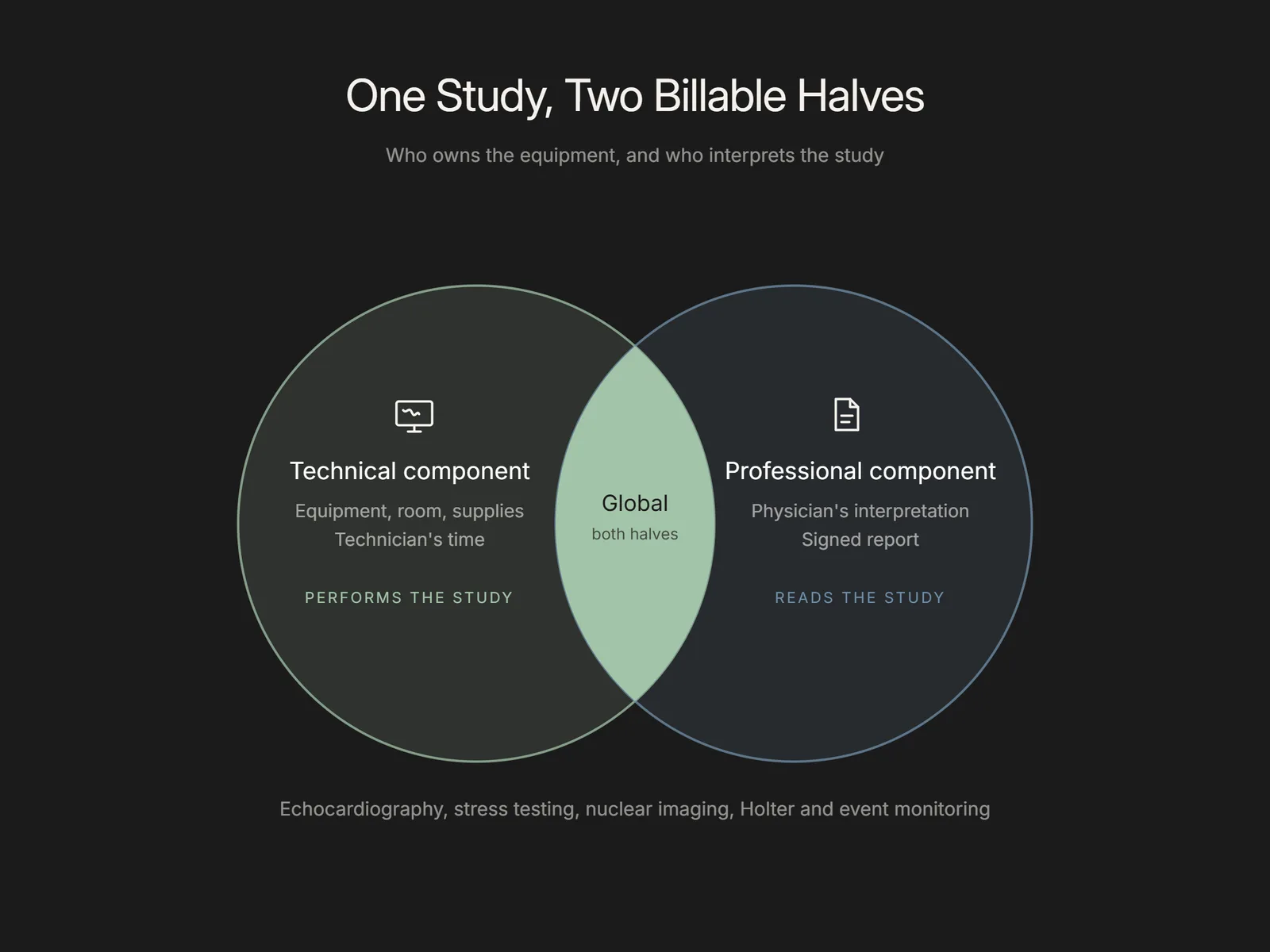
Many diagnostic tests in cardiology have two distinct parts that can be billed separately, and understanding the split is central to getting paid correctly. The technical component covers everything needed to perform the study: the equipment, the supplies, the room, and the technician's time. The professional component covers the physician's work interpreting the images or tracings and producing a signed report. When one organization owns the equipment and performs the test, and a separate physician reads and interprets it, each party bills only its own component. When the same practice both performs and interprets a study in its own office, it bills the test globally, meaning both components together as a single service. A common error is submitting a global charge when the practice is entitled to only one component, or the reverse, which produces a denial or an overpayment to correct later. An echocardiogram or a nuclear stress test are typical cases where the split has to be assigned based on who owns the equipment and who interprets the study.
See what AI can run at your facility. In a 30-minute audit we map the calls, eligibility, and follow-ups Flexbone can take off your team first.
Book an auditWhy do cardiology imaging claims get denied?
Cardiology imaging claims deny for a small set of recurring reasons, and each one traces back to something that could have been caught before the claim went out. The first is authorization: advanced studies such as cardiac CT, cardiac MRI, and nuclear stress testing are frequently reviewed by a benefit manager, and a claim that does not match the approved authorization, whether the study, the ordering provider, or the date of service, will deny. The second is medical necessity: if the diagnosis code does not support the reason the study was ordered under the plan's coverage criteria, the payer rejects it. The third is the professional and technical component split, where billing the wrong component produces a denial. Denials are common across the industry generally, not only in cardiology; an analysis of HealthCare.gov plans found that insurers denied 20% of in-network claims in 2023, and patients appealed fewer than 1% of those denials, per KFF's review of ACA marketplace denials. To tell which reason caused a specific denial, read the claim adjustment reason code and remittance advice remark code on the electronic remittance, the 835, rather than guessing.
How does prior authorization work for cardiac imaging?
For many advanced cardiac imaging studies, the health plan does not review the request itself. It delegates the review to a radiology or specialty benefit manager, and two administrators cardiology practices encounter most often are eviCore and Carelon. The practice submits the clinical picture, the ordered study, and the ordering and rendering providers, and the benefit manager checks that information against the plan's medical necessity criteria before issuing an approval or a denial. The standardized electronic version of this request and response is the 278 transaction, the health care services review used for prior authorization. An approval is not open-ended: it is tied to a specific study, provider, and window of time. That is why the claim later has to match the authorization exactly, because a study that drifts from what was approved, or is performed outside the authorized window, will deny even though an approval exists. Prior authorization is a heavy administrative load in its own right; the AMA reports that physicians complete about 39 prior authorizations per physician per week, spending roughly 13 hours on them, per its survey on prior authorization burden. For a deeper walkthrough, see cardiovascular prior authorization. For how eligibility, authorization, and denial follow-up run together in a cardiology practice, see AI for cardiology practices.
How do you reduce cardiology denials?
Reducing cardiology denials is mostly front-end work, done before the study is performed and the claim is filed. Start by verifying coverage and benefits with an electronic eligibility check, the 270/271 eligibility inquiry and response, so you know the plan is active and what it covers for the date of service. Next, secure imaging authorization through the correct benefit manager using the 278 transaction, and confirm the ordered study matches what was approved, since a mismatch is a frequent denial cause. Assign the professional and technical components based on who owns the equipment and who interprets the study, so the practice bills only what it is entitled to. When a claim still denies, read the claim adjustment reason code and remark code on the 835 remittance to identify the cause, then correct the pattern rather than reworking one claim at a time. Cardiology practices generally track authorizations, orders, and results across an electronic health record and a practice management system, so these checks and denial reads have to reach into those systems to be useful. The front-end steps are covered in insurance eligibility verification, and working the denials that do occur is covered in AI denials management.
To map exactly what AI can take off your cardiology billing, from eligibility checks and imaging authorizations to reading denials on the remittance, book a call with Flexbone and we will start by reviewing a sample of your current denials to see where claims are breaking down.