
Prior authorization in cardiology is a payer requirement that a cardiologist justify certain services before the health plan will cover them. It applies most often to advanced cardiac imaging, including CT angiography, cardiac MRI, and nuclear stress tests such as SPECT myocardial perfusion imaging. Some echocardiograms, elective percutaneous coronary intervention (PCI), and certain implantable devices are also reviewed by many payers. Requirements vary by payer and by the patient's specific plan, so the same study can need review under one plan and not another. The workflow runs in a set order: the office confirms a service needs review, gathers the diagnosis and prior workup, submits the request to the plan or the benefit manager it contracts with, and receives an authorization number, a denial with a reason and an appeal path, or a request for more information. An approval lets scheduling and billing proceed.
What cardiology procedures need prior authorization?
The services most commonly reviewed in cardiology are advanced imaging studies, because they are costly and can sometimes be replaced by a lower-cost test or a period of conservative management. Coronary CT angiography, cardiac MRI, and nuclear stress testing such as SPECT myocardial perfusion imaging are frequent examples. Certain echocardiograms, particularly stress or transesophageal studies, are reviewed by some plans, while a routine resting echocardiogram often is not. On the procedural side, elective PCI and certain implantable devices such as pacemakers or defibrillators are reviewed by many payers, though urgent and emergent cases follow different rules. Whether any specific service needs review depends on the plan, the ordering diagnosis, and the site of service. Prior authorization is a leading source of administrative work across specialties: the American Medical Association reports that practices complete about 39 prior authorizations per physician per week, roughly 13 hours of staff time. The reliable first step for any order is to check the plan's medical policy.
Want this mapped against your own call and claim volume? Book a 30-minute audit
Which payers and benefit managers administer cardiology authorizations?
Cardiology authorizations are often reviewed by a third party rather than the health plan directly. Many commercial and Medicare Advantage plans route advanced cardiac imaging to a radiology benefit manager, or RBM, that reviews the request against its own clinical criteria. Companies such as eviCore and Carelon (formerly AIM) often administer these advanced imaging authorizations on a plan's behalf. The office submits the study code, diagnosis, and prior workup through the RBM's portal or phone line, and the RBM approves the study, denies it, or asks for more clinical detail. Because the RBM sits between the practice and the plan, the office often has to learn a separate portal and criteria set for each one its patients' plans use. Device and procedural authorizations, by contrast, are more often handled by the plan's own utilization management team, so knowing which entity reviews which service, and where to submit, removes a common source of delay.
See what AI can run at your facility. In a 30-minute audit we map the calls, eligibility, and follow-ups Flexbone can take off your team first.
Book an auditWhy do cardiology prior authorizations get denied?
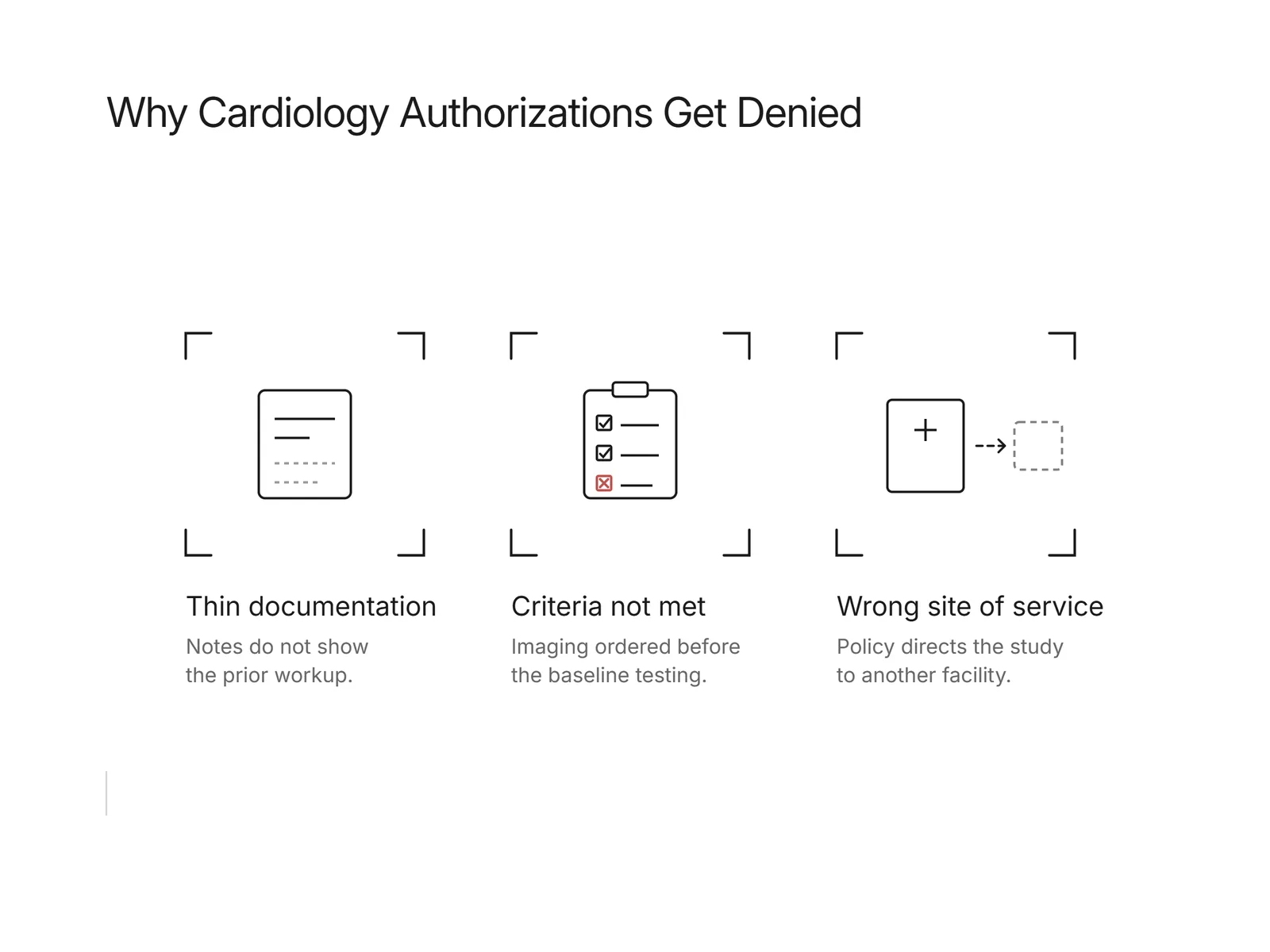
Denials tend to cluster around three causes. The first is missing or thin clinical documentation: the request does not show the symptoms, exam findings, or prior testing the payer's policy expects, so the reviewer cannot confirm the study is warranted. The second is medical-necessity criteria not met, where the documented picture does not match the criteria for that study, for example ordering advanced imaging before the conservative treatment or baseline testing the policy requires. The third is a wrong site of service, such as requesting a study in a hospital outpatient department when the plan's policy directs it to a freestanding facility. Preventing these means checking the plan's or RBM's criteria before submitting and attaching the relevant notes on the first pass. When a denial does arrive, the reason code tells the office whether to resubmit with more detail or move to a peer-to-peer review. Tracking those reasons is covered in our guide to AI denials management.
How long does a cardiology prior authorization take?
Timelines depend on the plan and on whether the request is standard or expedited, and most payers publish these deadlines in their provider manuals. A request that needs additional clinical records generally takes longer, because the review clock often does not start until the documentation arrives, which is one more reason to submit complete clinical detail on the first pass. The submission channel matters too: many payers support the electronic 278 prior authorization transaction, a standardized request-and-response format that can be faster and more traceable than a phone call or a fax. Confirming eligibility up front also prevents wasted cycles, since a service authorized under the wrong coverage still will not pay. That check runs on the standard 270/271 transaction health plans support under HIPAA Administrative Simplification, per CMS, covered in our overview of insurance eligibility verification.
How can a cardiology practice reduce prior authorization delays?
Start by identifying the services to check first. Advanced cardiac imaging is the highest-volume review category in most cardiology practices, so building a short pre-check into scheduling for CT angiography, cardiac MRI, and nuclear stress tests catches the majority of authorizations before they hold up a patient. For each, confirm against the plan's policy that the documentation supports medical necessity, the criteria for that specific study are met, and the site of service matches. When a peer-to-peer review is needed, scheduling it quickly is often faster than a written appeal. Finally, track each denial reason so recurring gaps, a particular study, a particular payer, a missing note, become visible and fixable at the source. Software that automates the status checks and documentation handoffs is covered in our guide to prior authorization automation. For how authorization fits alongside scheduling and denial work in a cardiology practice, see AI for cardiology practices.
How does Flexbone help with cardiology prior authorization?
Flexbone runs voice and browser agents, backed by US-based staff through our Nav Central partnership, that carry the repetitive parts of the cardiology prior authorization process. An agent can submit an advanced imaging authorization through an RBM portal such as eviCore or Carelon, file it through the electronic 278 transaction where a payer supports that, hold on the plan's phone queue to check or expedite a pending request, and write the authorization number and status back to the EHR. Each call and submission is logged, so a person can review what the agent did and why. We do not decide medical necessity or override a payer's clinical criteria; the agents gather and move information, and clinical judgment stays with the practice. Anything they cannot resolve, an ambiguous payer response or a denial that needs an appeal, escalates to US-based staff. If you want to map which parts of your cardiology prior authorization workload AI can take off your team, book a call with Flexbone and we will walk through it against your actual order and denial mix.