Cigna prior authorization is a coverage-review step in which the plan decides whether it will pay for a service, procedure, or drug before it is delivered. A provider submits clinical information, and Cigna or a delegated administrator reviews it against coverage policy to confirm medical necessity for coverage purposes. Categories that commonly require review include advanced imaging such as MRI and CT, specialty and injectable drugs, some outpatient procedures and surgeries, durable medical equipment, and certain diagnostic tests. Requirements vary by plan and change over time, so a service that needs authorization under one plan may not under another. Cigna uses eviCore, an Evernorth company, to administer many prior authorizations for imaging and certain specialty services, which means some requests are reviewed by eviCore rather than by Cigna directly. This guide explains what requires authorization, how to submit it, and why requests get denied.
What requires Cigna prior authorization?
Prior authorization applies to services and drugs where the plan wants to confirm medical necessity before it commits to coverage. The categories that most often fall under review are advanced imaging such as MRI, CT, and PET; specialty and injectable drugs, including many biologics; some outpatient procedures and scheduled surgeries; durable medical equipment; and certain diagnostic tests. Emergency care is generally not subject to prior authorization. The important point is that the specific list is tied to the member's plan and benefit design, and Cigna updates its coverage policies over time. A code that required authorization last year may not this year, and the reverse is also true. Because of that, the reliable practice is to check each service against the member's current plan before scheduling, rather than relying on a static list.
Want this mapped against your own call and claim volume? Book a 30-minute audit
How do you submit a Cigna prior authorization?
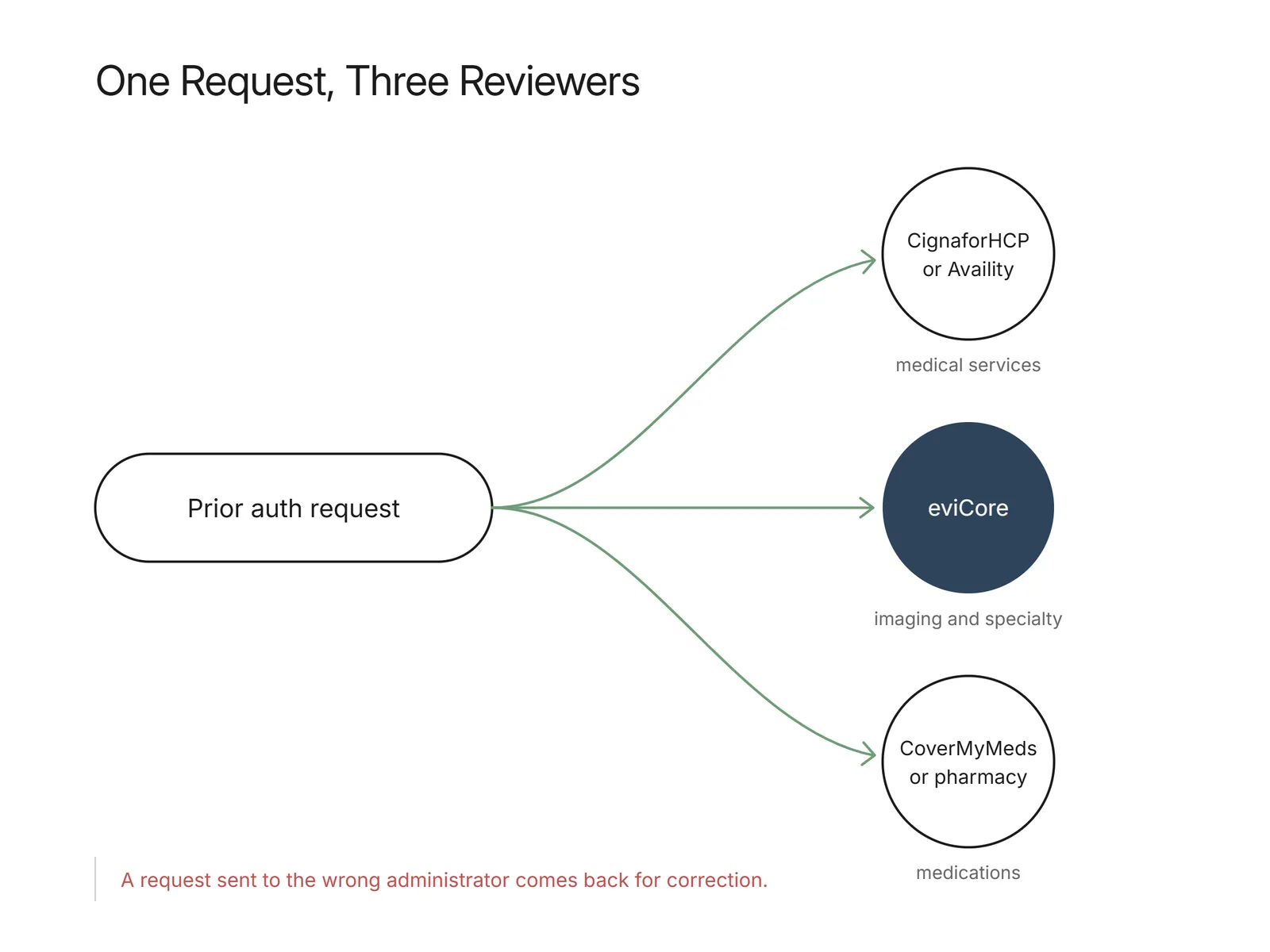
Cigna accepts prior authorization requests through several paths, and the right one depends on the service and the plan. Many providers submit medical prior authorizations through the CignaforHCP provider portal or through Availity, both of which support electronic submission and status tracking. When a service falls under an eviCore-managed program, the request typically routes through eviCore instead. Medication prior authorizations often run through CoverMyMeds or the pharmacy benefit path rather than the medical portal. Whatever the channel, the submission generally needs the member and provider identifiers, the specific procedure or drug codes, the diagnosis, and the clinical documentation that supports medical necessity. Verifying the correct route and the required fields before you assemble the packet reduces back-and-forth, because a request sent to the wrong administrator or missing a required detail usually comes back for correction.
What is eviCore and how does it relate to Cigna?
eviCore is an Evernorth company that Cigna uses to administer prior authorization for many imaging services and certain specialty categories. When a requested service is part of an eviCore-managed program, the clinical review is handled by eviCore rather than by Cigna's own review team, and the request is commonly submitted through the eviCore portal. This is a common industry pattern: payers delegate specific high-volume or specialized review categories to a third-party benefit manager while retaining others in-house. For providers, the practical consequence is that the same member can have some services reviewed by Cigna directly and others by eviCore, depending on the service type and the plan. Confirming which administrator owns a given request before submitting avoids a misrouted authorization, since sending an eviCore-managed request through the general Cigna channel can delay the decision.
See what AI can run at your facility. In a 30-minute audit we map the calls, eligibility, and follow-ups Flexbone can take off your team first.
Book an auditHow long does Cigna prior authorization take?
Turnaround time depends on the type of request, whether it is standard or expedited, and the state and federal rules that apply to the member's plan. Standard reviews generally take longer than urgent or expedited ones, which are reserved for situations where a delay could harm the patient. Incomplete submissions extend the timeline, because the reviewer has to pause and request the missing records before a decision can be made. Because the exact deadlines vary by plan and by state, and Cigna publishes its own policies, the dependable approach is to check the plan's stated turnaround for the specific service and any applicable regulatory deadline rather than assuming a single number. Building in lead time before a scheduled procedure, and submitting a complete packet the first time, most reduce delay-related rescheduling.
Why do Cigna prior authorizations get denied?
Denials tend to fall into two groups: administrative and clinical. Administrative denials come from missing or mismatched information, such as an incorrect code, a missing document, an expired eligibility, or a request sent to the wrong administrator. These are often correctable on resubmission or appeal once the gap is fixed. Clinical denials happen when the submitted documentation does not, in the reviewer's judgment, meet the plan's medical-necessity criteria for the service. When that occurs, the provider can submit additional clinical evidence, request a peer-to-peer review, or file a formal appeal following the plan's process. Verifying eligibility and benefits before submission removes a common source of avoidable administrative denials; the CMS eligibility inquiry and response (270/271) transaction standard exists so plans and providers can confirm coverage electronically before care is delivered. A clean insurance eligibility verification step and disciplined AI denials management together catch many issues before they become a denied claim.
How Flexbone helps with Cigna prior authorization
The slow part of a Cigna prior authorization is rarely the clinical decision. It is the surrounding work: confirming whether the service needs authorization under the member's plan, routing the request to the correct administrator, assembling the clinical documentation, and following up through portals and hold queues until a decision lands. That burden is well documented. The American Medical Association reports that practices complete about 39 prior authorizations per physician per week, taking roughly 13 hours of physician and staff time, in its summary on fixing prior authorization. Flexbone deploys AI voice and browser agents that carry out that legwork: they check requirements, gather the supporting records a practice already has, and submit requests through the channels a plan uses, including provider portals and delegated administrators. The agents are built to be audit-first, so every action is logged and reviewable, and a person confirms the clinical facts before anything goes to a payer. Flexbone operates under HIPAA and is aligned with SOC 2 controls. This work fits into a broader prior authorization automation approach that also covers eligibility and denials.
If you want to see what AI can take off your Cigna prior authorization workload, book a call with Flexbone and we will map the specific steps in your workflow that agents can handle and the ones your team should keep.