A clean claim rate is the percentage of claims that pass payer adjudication on the first submission, without edits, rejections, or denials. It is a leading indicator of revenue-cycle health because a low rate signals rework and delayed cash: every claim that comes back has to be researched, corrected, and resubmitted before it pays, which ties up staff time and pushes revenue further out. A clean claim is one that reaches the payer complete and accurate, with correct patient and insurance data, valid codes, and any required authorization already in place. Tracking the rate tells you how well the front end of the revenue cycle is working, because most of what makes a claim clean is decided before the claim is ever sent.
What is a clean claim rate?
A clean claim rate is the share of claims that pass on first submission and require no manual correction to be accepted for adjudication. A clean claim carries accurate patient demographics, active insurance coverage, correct procedure and diagnosis codes, and any prior authorization the service required. When any piece is wrong, the claim is rejected or denied and has to be reworked. The rate matters because it sits upstream of nearly every other revenue metric: days in accounts receivable, cost to collect, and denial volume all move with it, so a rising rate usually means the front end is catching errors earlier rather than paying to fix them later.
Want this mapped against your own call and claim volume? Book a 30-minute audit
How do you calculate clean claim rate?
In plain language, the clean claim rate is the number of claims accepted on first submission divided by the total number of claims submitted in the same period, expressed as a percentage. Count the claims that passed without any edit or rejection, divide by all claims submitted, and multiply by 100. If a practice submits 2,000 claims and 1,880 clear on the first attempt, the clean claim rate is 94 percent.
The one thing to fix before you trust the number is the definition of clean. Some teams count a claim as clean only if it pays on first pass, while others count it if the clearinghouse accepts it, even though the payer may deny it later. Both are valid, but they measure different points in the process, so pick one definition and apply it consistently.
What is a good clean claim rate?
Many revenue cycle teams aim for a first-pass rate around 95 percent or higher, and it is fair to treat that as a common target rather than a universal fact. What is achievable depends on the payer mix, the specialty, the complexity of the services billed, and how much verification happens on the front end before a claim goes out.
The benchmark is less useful than the trend. A rate that climbs quarter over quarter shows the front-end process is improving, while a rate that slips flags a new problem, such as a payer policy change or a registration workflow capturing bad data. Measuring against your own baseline is more actionable than measuring against an industry number that may not match your case mix.
See what AI can run at your facility. In a 30-minute audit we map the calls, eligibility, and follow-ups Flexbone can take off your team first.
Book an auditWhat causes claims to not be clean?
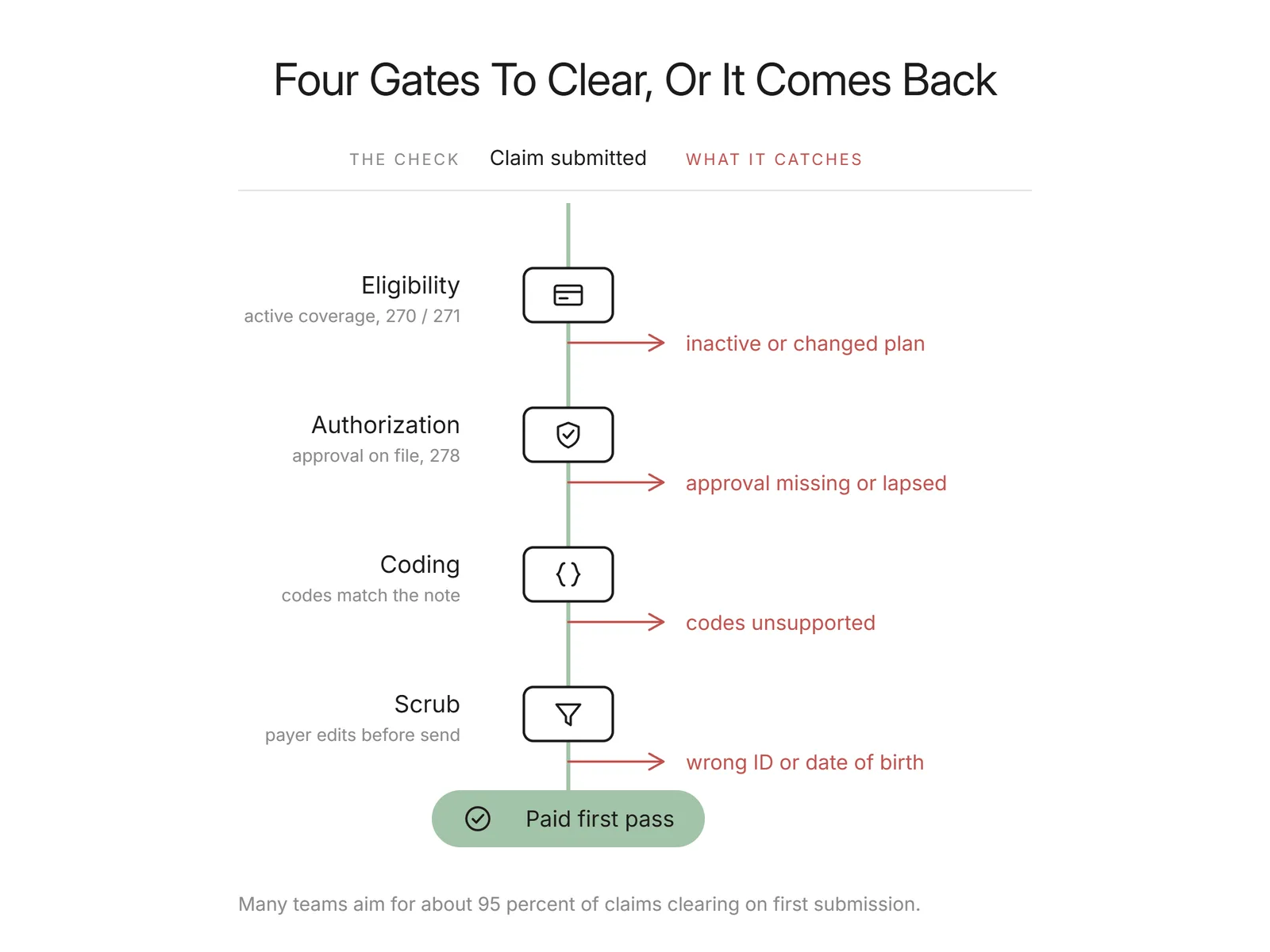
Claims fail to be clean when something upstream of submission is missing or wrong, and most of those causes trace back to the front end of the revenue cycle. The common ones include:
- Eligibility and coverage errors. The patient's plan was inactive, changed, or entered incorrectly at registration, so the payer rejects the claim.
- Missing or expired prior authorization. The service required approval that was never obtained or had lapsed by the date of service.
- Coding problems. Procedure and diagnosis codes are mismatched, unsupported by documentation, or do not meet the payer's specific rules.
- Demographic and data-entry mistakes. A wrong subscriber ID, date of birth, or name mismatch is enough to stop a claim.
These errors are expensive because they are usually invisible until the claim is denied, often weeks after the service was delivered. In HealthCare.gov marketplace plans, insurers denied 20% of in-network claims in 2023, and consumers appealed fewer than 1% of those denials, according to KFF. A claim that was never clean to begin with is more likely to land in that denied bucket.
How do you improve clean claim rate?
Improving a clean claim rate means fixing errors before submission rather than reworking claims after a denial, and the highest-value levers are all on the front end. Four steps carry most of the weight:
- Verify eligibility and benefits. Confirm active coverage before the visit using the electronic eligibility (270/271) transaction, which CMS adopted under Administrative Simplification so providers and payers can exchange coverage data in a standard format, per CMS. This catches inactive and changed plans while there is time to correct them.
- Confirm prior authorization. Check whether the service needs approval, obtain it through the prior authorization (278) transaction, and record the authorization number before the claim is built.
- Improve coding accuracy. Make sure procedure and diagnosis codes match the documentation and the payer's rules, so the claim is not denied for a coding reason it could have avoided.
- Scrub claims before submission. Run each claim through edits that check for missing fields, invalid codes, and payer-specific requirements, and hold anything that fails until it is corrected.
Each of these is repetitive, rules-based work, which is exactly where automation fits. AI agents can run eligibility checks, verify authorization status, and scrub claims against payer rules at volume, flagging a missing plan or an absent authorization before the claim is sent rather than after it comes back. Handling these tasks up front prevents denials instead of paying to fix them, and it moves the clean claim rate in the right direction because the claim is correct the first time.
How Flexbone helps raise the clean claim rate
Flexbone's AI voice and browser agents take on the front-end access work that decides whether a claim is clean, then write structured results back into the EHR the team already uses. For insurance eligibility verification, the agents run electronic checks where a data path exists and fall back to a payer portal or a phone call when it does not, so coverage is confirmed before submission. They handle prior authorization automation by checking requirements and following up on status, which keeps missing authorizations from turning into denials, and they reduce the manual chasing that sits behind AI denials management on the back end. Every action an agent takes is logged for review before a claim goes out. Flexbone is HIPAA compliant and SOC 2 aligned, and the agents gather, record, and hand off rather than decide coverage or payment on their own.
If you want to map what AI can do for your first-pass claim rate, book a call with Flexbone.