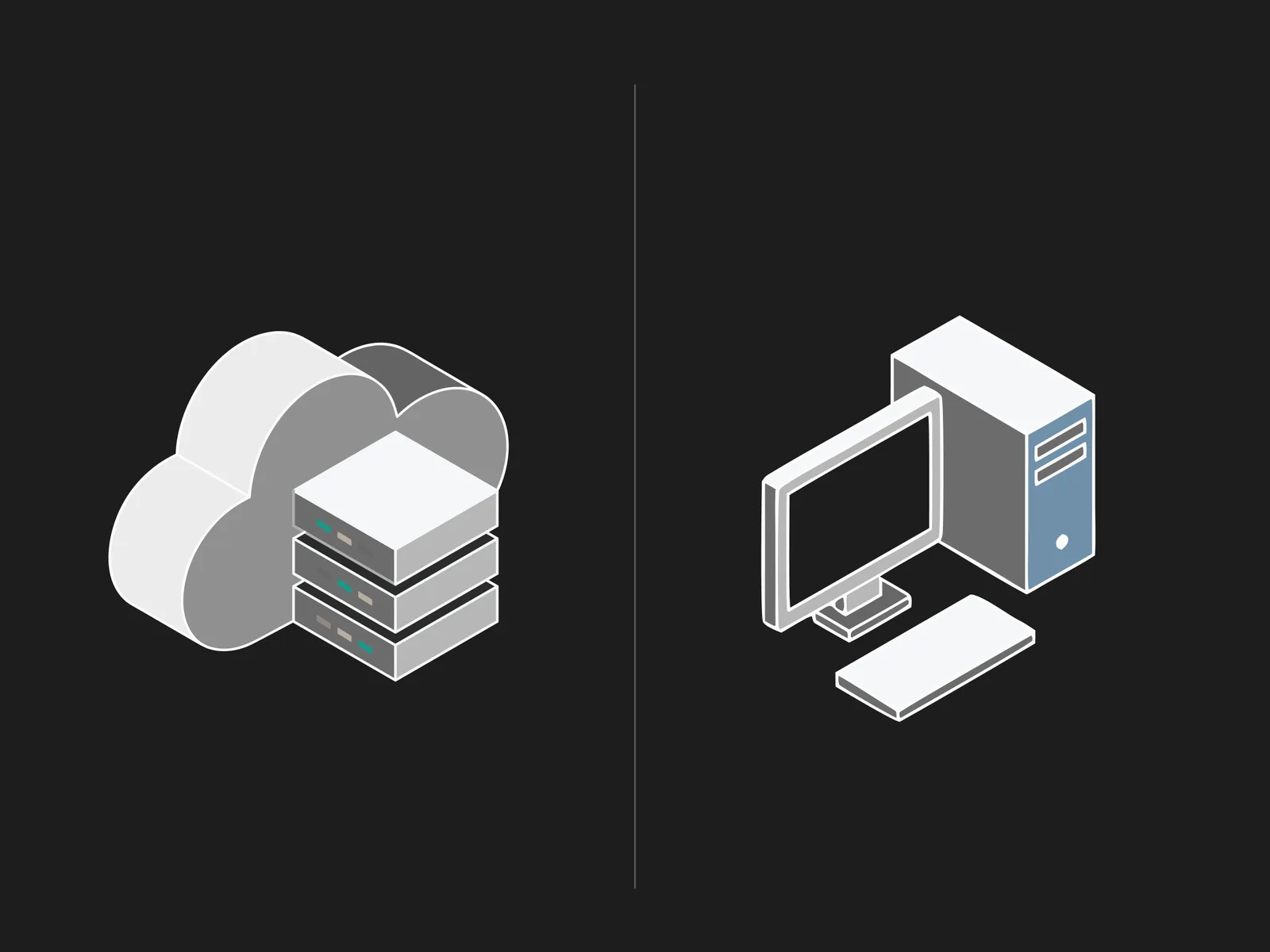
Cloud based call center software runs your contact center from a vendor's data centers and reaches your agents over the internet, while an on-premise call center runs on telephony hardware and servers you buy and maintain yourself. Cloud, usually sold as contact center as a service (CCaaS), fits teams that want to grow or shrink seats quickly, avoid large upfront hardware spend, and let a vendor handle updates and uptime. On-premise fits organizations with strict data-residency needs, stable and predictable volume, existing telephony staff, and a preference for direct control over every layer. Most healthcare contact centers now start in the cloud for the lower entry cost and faster changes, then weigh security and integration questions before committing. The sections below define each model, compare cost and scaling, and give a decision framework.
What is cloud vs on-premise contact center software?
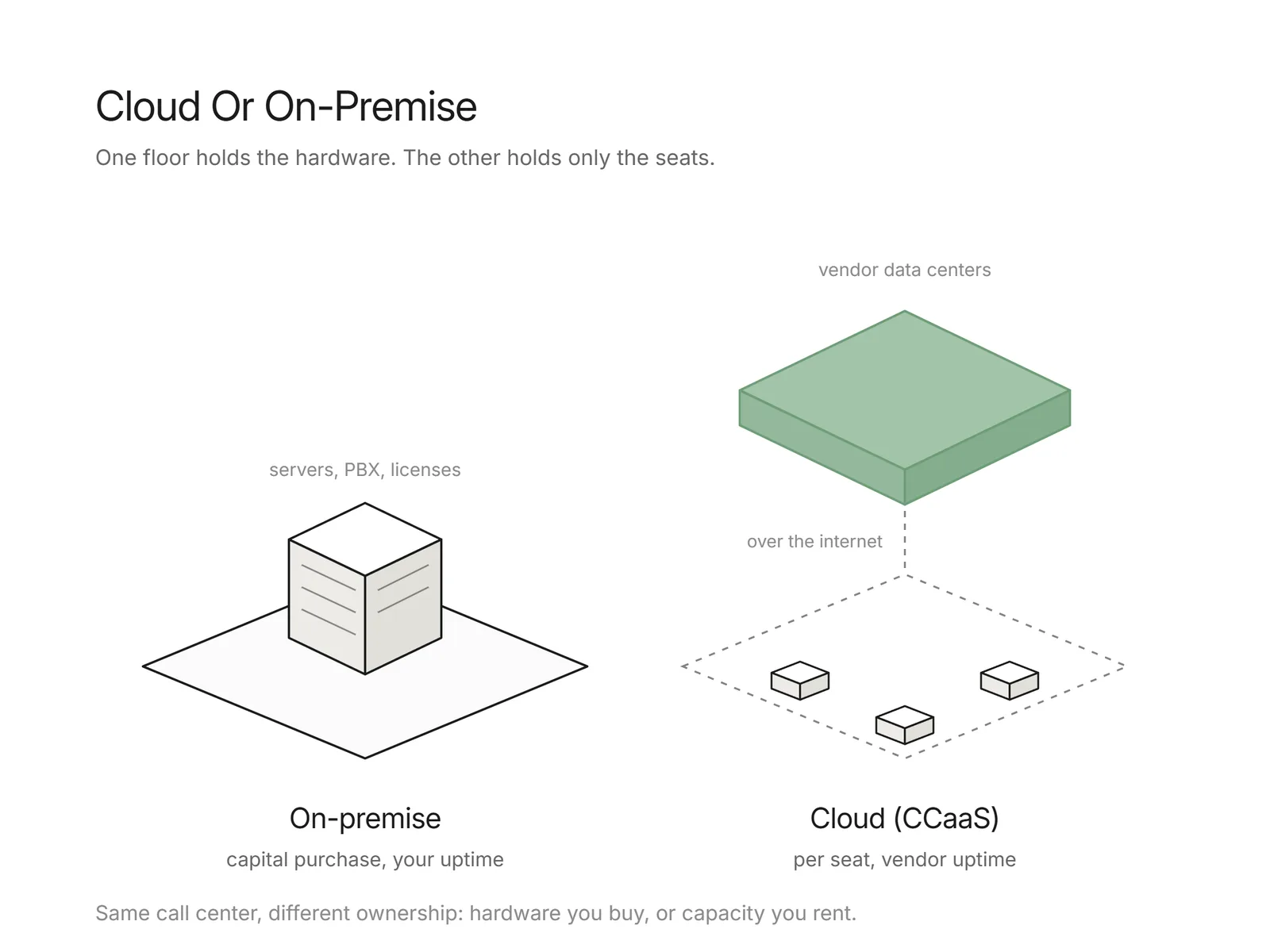
Cloud based call center software is delivered as a subscription: the vendor owns the servers, telephony, and call routing in their data centers, and your agents connect through a browser or app. It is commonly called CCaaS, and you pay per seat per month. An on-premise call center is the older model, where you buy the private branch exchange (PBX), servers, and software licenses, install them in your own facility, and run them with your own IT and telephony staff. The core split is ownership. In the cloud, you rent capacity and the vendor carries maintenance, patching, and scaling. On-premise, you own the assets and carry all of that work yourself. A third pattern, hybrid, keeps some systems local while moving others to the cloud, which is common when an organization migrates gradually.
Want this mapped against your own call and claim volume? Book a 30-minute audit
How do cost and scaling compare?
The cost structures are different in kind, not just amount. Cloud based call center software shifts spending from capital expense to operating expense: little upfront hardware, then a recurring per-seat fee that rises and falls with headcount. On-premise front-loads a large capital purchase (hardware, licenses, installation) and then carries ongoing maintenance, upgrades, and the staff to run it. Scaling is where the gap is clearest. Adding twenty seasonal agents in the cloud is a billing change you can make in a day; on-premise, the same surge can mean buying and provisioning hardware you only need for a few months. That flexibility is why cloud tends to win for teams with variable or growing volume. On-premise can still be cheaper per seat at very large, steady scale, where the hardware is already bought and fully used. The right comparison is total cost of ownership over several years, not the first invoice.
Either platform can host voice agents, since an agent connects through the telephony layer rather than replacing it. Flexbone deploys that way, so the choice between cloud and on-premise does not have to wait on an automation decision. See AI voice agents.
What are the security and HIPAA considerations?
For healthcare, security is where the choice gets scrutinized, and neither model is compliant by default. Any system that stores or transmits electronic protected health information must meet the HIPAA Security Rule, which requires administrative, physical, and technical safeguards to protect that data. With cloud based call center software, the vendor is a business associate: they must sign a business associate agreement and implement their share of those safeguards, but you still owe your own risk analysis and access controls. The American Medical Association notes that every covered entity must conduct a risk assessment sized to its own organization and document its safeguards. On-premise keeps the data inside your own walls, which some organizations prefer for control and data residency, but it also puts the full weight of encryption, patching, and physical security on your team. Cloud shifts part of that burden to a vendor whose security you must then verify.
See what AI can run at your facility. In a 30-minute audit we map the calls, eligibility, and follow-ups Flexbone can take off your team first.
Book an auditWhich is more reliable and has better uptime?
Both models can hit high availability, but the failure modes differ, so "more reliable" depends on what you can control. Cloud providers typically run redundant data centers across regions and publish uptime commitments in their service-level agreements, so your exposure is a provider-wide outage or a problem with your own internet connection. On-premise reliability rests entirely on your infrastructure: your servers, your power, your network, and whatever redundancy you have paid to build. That gives you direct control, which matters to some teams, but it also means you own every single point of failure. In practice, a small or mid-sized contact center rarely matches the redundancy a large cloud provider maintains as a core part of its business. A large enterprise with mature IT and its own backup sites can reach comparable uptime on-premise. The reliability question is really a question of whose engineering you would rather depend on.
How do you decide between cloud and on-premise?
Start from your constraints, not the technology. Weigh how fast your volume changes, how much upfront capital you can spend, whether you have telephony staff, and how strict your data-residency rules are. The table below maps the common trade-offs.
| Factor | Cloud (CCaaS) | On-premise |
|---|---|---|
| Upfront cost | Low, subscription based | High, capital purchase |
| Scaling speed | Fast, change seats on demand | Slow, tied to hardware |
| Maintenance | Vendor handles updates and uptime | Your team owns it |
| Data location | Vendor data centers, verify region | Inside your facility |
| Reliability | Provider redundancy, provider risk | Depends on your own setup |
| Best fit | Variable volume, limited IT staff | Stable volume, strict control needs |
As a rule of thumb, cloud based call center software suits teams that value flexibility, predictable operating costs, and offloading maintenance. On-premise suits organizations with stable volume, in-house telephony expertise, and requirements that keep data on their own hardware. Many healthcare organizations choose a hybrid path, keeping sensitive systems local while moving front-line contact handling to the cloud. For a deeper look at the healthcare-specific version of this decision, see our guides to the AI call center and healthcare call center software.
How Flexbone fits your contact center
Flexbone does not ask you to replace your phone system or CCaaS platform. Our AI voice agents are cloud deployed and layer onto the telephony you already run, joining specific call types rather than taking over the whole contact center. When a call comes in, the agent works inside your electronic health record (EHR) to resolve it, handling tasks like eligibility checks and scheduling and writing the result back where your staff expect to find it. We build audit-first, so the calls the agent handles are logged and reviewable before you widen its scope. On the security side, we operate as a HIPAA compliant business associate and align our controls with SOC 2. The aim is to automate the routine, high-volume calls that pull agents off complex work, while keeping a human path open for everything that needs judgment. Because the agents are cloud based, you can start with one call type and expand as the audit trail proves out.
Want to see how this works on your own call types? book a demo.