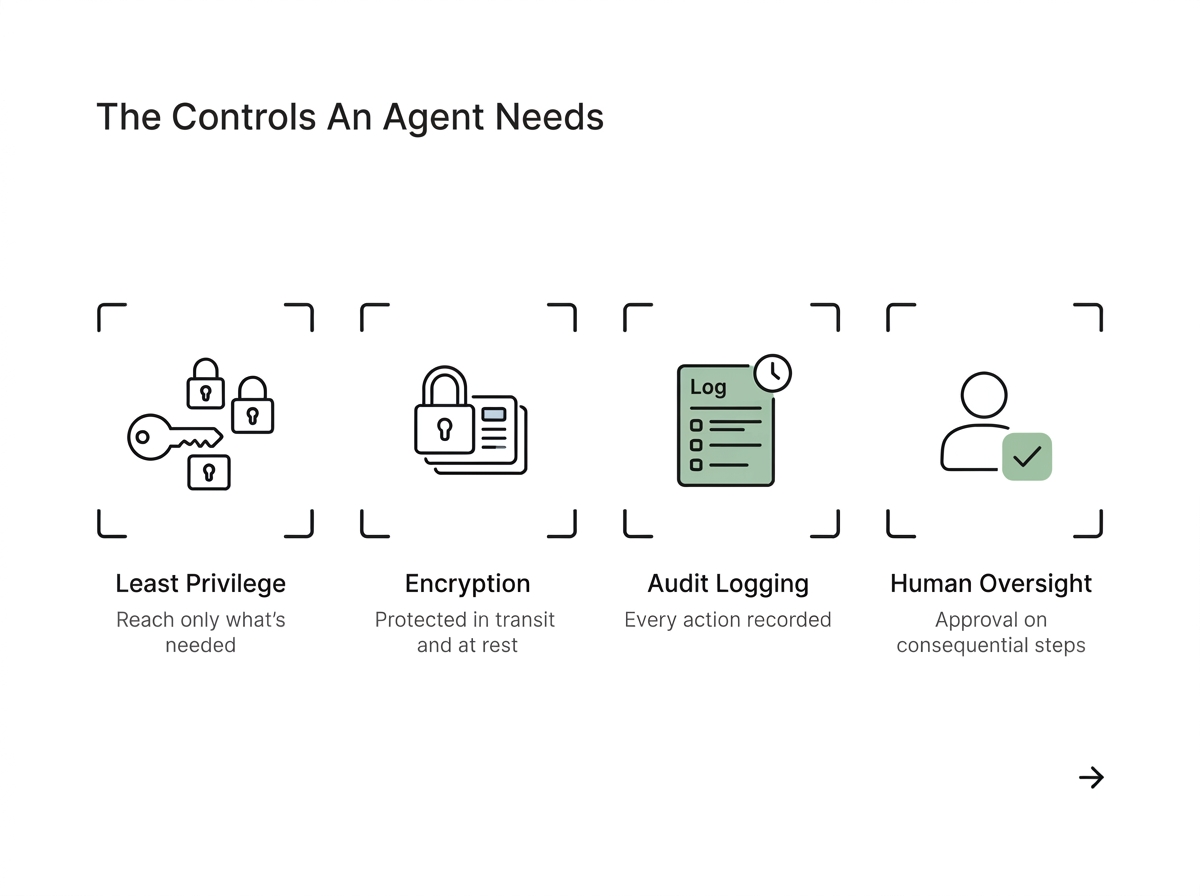
Deploying AI agents in regulated industries means putting the same controls around the agent that you would put around any system handling sensitive data: scoped access, encryption, audit logging, human oversight, and evidence you can show an auditor. A regulated environment is one where law or contract dictates how specific data is handled, such as health records under HIPAA. The added wrinkle with agents is that they act, not just read, so you have to govern their actions as well as their data access. The NIST AI Risk Management Framework gives a structure for this, organizing the work into Govern, Map, Measure, and Manage functions and defining trustworthy AI as secure, accountable, transparent, and privacy-enhanced. This guide covers what makes an environment regulated, the controls agents need, how to protect sensitive data, and how to prove compliance.
What makes an environment regulated?
An environment is regulated when a law, standard, or contract sets binding rules for how a defined category of data must be handled, stored, and disclosed. In US healthcare, the HIPAA Security Rule is the clearest example: it requires covered entities and their business associates to protect electronic protected health information through administrative, physical, and technical safeguards. The HHS summary of the Security Rule states that regulated entities must ensure the confidentiality, integrity, and availability of ePHI they create, receive, maintain, or transmit, and protect against reasonably anticipated threats. The consequence for an AI deployment is that "it works" is not the bar. The agent, its data flows, and its vendors all fall inside the compliance boundary, so anything touching that data has to meet the same standard as the rest of the covered system.
Want this mapped against your own call and claim volume? Book a 30-minute audit
What controls do AI agents need (HIPAA, SOC 2, audit logging)?
AI agents need access controls, unique user identity, encryption, audit controls, and change management, the same technical and organizational controls any regulated system carries. Under the HIPAA Security Rule, that includes audit controls that record and examine activity in systems containing ePHI, and access controls that let only authorized identities reach the data. On the organizational side, SOC 2 provides the framework buyers ask for. The AICPA's Trust Services Criteria define the Security criterion, required in every SOC 2 engagement, covering logical and physical access, system operations, change management, and monitoring. For an agent specifically, audit logging is the control that ties the others together: every read, action, and outbound message needs a timestamped, attributable record, because an agent that acts without a log is one you cannot investigate after the fact.
Flexbone publishes its controls, including a signed BAA and encryption in transit and at rest, on its security page.
See what AI can run at your facility. In a 30-minute audit we map the calls, eligibility, and follow-ups Flexbone can take off your team first.
Book an auditHow do you keep PHI and sensitive data safe?
You keep sensitive data safe by minimizing what the agent can reach, encrypting it in transit and at rest, and putting a human in the loop on consequential actions. Least privilege is the anchor: the agent gets access only to the specific records a task requires, through a unique identity that its activity can be traced to. The HHS Security Rule guidance lays out technical safeguards including access control, audit controls, integrity protections, and transmission security, and these map directly onto an agent deployment. Beyond the required safeguards, grounding the agent in the actual record instead of letting it improvise, and requiring approval before it sends anything externally, reduces the chance of an incorrect disclosure. The principle is to make the safe path the default: narrow permissions, encrypted data, logged actions, and escalation to a person whenever the agent is uncertain or the action is hard to reverse.
How do you prove compliance to a buyer or auditor?
You prove compliance with evidence: a SOC 2 report, documented policies, and audit logs that show the controls operated over time. A buyer's security team will typically ask for a SOC 2 Type II report, which describes controls and tests whether they worked across a period rather than at a single moment. The AICPA's Trust Services Criteria are what an independent auditor evaluates against to produce that report, covering the control environment, access, operations, and change management. For the agent itself, the strongest evidence is the audit trail: a complete, attributable log of what it accessed and did, which lets you reconstruct any transaction on request. Pairing an organizational attestation like SOC 2 with per-action logging answers the two questions buyers and auditors actually ask: are your controls sound, and can you show what the agent did.
How Flexbone deploys agents in regulated environments
Flexbone builds audit-first AI agents, voice, browser, document, and desktop, for exactly these environments, with healthcare patient access and revenue cycle as the core use. Audit-first means the log is not an afterthought: every action an agent takes is recorded and attributable, so you can review, investigate, and prove what happened. The platform is HIPAA compliant and SOC 2-aligned, agents run with least-privilege, scoped access to only the data a task needs, and human approval sits on consequential steps. That combination lets regulated teams automate high-volume work without taking on new compliance risk, because the controls the auditors and buyers ask for are built into how the agents operate. Read more on our security approach.
Book a demo: https://www.flexbone.ai/contact