Electronic prior authorization (ePA) is the exchange of authorization requests and decisions as structured data between a provider's system and a payer, instead of a fax, a phone call, or a manual portal login. In-workflow PA is the tighter version of that: the request happens inside the EHR the clinician is already using, so the ordering provider can check whether authorization is required and submit it without leaving the chart. The federal push behind this is the CMS Interoperability and Prior Authorization final rule, which requires affected payers to stand up authorization APIs, detailed on the CMS-0057-F rule page. The important caveat is that ePA does not cover every payer or every service, so portals, phone follow-up, and status checks still fill the gap, which is where automation earns its place.
What is electronic prior authorization (ePA)?
Electronic prior authorization is a standards-based way for a provider to ask a payer whether a service needs authorization, send the request, and receive the decision as structured data rather than through fax or phone. Under the CMS rule, affected payers, including Medicare Advantage, Medicaid, and CHIP plans, must build a Prior Authorization API that lets a provider query whether authorization is required, see what documentation is needed, submit the request from the EHR, and get back an approval or denial with its duration, as described in the CMS Prior Authorization API guidance. The goal is to replace a slow, opaque back-and-forth with a defined transaction that both sides can track. When it works, the request and decision are captured in the record automatically, without a staff member rekeying anything into a payer website.
Want this mapped against your own call and claim volume? Book a 30-minute audit
What is in-workflow PA?
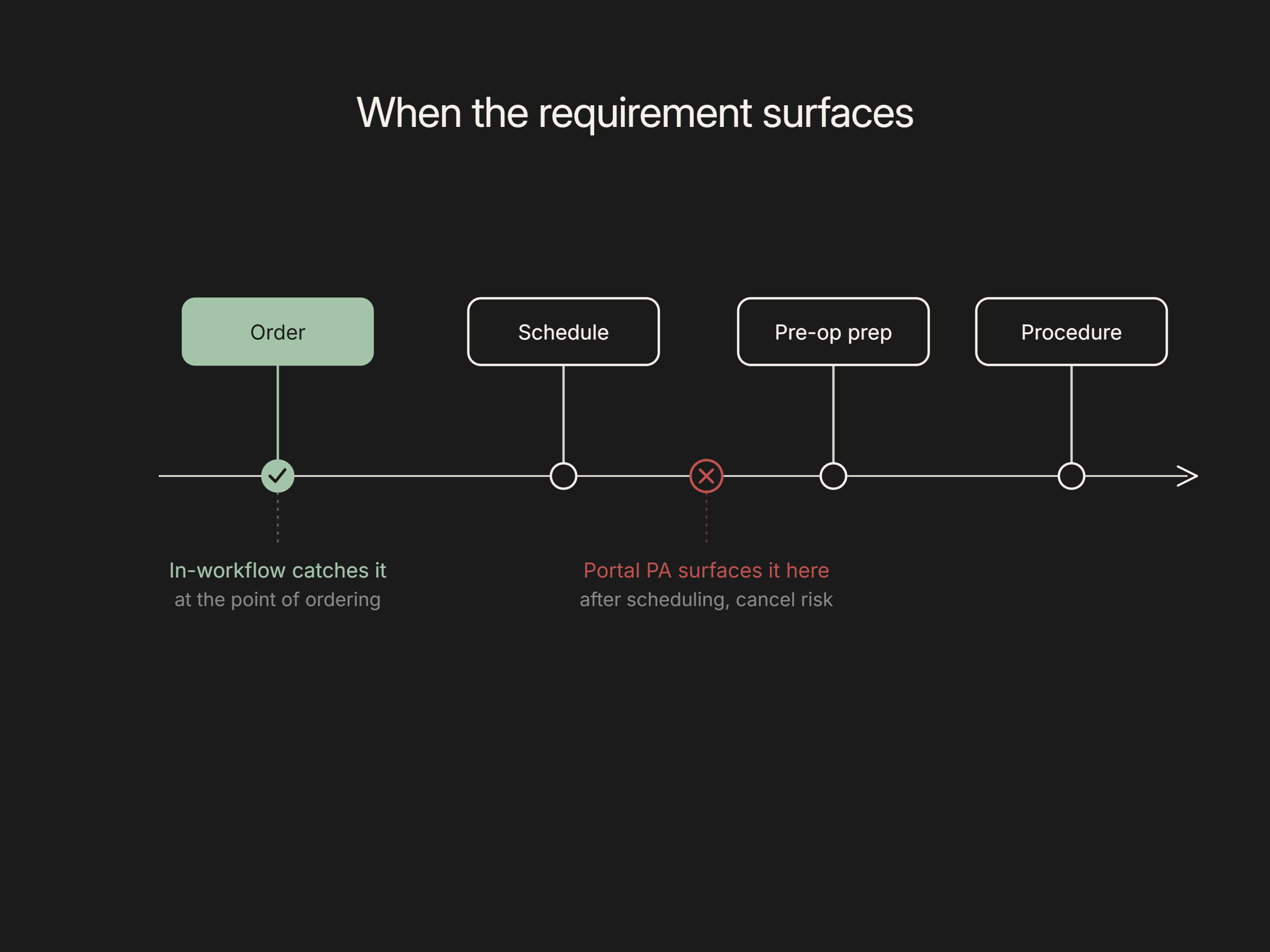
In-workflow PA means the authorization step lives inside the clinical workflow the provider is already in, rather than as a separate task handed to a back-office team hours or days later. The clinician orders a service, the system checks in real time whether that payer requires authorization, and the request is assembled and submitted from within the EHR, whether that is Epic, athenahealth, or another system. Drug prior authorization has run this way for years through pharmacy systems, and the CMS rule extends the same in-workflow expectation to medical items and services, a shift summarized in this legal analysis of the new electronic prior-authorization requirements. The benefit is timing: catching an authorization requirement at the point of ordering, rather than after scheduling, prevents the last-minute scramble and the canceled procedure that follows a missed requirement.
Whatever the channel, the steps an office performs are nearly the same, which is why the channel matters less to automation than it first appears. Flexbone runs the same request logic whether a payer takes ePA, a portal, or a phone call, and it maps which payers use which channel from the practice's own traffic. The channel-by-channel view is in portals and clearinghouses.
See what AI can run at your facility. In a 30-minute audit we map the calls, eligibility, and follow-ups Flexbone can take off your team first.
Book an auditHow does ePA differ from portal PA?
ePA and portal PA reach the same payer, but they differ in who does the work and where the data lives. With ePA, systems exchange structured data through an API, so the request and decision are machine-readable and land in the record automatically. With portal PA, a staff member logs into the payer's website, retypes the clinical information, uploads documents, and checks back later for a decision that then has to be entered into the practice system by hand. The CMS rule requires the API path partly because the manual path is slow and inconsistent across payers, reasoning laid out in the final rule in the Federal Register. The practical difference for a practice is labor: ePA removes the retyping and the manual status checks that portal PA demands for every request.
How do you automate the parts ePA does not cover?
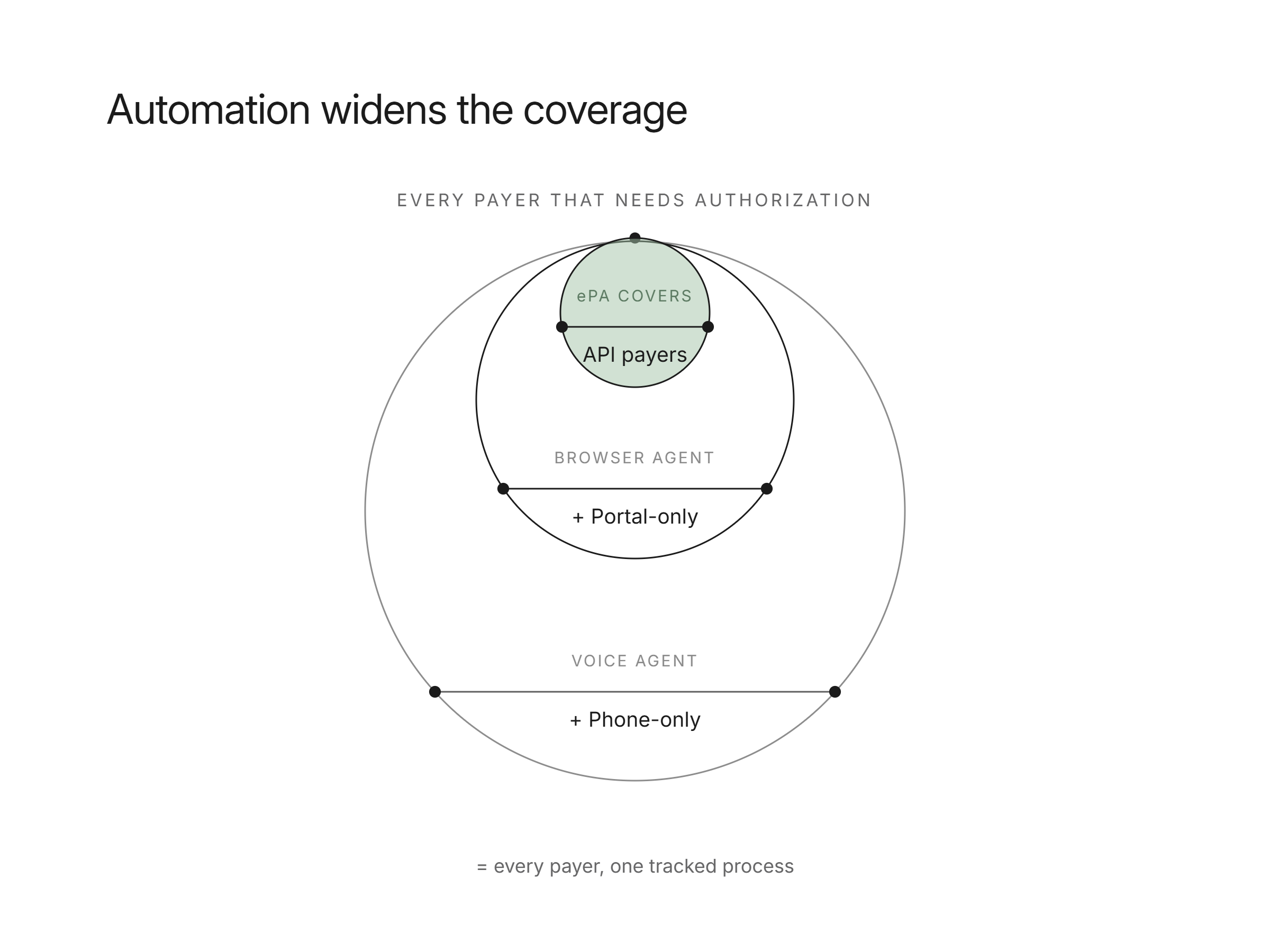
You automate the gaps with agents that do the manual work ePA leaves behind: portal submissions for payers without a working API, phone calls for plans that still require them, and repeated status checks until a decision posts. Even as APIs come online, the phased timeline means many payers and services will run on portals and phones for years, and prior authorization already consumes an average of 13 hours of physician and staff time each week, per the AMA's prior-authorization physician survey. A browser agent can log into a payer portal such as Availity, submit the request through the X12 278 authorization transaction or the portal form, and poll for the decision, while a voice agent handles the plans that only take authorizations by phone. The result is one consistent process across API, portal, and phone payers, instead of three separate manual workflows.
How Flexbone automates prior authorization across every channel
ePA covers the payers with working APIs; it does not cover the portal-only plans, the phone-only plans, or the endless status checks in between. Flexbone deploys AI browser, voice, and document agents that submit authorizations wherever the payer requires, whether that is an API, a portal login, or a phone call, and track each one to a decision inside your EHR. The approach is audit-first, HIPAA compliant, and SOC 2-aligned, with exceptions routed to your team.
See it run against your payer mix: book a demo, or read more on prior authorization automation.