A patient no-show is a recurring revenue leak, and you can size it with three numbers you already track. Industry estimates put a single missed appointment near $200 once you count lost revenue, staff time, and idle room and equipment, and missed appointments cost the U.S. healthcare system about $150 billion a year. To model your own exposure, multiply three figures: your no-show rate times your annual scheduled volume times your average revenue per visit. A practice with 20,000 scheduled visits, a 10 percent no-show rate, and $200 per visit is losing roughly $400,000 a year before any reduction effort. That headline number understates the real cost, because no-shows also drive downstream expense in sicker patients and lost future visits, which the model below accounts for.
How much does a single no-show cost?
A single no-show commonly costs a practice around $200, though the exact figure depends on your specialty and revenue per visit. The number reflects more than the one missed charge: it bundles the provider's idle time, the front-desk and clinical staff who prepared for the visit, and the room and equipment that sat empty during a slot you cannot resell on short notice. The AAFP frames missed appointments as recurring lost revenue for the practice for exactly these reasons. For a procedural or imaging visit, the per-slot cost runs well above $200; for a brief established-patient visit, below it. Use your own average collected revenue per visit as the starting figure rather than the industry rule of thumb, which will make the model that follows far more accurate.
Want this mapped against your own call and claim volume? Book a 30-minute audit
How do you model annual revenue lost to no-shows?
The model points at the lever: empty slots are the cost, so the recoverable part is confirming and refilling them. Flexbone does that with outbound voice agents that confirm, rebook, and fill from a waitlist. See AI patient coordinator.
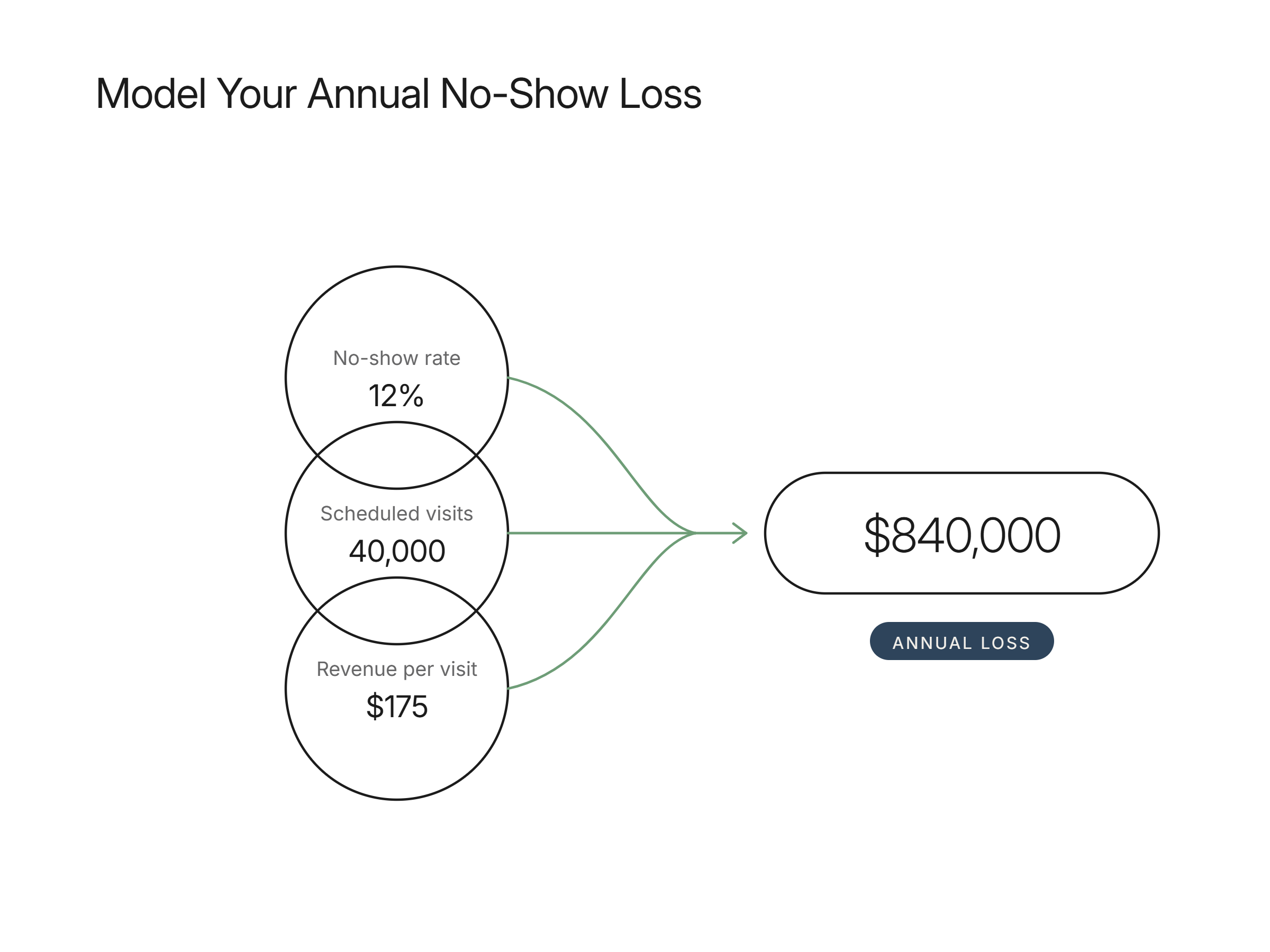
Use one formula: annual loss = no-show rate x annual scheduled appointments x average revenue per visit. Start with a conservative revenue-per-visit figure (your average collected amount, not billed), because overstating it inflates the whole model. Worked example: a group with 40,000 scheduled visits a year, a 12 percent no-show rate, and $175 average revenue per visit loses about $840,000 annually (0.12 x 40,000 x 175). Then run the same math per segment, because a study of no-show prevalence and economic consequences shows the burden concentrates in specific clinics and patient types. Segmenting tells you which slots to defend first. For the reduction levers that lower the rate in this model, see our patient no-show rate guide.
See what AI can run at your facility. In a 30-minute audit we map the calls, eligibility, and follow-ups Flexbone can take off your team first.
Book an auditWhat are the downstream costs?
The direct lost-revenue figure is only the visible layer; no-shows also raise cost elsewhere. When patients miss appointments, conditions go unmanaged and some patients later need more expensive acute care. A study of no-shows to primary care and subsequent acute care use among patients with diabetes found missed primary care visits associated with higher downstream acute care utilization. There are two other hidden costs. First, patient attrition: patients who no-show once are far more likely to churn, taking their lifetime value with them. Second, access: an empty slot that could have served a waiting patient represents a real opportunity cost. A full model of no-show impact should note these effects even when they are harder to price than the direct per-visit loss.
How much can you realistically recover?
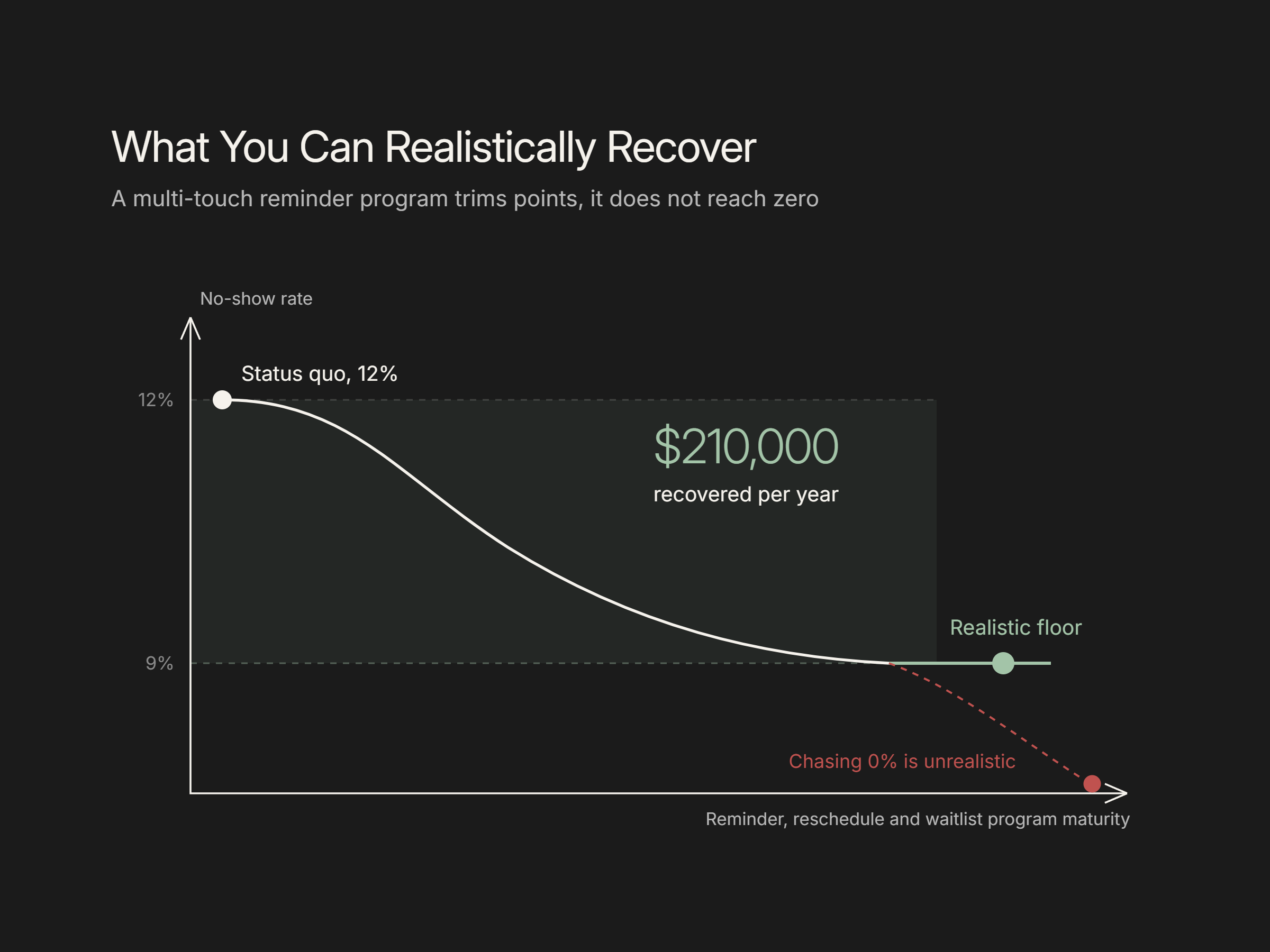
You will not recover the full modeled loss, so set expectations around what interventions actually move. Reminders are the highest-yield starting point: a randomized study of outpatient appointment reminders found they lower no-show rates, with live staff calls outperforming a single automated touch. In practice, a well-run multi-touch reminder, rescheduling, and waitlist program can trim several points off a double-digit rate rather than eliminate no-shows entirely. Model the recovery conservatively: apply a realistic reduction, say from 12 percent to 9 percent, to your annual loss formula. In the 40,000-visit example above, that three-point drop recovers roughly $210,000 a year. Recovering a portion reliably, every month, beats chasing an unrealistic zero and abandoning the effort when it falls short.
How Flexbone recovers no-show revenue inside your EHR
The model tells you what is at stake; recovering it means running the reminder, rescheduling, and waitlist cadence across your whole panel without adding staff. Flexbone deploys AI voice and messaging agents that work inside your EHR to run multi-touch reminders, confirm high-value visits by phone, offer one-step rescheduling, and backfill cancellations from a waitlist, with each action written back to the schedule. In the engagements we run, we start by modeling your loss by segment, then automate against the visit types with the most recoverable revenue.
See what you can recover: book a patient access audit, or read more on the AI patient coordinator.