
Gastroenterology billing follows the same revenue cycle as any specialty, but a few features make it distinct. GI practices run a high volume of endoscopic procedures, including colonoscopy, upper endoscopy (EGD), and endoscopic retrograde cholangiopancreatography (ERCP). The colonoscopy is the clearest example: the same procedure can bill as a preventive screening or as a diagnostic service depending on why it was performed, and that changes both coverage and what the patient owes. Many procedures happen in an ambulatory surgery center (ASC), which produces two separate claims, one professional and one facility, that have to agree, and modifiers describe what happened during a case, such as an exam that began as screening and became therapeutic. Inflammatory bowel disease (IBD) care adds biologic drugs that usually require prior authorization. Each of these is a place where a claim can stall.
What makes gastroenterology billing complex?
The complexity in GI billing comes from volume layered on top of rules that other specialties encounter less frequently. A busy practice may perform dozens of endoscopies a week, and each one moves through coding, claim submission, and payment on a tight cycle. On top of that throughput sit the conditions above: screening-versus-diagnostic classification, split professional and facility claims from an ASC, case-specific modifiers, and biologic authorization for IBD. None of these rules is unusual on its own, but a GI practice hits all of them repeatedly, and a small error in any one produces a denial or an unexpected patient bill. That is why front-office work, verifying benefits before the visit, does as much to protect revenue as the coding itself.
Want this mapped against your own call and claim volume? Book a 30-minute audit
How does screening vs diagnostic colonoscopy billing work?
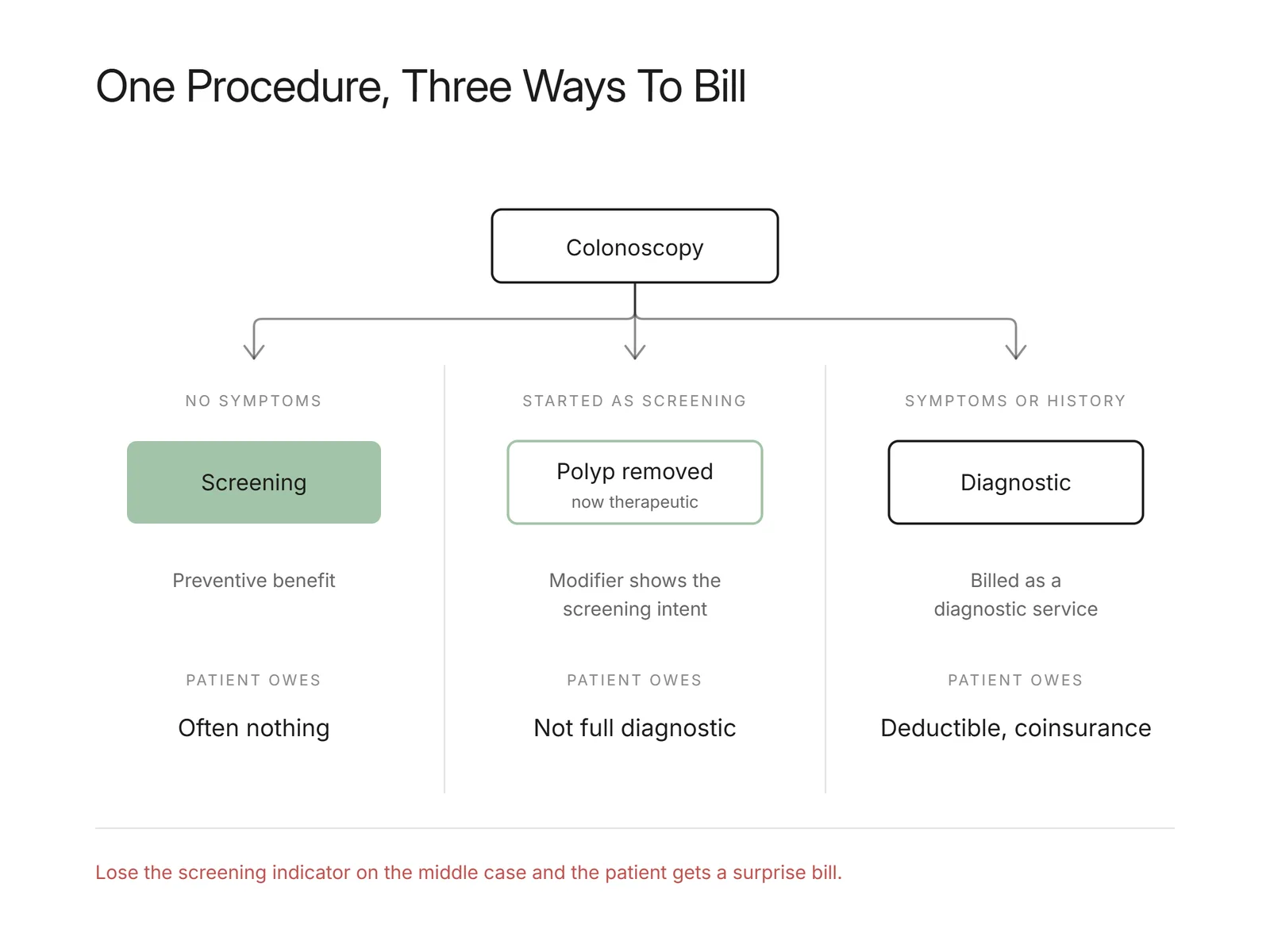
The screening-versus-diagnostic distinction is the most consequential rule in GI billing, because it changes coverage and patient cost for the most common procedure in the specialty. A screening colonoscopy is performed on a patient with no symptoms, specifically to look for colorectal cancer or precancerous polyps, and preventive screening is frequently covered with no cost share to the patient. A diagnostic colonoscopy is performed because the patient has symptoms, an abnormal test, or a history that warrants a look, so it is billed differently and the patient may owe a deductible or coinsurance.
The situation that trips up billing is the one in between. If a colonoscopy starts as a screening and the gastroenterologist finds and removes a polyp, the procedure becomes therapeutic. The coding then has to show that the case began as a screening exam, which is done with a modifier that signals the screening intent, so the patient is not unfairly moved into full diagnostic cost sharing. The exact modifiers and codes vary by payer, so the reliable thing is the concept: capture why the procedure started and what was done, and make the claim reflect both. Getting that indicator wrong is a frequent cause of a surprise patient bill and a downstream denial.
How does ASC facility billing work in gastroenterology?
Many GI endoscopies are performed in an ambulatory surgery center rather than a hospital, and that setting splits one procedure into two bills. The gastroenterologist submits a professional claim for performing the procedure, and the ASC submits a separate facility claim for the resources it provided: the procedure room, nursing and technical staff, supplies, anesthesia support, and recovery. These two claims use different code sets and payment rules, and each goes to the payer on its own path.
The reconciliation between them is where facility billing gets error prone. Both claims describe the same case, so the procedures, the diagnoses, and the details have to line up. When they do not, for example if one side codes a therapeutic removal and the other codes a diagnostic exam, one or both claims can be denied or underpaid. A practice affiliated with an ASC has to manage both streams and confirm the patient's benefits cover the facility as well as the professional service. This double-billing structure is normal in GI, but it doubles the surface area where a coding or eligibility mistake can cost the practice.
See what AI can run at your facility. In a 30-minute audit we map the calls, eligibility, and follow-ups Flexbone can take off your team first.
Book an auditHow does biologic prior authorization work in gastroenterology?
Inflammatory bowel disease, which includes Crohn's disease and ulcerative colitis, is often treated with biologic drugs, and those drugs are a major source of prior-authorization work in a GI practice. Biologics such as infliximab, adalimumab, vedolizumab, and ustekinumab are expensive, and payers commonly require authorization before they will cover them. The plan typically wants to see the diagnosis, the therapies already tried, and supporting labs or imaging, and many apply step therapy that requires a lower-cost option to fail first. The workflow is a documentation and tracking exercise: the practice assembles the clinical justification, submits the request in the payer's format, and follows up until the plan approves it, denies it, or asks for more.
This is slow, repetitive work, and it is not unique to GI. The American Medical Association reports that physicians complete about 39 prior authorizations per physician per week, taking roughly 13 hours of staff and physician time. For a GI practice managing a panel of IBD patients on biologics, plus authorizations for certain endoscopic procedures, that burden is concentrated. The mechanics of building and tracking these requests are the same ones described in GI and general surgery prior authorization. For how scheduling, bowel-prep adherence, and endoscopy authorization run together inside gGastro and Provation, see AI for gastroenterology practices.
Why do gastroenterology claims get denied?
GI denials tend to cluster around the same features that make the billing distinct. A screening colonoscopy coded without the correct screening indicator, or a screening-turned-therapeutic exam that loses its screening modifier, can be denied or pushed onto the patient incorrectly. A professional claim and a facility claim that do not agree can bounce one or both. A biologic administered before its authorization is approved may not be paid. Underneath all of these sit ordinary eligibility errors: an expired plan, an out-of-network facility, or an unmet deductible never checked before the visit.
Denials are common across insurance. A KFF analysis found that insurers denied 20% of in-network claims on HealthCare.gov marketplace plans in 2023, and consumers appealed fewer than 1% of those denials. Many GI denials are correctable, because they stem from a missing indicator, a mismatched claim, or a benefits question that could have been resolved earlier. Confirming coverage in advance through insurance eligibility verification prevents a large share of them, and the ones that still occur can be reworked and appealed through a structured process, which is the focus of AI denials management.
AI agents fit the parts of GI billing that are repetitive and rule driven. They can verify a patient's screening-versus-diagnostic benefits before the visit, run endoscopy and biologic prior authorization end to end, and work denials by identifying the reason and preparing the correction or appeal. To see where that would land, book a call with Flexbone and we will run a quick audit of what AI can take off your GI billing.