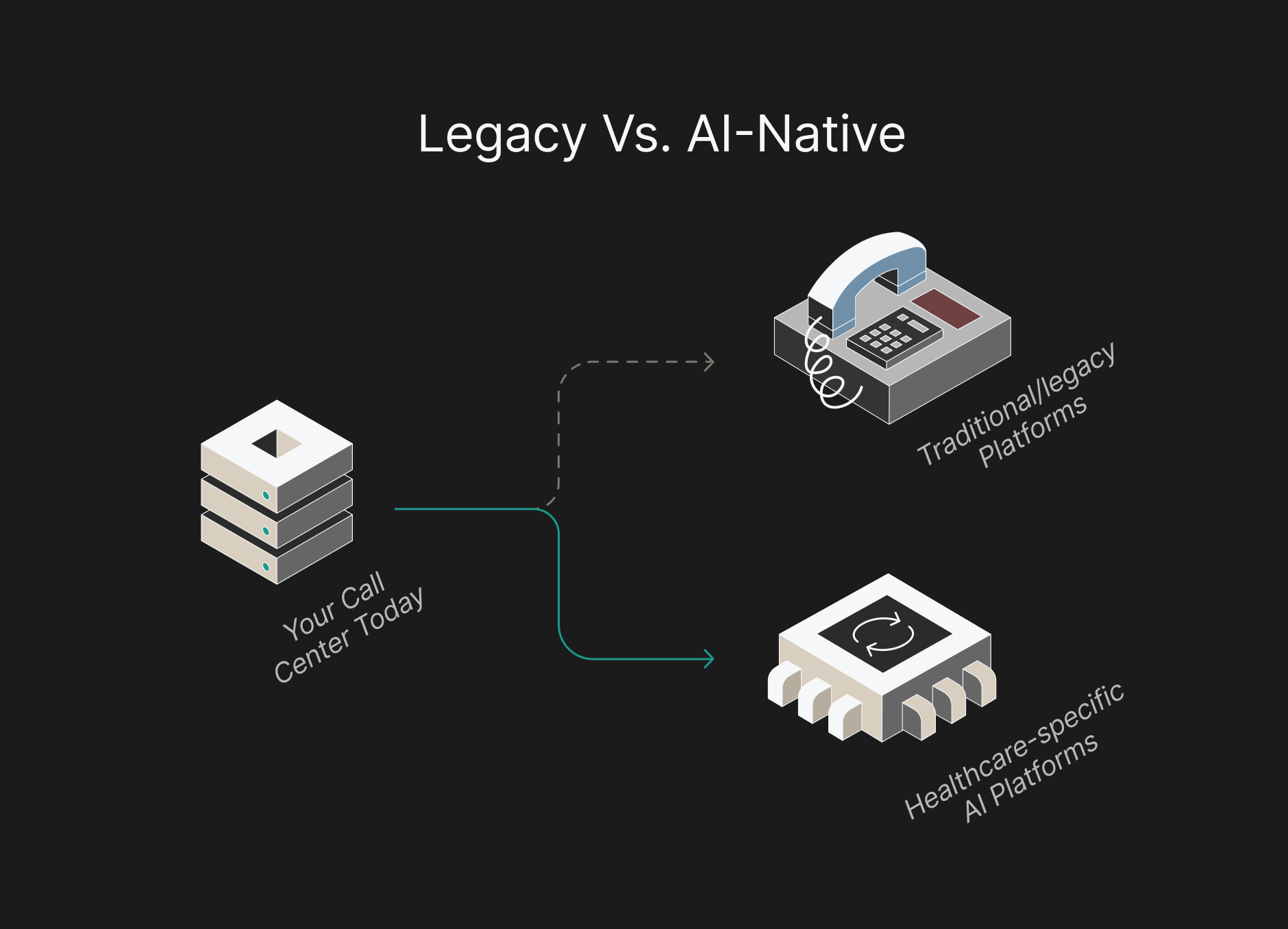
Choosing the right healthcare call center software is now an operations decision, not just telephony. It affects patient access, revenue recovery, compliance risk, and staff retention. The market falls into three categories: traditional IVR/telephony platforms, horizontal AI tools adapted for healthcare, and purpose-built healthcare AI platforms. Each fits a different operational need, and choosing the wrong category can cost more than choosing the wrong vendor.
This comparison helps hospital and health system leaders evaluate each approach, including where it performs well and where it falls short. The stakes are concrete: MGMA reports that phone volume remains a backlog that costs medical practices time they cannot easily staff for, which is exactly the pressure the software below is meant to relieve. If you are building or restructuring your healthcare call center, use this framework.
Quick Comparison Table
Traditional and Legacy Contact Center Platforms
Traditional hospital contact center platforms like Five9, Genesys, NICE CXone, and Talkdesk Healthcare Experience Cloud are known for reliable call routing, omnichannel support, and enterprise-grade uptime. They serve healthcare as one of many verticals.
What they do well:
- Proven scalability for high-volume contact centers (500+ agents)
- Mature omnichannel capabilities across voice, chat, email, and SMS
- Established compliance frameworks with HIPAA Business Associate Agreements
- Extensive workforce management and scheduling tools
Where they fall short for healthcare:
- Quality assurance relies on manual sampling, typically reviewing 1-5% of calls. The other 95-99% are unmonitored for compliance and quality.
- IVR trees frustrate patients. Long hold times and rigid menu systems increase call abandonment, and a caller who gives up is a patient who did not reach the practice.
- EHR integration requires custom development. Connecting to eClinicalWorks, ModMed, or Greenway typically involves months of professional services work.
- No agentic automation. These platforms route calls and provide agent tools, but they do not autonomously complete tasks like appointment scheduling or insurance verification.
Traditional platforms work for organizations needing a stable telephony backbone with specialized AI tools layered on top. They are not ideal standalone solutions for patient contact centers facing staffing shortages and access challenges.
Want this mapped against your own call and claim volume? Book a 30-minute audit
Horizontal AI Platforms
Observe.AI is a strong example of horizontal AI entering healthcare. With $214 million in funding and a proprietary 30-billion-parameter contact center LLM, it built its platform for financial services, retail, insurance, and telecom before expanding into healthcare.
What Observe.AI does well:
- Analyzes 100% of interactions with NLP-powered quality assurance
- Provides real-time agent assistance with contextual prompts during calls
- Reduces after-call work by up to 55% through GenAI-powered summaries
- Offers strong compliance monitoring with automatic PCI/PII data redaction
Where horizontal AI falls short for healthcare:
- EHR integrations are API-level, not pre-built. Connecting to specialty EHRs like ModMed, Greenway, or NextGen requires custom work, and the platform does not list specific healthcare EHR integrations on its product pages.
- Healthcare workflows are adapted from general contact center workflows, not built specifically for patient access.
- The platform provides insights and agent assistance but does not autonomously perform healthcare-specific actions like EHR scheduling, eligibility checks, or outbound patient campaigns.
- Healthcare clients such as Providence, Signify Health, and Accolade use it mainly for analytics and QA, not patient-facing automation.
Observe.AI is a strong analytics layer. If your main need is understanding calls and coaching agents, it delivers. If you need software that completes healthcare workflows autonomously, you need a different category.
Healthcare-Specific AI Platforms
This is where the market has moved most aggressively in the past 18 months. Four vendors stand out, each with a distinct approach:
Flexbone AI
Flexbone AI takes a different architectural approach, building a unified AI platform specifically for healthcare operational workflows with three core products:
- Voice Room: Analyzes 100% of calls (not the 1-5% sampling that traditional QA supports) with sentiment analysis, compliance monitoring, and automated QA scoring.
- Voice Agents: Outbound AI agents that handle appointment scheduling, recall campaigns, and patient outreach directly within EHR workflows.
- Eligibility Agents: Automated insurance verification with real-time EHR integration, recovering an average of ~$80K/month in previously missed revenue.
Differentiators:
- 15+ pre-built EHR integrations including eClinicalWorks, ModMed, Greenway, and NextGen, the mid-market EHRs that most healthcare AI vendors overlook in favor of Epic-only strategies.
- Zero-Retention Security Architecture: Patient data is processed for analysis but never stored, eliminating an entire category of breach risk.
- Audit-First Sales Model: Every implementation begins with a no-cost operational audit, so you see your own data and gaps before any commitment.
- Forward-deployed engineers embedded with your team during implementation and beyond.
Limitation: Flexbone is newer than vendors with hundreds of enterprise deployments. Organizations requiring a 10-year track record should evaluate deployment references carefully.
Hyro AI
Hyro, with $95M in funding, focuses on conversational AI for healthcare call centers, especially within the Epic ecosystem. Its AI voice agents handle inbound calls, automate tasks like MyChart password resets and appointment scheduling, and route complex calls to human agents.
Key results: Tampa General Hospital reduced call abandonment by 56% and wait times by 58% within two weeks. Intermountain Health reported an 85% reduction in call abandonment and 5x ROI.
Limitation: Hyro is strong in call deflection and routing but has less depth in analytics, QA scoring, and revenue cycle integration. It is a patient-facing automation tool, not a full operations platform.
Assort Health
Assort Health, with $102M in funding, built specialty-specific AI agents trained on 55M+ patient interactions across 20+ specialties. Its platform handles appointments, call triage, prescription refills, billing inquiries, and outbound campaigns in 29 languages.
Key results: Assort reports 89% shorter patient call wait times for its customers, per its 2025 funding announcement.
Limitation: Assort Health is primarily a patient communication platform. It is strong for patient-facing workflows but offers less depth in operations analytics, agent QA, and call-level intelligence needed to optimize staffing and workflows.
Commure
Commure is valued at $6B. It offers enterprise AI for documentation, revenue cycle, and contact centers. Its AI Call Center Agent handles confirmations, billing, insurance verification, and prior authorization with 60+ EHR integrations.
Key results: Commure processes $25B+ in annualized payments and powers over 1% of U.S. appointments through their ambient AI platform.
Limitation: Commure is built for large health systems. Its broad platform makes it a major commitment, and organizations needing only contact center AI may be buying more than they need.
See what AI can run at your facility. In a 30-minute audit we map the calls, eligibility, and follow-ups Flexbone can take off your team first.
Book an auditFeature-by-Feature Comparison
EHR Integration
This is where the field separates. Traditional platforms need custom EHR integrations. Observe.AI connects at the API level, Hyro is strongest with Epic, Assort Health covers major EHRs, Commure has 60+ integrations, and Flexbone AI focuses on mid-market EHRs like eClinicalWorks, ModMed, Greenway, and NextGen.
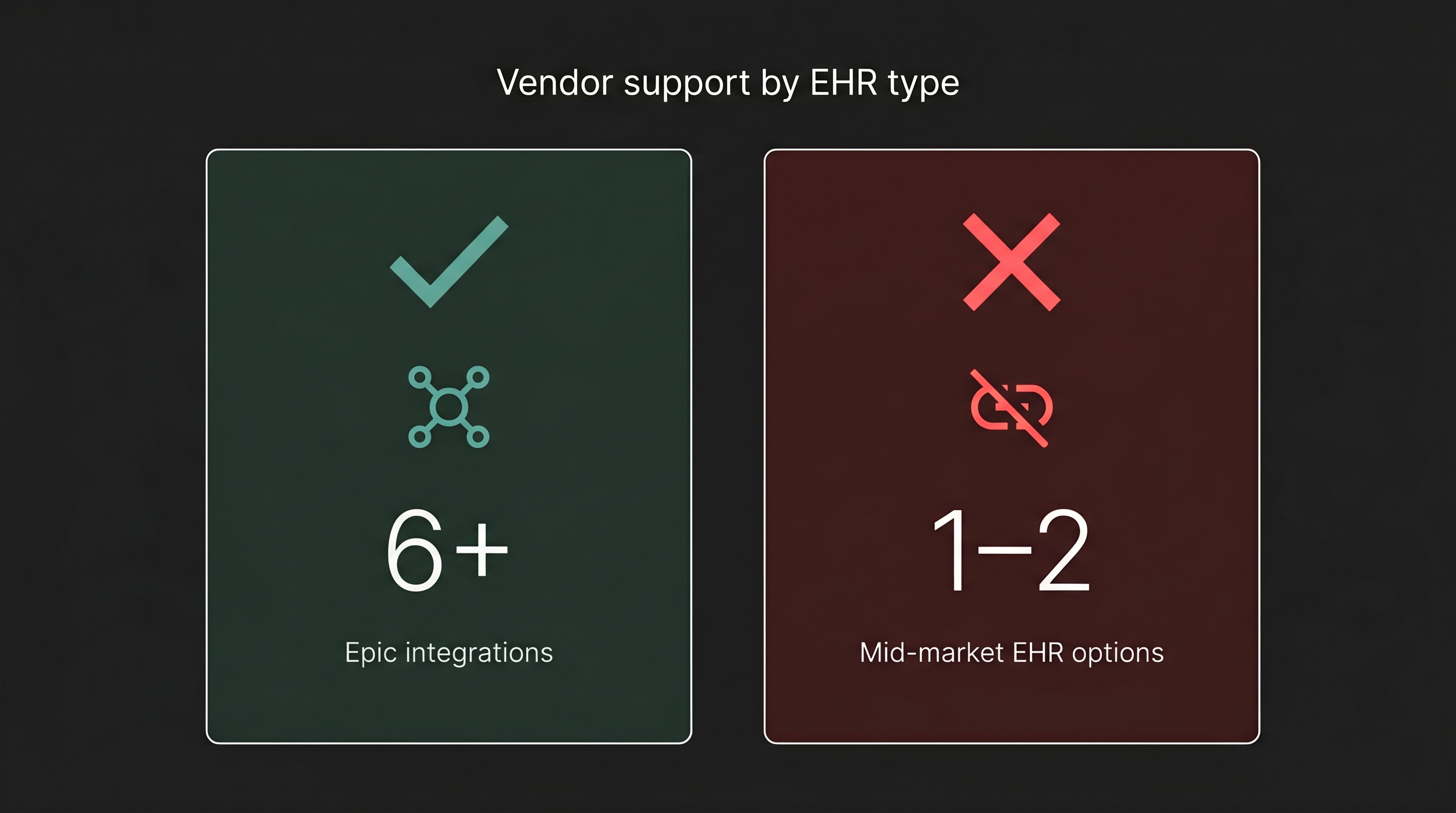
If you use Epic, you have many options. If you use eClinicalWorks, ModMed, or Greenway, Flexbone and Assort Health are stronger contenders.
Call Analysis Coverage
Traditional platforms manually sample 1-5% of calls. Observe.AI and Flexbone AI analyze 100% of calls, but differently: Observe.AI focuses on coaching and compliance, while Flexbone adds sentiment analysis, QA scoring, and workflow insights. Hyro and Assort Health focus mainly on calls handled by their own AI.
Security and Compliance
All vendors offer HIPAA compliance, but architecture matters. Traditional platforms store recordings and transcripts, Observe.AI provides PII/PCI redaction, and Flexbone AI uses zero-retention processing to reduce stored patient data and security risk.
Automation Depth
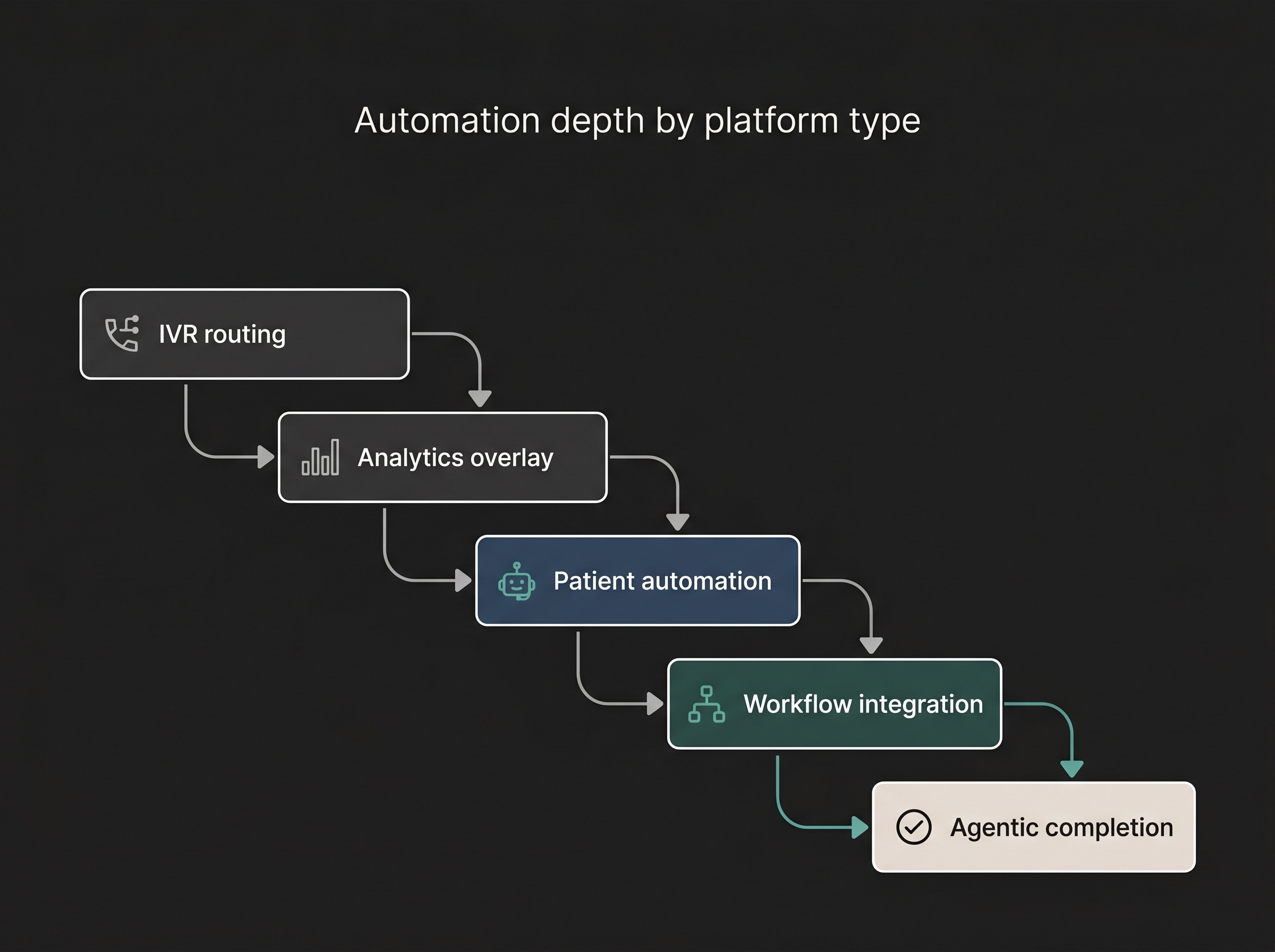
This is the biggest strategic difference. Traditional IVR handles routing, Observe.AI provides insights, Hyro and Assort Health automate patient communication, and Commure automates broader workflows. Flexbone AI works at the agentic level, completing tasks like scheduling, insurance verification, and outbound campaigns directly within EHR workflows.
Deployment and Support
Traditional platforms take 3-6 months to deploy, while Observe.AI takes 4-8 weeks. Healthcare-specific platforms are usually faster because of pre-built EHR integrations. Hyro deployed at Tampa General in under 3 months, Assort Health targets 6 weeks, and Flexbone AI uses an audit-first approach with direct integration support.
Pricing and Value
Transparent pricing is rare. Traditional platforms charge $100-200/agent/month plus implementation fees, while AI platforms price per interaction, per call, or by platform license.
The real measure is total cost of impact. If missed eligibility checks cost $80K/month, or 20+ minute hold times push patients to competitors, recovered revenue can outweigh software costs.
Request pricing using your actual call volumes and workflows, and avoid vendors that cannot model ROI from your operational data.
Who Should Choose Traditional Solutions
Choose a traditional platform like Five9, Genesys, or NICE CXone if:
- You operate a large, multi-industry contact center where healthcare is one of several lines of business
- Your primary need is reliable telephony infrastructure, workforce management, and omnichannel routing
- You plan to layer specialized AI tools on top of your telephony backbone
- Your organization has the technical resources to build and maintain custom EHR integrations
Who Should Choose Horizontal AI
Choose Observe.AI or a similar horizontal AI platform if:
- Your biggest gap is call analytics and agent performance visibility, not workflow automation
- You need 100% call analysis for compliance monitoring across a contact center that serves multiple industries
- Your EHR integration needs are limited (Epic-only, or you do not need the AI platform to interact with your EHR)
- You already have a telephony platform and want an analytics overlay
Who Should Choose Healthcare-Specific Call Center Software
Choose a healthcare-specific AI platform if:
- Patient access is a core operational challenge: long hold times, high abandonment rates, scheduling backlogs
- You need your call center software to interact directly with your EHR for scheduling, eligibility, and patient workflows
- Compliance and security architecture are board-level concerns, not just IT checklists
- You want agentic automation that completes tasks, not just insights that require human action
Within this category, your choice depends on your specific profile:
- Hyro if you are an Epic-centric health system focused on call deflection and routing automation
- Assort Health if you need specialty-specific patient communication across many languages
- Commure if you are a large enterprise health system buying a full clinical and operational AI platform
- Flexbone AI if you need 100% call analysis combined with agentic automation, run mid-market EHRs (eClinicalWorks, ModMed, Greenway, NextGen), or want to start with an operational audit before committing to a platform
Decision Framework
Your healthcare call center software decision comes down to three questions. (For a detailed evaluation checklist, see our medical call center buyer's guide.)
- What is your primary operational pain? If it is telephony reliability, go traditional. If it is call visibility, go horizontal AI. If it is patient access and workflow automation, go healthcare-specific AI.
- Which EHR do you run? Epic-centric organizations have the most vendor options. Mid-market EHR users (eClinicalWorks, ModMed, Greenway, NextGen) should prioritize vendors with pre-built integrations for their system.
- Do you need insights or actions? Platforms that analyze calls and surface dashboards solve a different problem than platforms that autonomously schedule appointments, verify insurance, and run outbound campaigns.
The healthcare contact center market is projected to grow from $8B to $49B by 2033. Organizations that choose the right healthcare call center software now can build an advantage as patient expectations and staffing pressures rise.
To see where your contact center stands, request a Flexbone AI operational audit. You’ll get real call data, coverage gaps, and revenue recovery opportunities with no commitment.