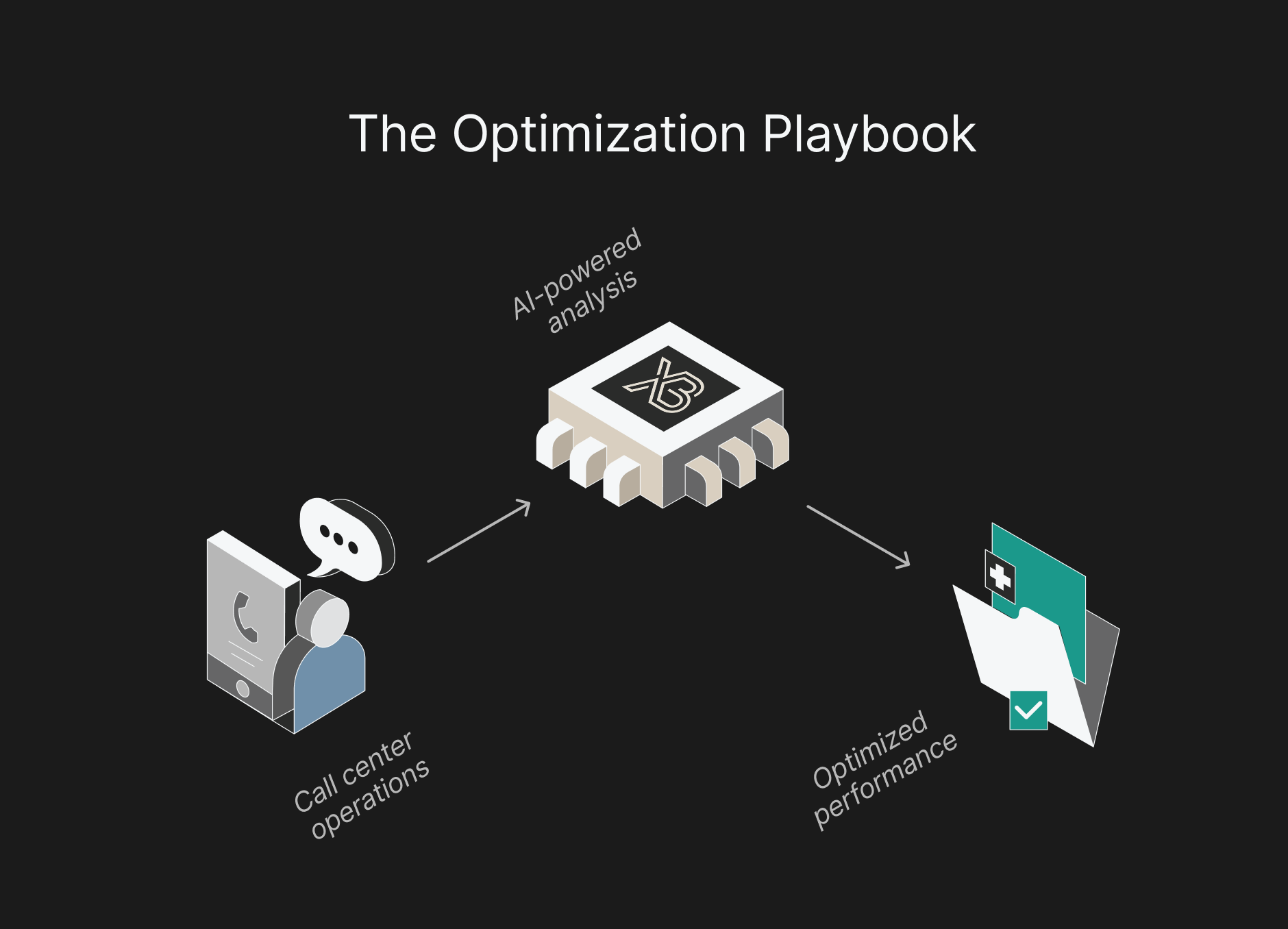
Your healthcare call center handles thousands of patient interactions daily, yet a typical center analyzes only 1% to 5% of calls. The result is blind spots in quality, missed compliance gaps, and growing operational inefficiencies.
Healthcare call center hold times average 4.4 minutes, nearly five times the HFMA target of 50 seconds. Meanwhile, staffing covers just 60% of need, and annual agent turnover ranges from 30% to 45%.
This guide covers modern healthcare call center optimization, including key metrics, new technology, and strategies that improve patient satisfaction and operational efficiency. Whether you run a health system patient access center or a multi-site medical call center, this is your playbook.
What Is a Healthcare Call Center (And Why It Is More Than a Phone Bank)
A healthcare call center is a centralized hub where trained agents handle patient interactions, including scheduling, insurance verification, triage, billing, and follow-up. Unlike general call centers, healthcare contact centers follow strict regulations and manage conversations that are personal and often urgent.
The modern term is increasingly “patient access center,” reflecting a shift in how health systems view the role. It is no longer a cost center with agents reading scripts. It is a strategic function that impacts revenue, patient retention, and clinical outcomes.
Core functions of a modern healthcare call center include:
- Appointment scheduling and management across providers, locations, and specialties
- Insurance eligibility verification before appointments to reduce claim denials
- Clinical triage and nurse lines for symptom assessment and care navigation
- Billing and payment support including payment plans and balance inquiries
- Referral coordination between primary care, specialists, and ancillary services
- Outbound outreach for appointment confirmations, preventive care reminders, and post-discharge follow-up
What sets a healthcare contact center apart is its mix of HIPAA compliance, clinical urgency, emotional sensitivity, and deep integration with EHRs, practice management platforms, and clearinghouses.
According to Tegria, 25% to 33% of patient access center calls require clinical knowledge. This isn’t a function you can staff with generic customer service agents and expect strong outcomes.
Want this mapped against your own call and claim volume? Book a 30-minute audit
The State of Healthcare Call Centers in 2026
Healthcare call centers face more pressure than ever. Patient expectations have risen, staffing has lagged, and administrative complexity keeps growing.
The operational picture a center usually lacks is what happens inside the calls. Flexbone starts there, transcribing and classifying calls to separate the ones that follow a script from the ones that need judgment, and only then builds agents for the first group. See contact center automation.
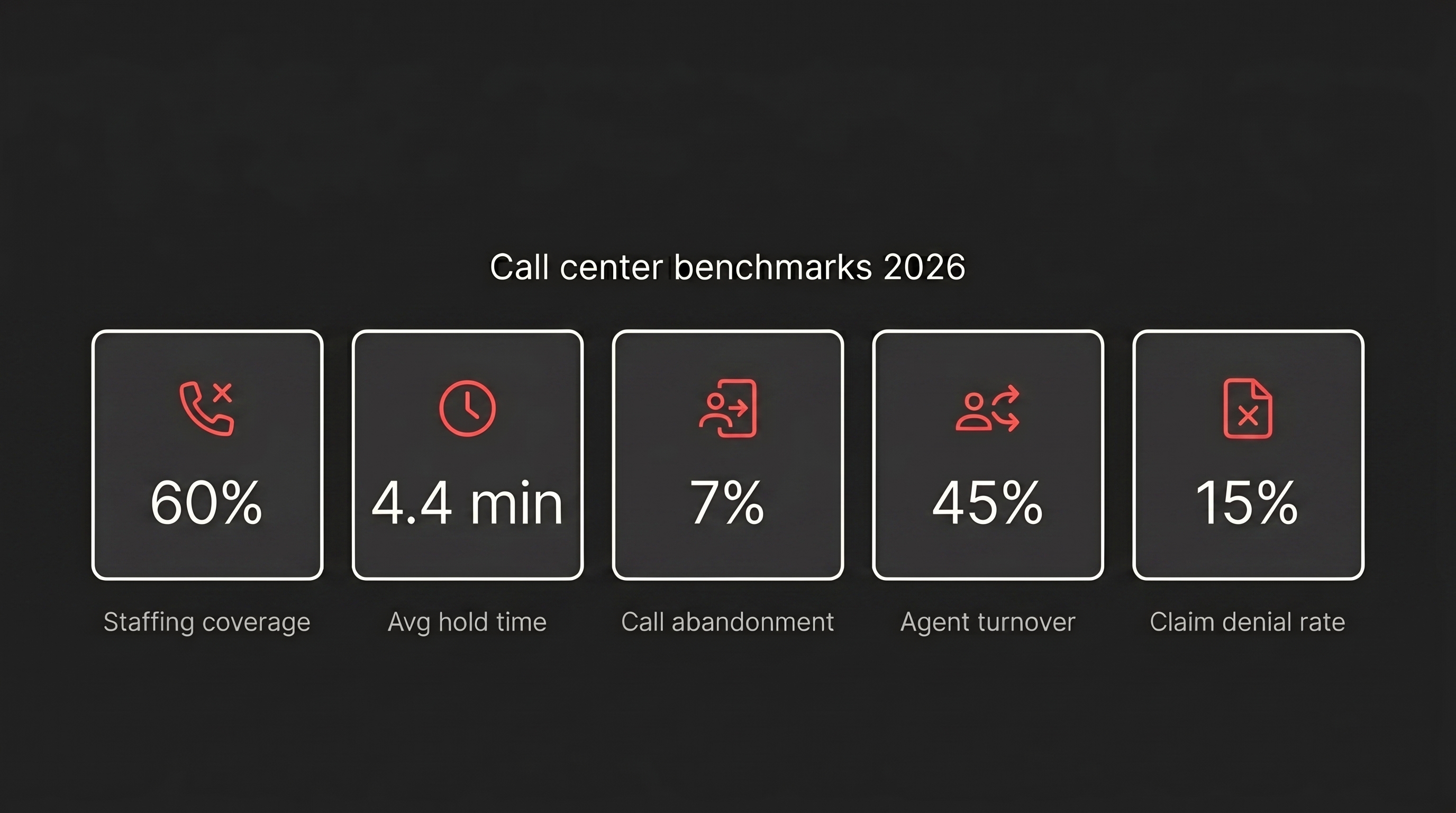
Here is what the data shows:
- The average healthcare call center handles roughly 2,000 calls per day but is staffed for only 60% of that volume
- Average hold times reach 4.4 minutes , far exceeding the HFMA target of 50 seconds
- Call abandonment rates average 7% , meaning roughly 140 patients per day hang up before reaching an agent
- Agent turnover runs between 30% and 45% annually , driving constant recruitment and training costs
- Initial claim denial rates have climbed to 12% to 15% as of 2025, with eligibility errors as a leading cause
The healthcare contact center as a service market reached $7.05 billion in 2025 and is projected to hit $36.24 billion by 2034. That growth reflects demand, not satisfaction.
For patient access leaders, the problem compounds quickly. Long hold times drive abandonment, dissatisfaction, and patient attrition. Turnover weakens training investments, while eligibility errors lead to denials and revenue loss, with some organizations losing $80,000 or more per month to preventable verification failures.
Scheduling is also strained. ECG Management Consultants found patients make 3.5 calls per scheduling need, and sometimes up to five. That is not a phone system problem. It is a resolution problem.
According to MGMA’s 2026 patient access priorities survey, wait times, phone accessibility, and no-show rates remain top concerns for practice leaders.
Healthcare Call Center Metrics That Actually Matter
If you manage a healthcare call center, you are likely tracking dozens of KPIs. But not all metrics carry equal weight. Here are the ones that operations leaders should prioritize, along with current benchmarks.
FCR deserves special attention. Only 1% of healthcare call centers achieve an FCR rate between 80% and 100%. That means the vast majority of patients are making multiple calls to resolve a single issue. SQM Group research found that for every 1% improvement in FCR, patient satisfaction rises by 1% and operating costs decrease by 1%. For a detailed breakdown of strategies to improve this metric, see our guide on how to drastically improve first call resolution in healthcare.
AHT is important but dangerous in isolation. Pressuring agents to reduce handle time often pushes problems downstream, increasing repeat calls and lowering FCR. For a deeper look at how to use this metric correctly, read Reducing Average Handle Time: Efficiency Metrics That Matter.
The key insight for operations leaders: optimize for resolution and satisfaction first. Efficiency gains follow when patients get what they need on the first call.
How to Improve First Call Resolution in Healthcare
First call resolution is the most impactful healthcare call center metric. When patients resolve issues in one interaction, satisfaction rises, repeat calls drop, and agents spend less time on callbacks.
Yet average healthcare FCR is just 52%. SQM Group estimates a 1% FCR improvement can save $286,000 annually, while American Health Connection reports nearly 40% of patients switch providers within a year if they must call multiple times.
Root causes of low FCR:
- Siloed information systems: Agents toggle between EHR, billing, scheduling, and eligibility platforms without a unified view. They cannot answer a billing question if they cannot see the clinical record, and vice versa.
- Insufficient agent authority: Many organizations require supervisor approval for actions agents could handle themselves, like rescheduling across providers or adjusting payment plans.
- Lack of real-time patient context: When a patient calls back about a prior issue, the agent often has no visibility into the previous interaction, forcing the patient to repeat themselves. CallMiner research shows that a single transfer reduces satisfaction ratings by 12%, and satisfaction drops 15% each time a patient has to call back.
- Inadequate training on complex scenarios: Insurance eligibility, prior authorization requirements, and referral workflows are genuinely complex. Generic customer service training does not prepare agents for these conversations.
Strategies that move FCR measurably:
- Unified agent desktops that pull data from EHR, billing, and scheduling into one screen
- Expanded agent authority with clear decision trees for common resolution scenarios
- Conversation continuity tools that surface prior interaction history when a patient calls back
- Specialized training paths for eligibility, billing, and clinical triage workflows
- Post-call analytics that identify the specific call types with the lowest FCR rates
For a step-by-step framework, see our guide on improving first call resolution in healthcare. You can also explore how call center performance impacts patient satisfaction and loyalty.
Quality Assurance: From Sampling to Full-Coverage Analysis
Traditional quality assurance relies on manually reviewing a small call sample. Most healthcare QA teams listen to 1% to 5% of calls, score them against a rubric, and use the results for coaching.
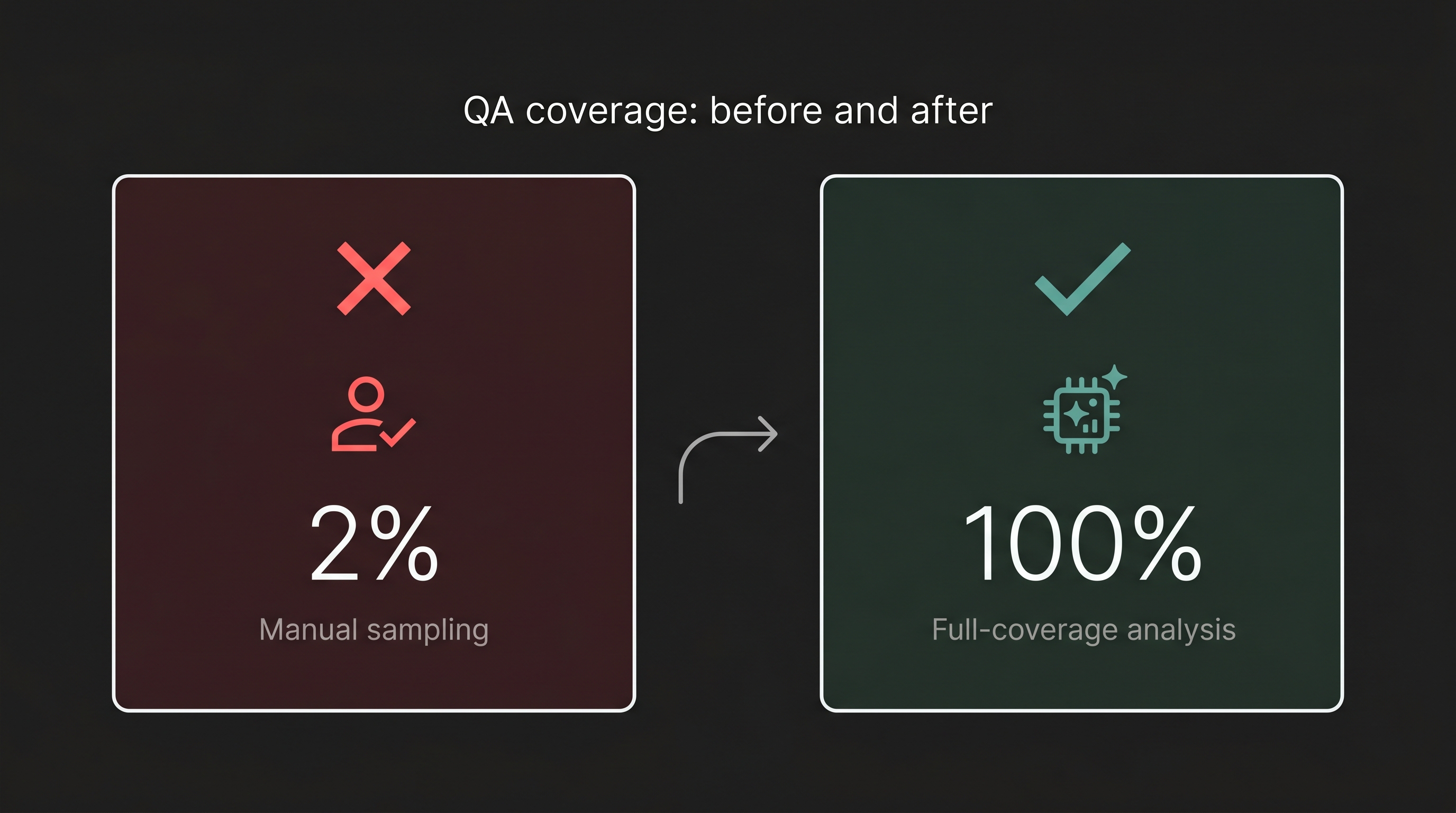
The problem is statistical: a 2% sample of 2,000 daily calls means only 40 are reviewed. The other 1,960 remain a black box, leaving compliance issues, escalations, and training opportunities undetected.
What full-coverage analysis looks like:
Modern AI-powered call center quality assurance platforms can analyze 100% of calls automatically, scoring each interaction against customizable criteria. This includes:
- Automated scorecard evaluation against your specific QA rubric, applied consistently across the full call volume
- Sentiment analysis that detects patient frustration, confusion, or satisfaction in real time
- Compliance monitoring that flags HIPAA violations, missing disclosures, or script deviations as they happen
- Trend identification across call types, agents, time periods, and patient demographics
- Coaching prioritization that surfaces the highest-impact training opportunities rather than random selections
The difference is not incremental. Moving from 2% to 100% call analysis changes what you can see and act on. Hidden patterns become clear, performance gaps are identified faster, and compliance risk drops because every interaction is monitored.
For QA evaluation, see our operations leader’s guide to quality assurance in call centers.
What would you find in 100% of your calls?
Most healthcare call centers uncover recurring eligibility errors, compliance gaps, and training opportunities that random sampling misses. To understand what is really happening across your call volume, start with a comprehensive call data audit.
See what AI can run at your facility. In a 30-minute audit we map the calls, eligibility, and follow-ups Flexbone can take off your team first.
Book an auditThe Patient Satisfaction Connection
Healthcare call center performance directly affects patient satisfaction. Research from Physicians Angels shows 96% of patient complaints stem from poor customer service, not clinical care. Patients with poor call center experiences are also four times more likely to switch providers.
For healthcare organizations, the call center is not just operations. It is the front line of patient retention.
What drives patient satisfaction in healthcare call centers:
- Speed to resolution , not just speed to answer. Patients care less about hold time and more about whether their issue is resolved.
- Empathy and communication quality: McKinsey research found that clarity and confidence during service interactions are stronger predictors of satisfaction than raw speed.
- Consistency across channels: Patients who call, then use the portal, then call again expect continuity. Disconnected systems create frustration.
- Proactive communication: Appointment reminders, follow-up calls after procedures, and prescription refill notifications build trust before problems arise.
According to Healthcare IT News, 89% of patients cite care navigation challenges, including scheduling issues, long waits, and access barriers, as reasons for switching providers.
The financial impact is significant. CMSWire found that over 95% of consumers consider customer service a key factor when choosing a healthcare provider. For health systems competing for patient volume, the call center experience is a clear differentiator.
For more, see the link between patient satisfaction and call center performance.
Technology and AI in the Modern Healthcare Contact Center
The healthcare contact center software landscape has shifted dramatically in the last two years. AI is no longer a future-state aspiration. It is actively deployed in production at health systems of all sizes.
Key technology capabilities reshaping medical call center operations:
- AI-Powered Voice Agents: Outbound AI agents now handle appointment confirmations, scheduling, and simple query resolution autonomously. According to Healthcare IT News , AI agents are redefining healthcare call centers by automating routine tasks, easing staffing strain, and improving response times.
- Intelligent Call Routing: Natural language processing enables intent-based routing that goes beyond IVR menu trees. An AI system can parse a caller's opening statement ("I need to reschedule my MRI" vs. "I am having chest pain") and route accordingly, matching urgency levels to appropriate staff.
- Automated Eligibility Verification: Backend AI agents can verify insurance eligibility, check clearinghouse data, and populate EHR fields before the patient appointment. This addresses a major pain point: Experian Health research shows that eligibility issues are among the top causes of the 12% to 15% claim denial rate.
- Conversation Analytics: Real-time and post-call analysis of patient interactions, covering sentiment, compliance, quality scoring, and trend detection. Platforms that analyze 100% of calls provide a fundamentally different view of operations compared to the 1% to 5% sampling most centers rely on today.
- Omnichannel Integration: Unified platforms that connect phone, chat, SMS, patient portal, and email into a single agent workspace with full conversation history. SMS alone has a near-98% open rate , making it particularly effective for appointment confirmations and follow-up.
The ROI is becoming measurable. Tampa General Hospital reported that AI reduced wait times by 58%, cut daily call abandonment by 56%, and increased scheduled appointments by 21% within two weeks.
What to look for in healthcare call center technology:
- EHR integration depth: Solutions that connect with your specific EHR (whether Epic, Cerner, eClinicalWorks, ModMed, Greenway, NextGen, or others) deliver far more value than standalone tools. Some platforms integrate with 15 or more EHR systems, including the non-Epic systems that many vendors overlook.
- Data security architecture: Look for zero-retention models where data is processed but never stored, exceeding baseline HIPAA requirements.
- Platform flexibility: Choose platforms over point solutions. The ability to deploy multiple AI agents (voice, eligibility, QA) on a single platform reduces integration complexity.
- Implementation model: Some vendors offer forward-deployed engineering teams that build custom integrations tailored to your specific infrastructure, rather than one-size-fits-all configurations.
For a detailed comparison, see healthcare call center software for operations leaders. For broader evaluation criteria, read medical call center solutions: what to look for in 2026.
HIPAA Compliance and Data Security
Every healthcare call center is a HIPAA-covered entity or business associate, and the compliance requirements are non-negotiable. Under the 2013 Final Omnibus Rule, business associates that process, store, or transmit electronic protected health information (ePHI) are directly liable for compliance with the applicable HIPAA Rules, per HHS Office for Civil Rights.
As of 2026, HIPAA penalties range from $145 to $2.19 million per violation category, depending on negligence level. Willful neglect that is not corrected carries the harshest penalties.
Core HIPAA requirements for healthcare call centers:
- Business Associate Agreements (BAAs) with every third-party vendor that touches patient data
- Encryption for call recordings, data in transit, and data at rest
- Role-based access controls restricting PHI access based on job function
- Audit trails tracking every interaction with patient data, including who accessed what and when
- Agent training and certification on PHI handling, caller verification, and breach response
- Incident response plans with documented procedures for breach notification
Beyond baseline compliance:
Leading organizations are moving beyond minimum HIPAA requirements toward risk-reducing architectures. Zero-retention data models process and analyze calls in real time without storing them, removing a major breach risk.
According to Convin’s 2026 compliance guide, real-time monitoring can flag potential HIPAA violations during live interactions, allowing managers to intervene immediately instead of finding issues weeks later.
For QA and compliance teams, this shift is significant. Automated compliance scoring across 100% of calls means every interaction is checked, not just a small manual sample.
Common Mistakes in Healthcare Call Center Operations
Certain patterns of failure show up repeatedly across healthcare operations teams. Here are the most costly ones to avoid.
1. Optimizing AHT at the expense of everything else. When leadership pressures agents to reduce handle time, agents rush calls. Patients do not get their issues resolved. They call back. Repeat call volume increases. FCR drops. CSAT drops. The organization saves seconds per call but loses patients. Sprinklr research confirms that lowering AHT is no longer as impactful as raising FCR.
2. Relying on 1% to 5% QA sampling. If you are only reviewing a handful of calls, you are making decisions based on incomplete data. Compliance issues, training gaps, and patient experience problems hide in the 95%+ of calls you never hear.
3. Ignoring eligibility verification at the front end. Eligibility errors at scheduling cascade into claim denials downstream. With denial rates at 12% to 15% and the average cost to rework a denied claim ranging from $25 to $181, organizations that do not automate eligibility verification at the point of patient contact are leaving significant revenue on the table.
4. Treating the call center as a cost center. Healthcare call centers that are funded and managed as overhead rather than as strategic operations functions consistently underperform. They get the lowest technology budgets, the least experienced leadership, and the poorest integration with clinical and financial systems.
5. Underinvesting in agent training and retention. With turnover at 30% to 45% annually and replacement costs running approximately 20% of annual salary per agent, the math on training investment is straightforward. Organizations that invest in specialized healthcare training, expanded authority, and data-driven coaching retain agents longer and deliver better patient outcomes.
Your Next Move: A 30/60/90-Day Optimization Plan
Optimizing your healthcare call center does not require a multi-year transformation plan to show results. Here is a phased approach that builds momentum from day one.
First 30 Days: Measure and Understand
- Baseline your FCR, AHT, CSAT, abandonment rate, and cost per call
- Audit your current QA coverage (what percentage of calls are you actually reviewing?)
- Identify your top 10 call types by volume and map their current resolution rates
- Calculate your downstream costs from eligibility errors and repeat calls
- Map your current EHR integration points and identify manual workarounds
Days 31-60: Target the Highest-Impact Gaps
- Expand agent authority for the 3 call types with lowest FCR
- Launch targeted training on eligibility verification and complex scheduling
- Pilot AI-powered QA on a subset of calls to demonstrate the difference between 2% and 100% coverage
- Implement conversation continuity tools so patients stop repeating themselves
Days 61-90: Scale What Works
- Roll out full-coverage call analysis across all call volume
- Deploy automated eligibility verification at the point of scheduling
- Connect your call center metrics to revenue cycle outcomes
- Build your ongoing optimization cadence with monthly reviews and quarterly adjustments
The organizations that get the most from their healthcare call center treat optimization as a continuous, data-driven process, not a one-time technology purchase.
To understand what is happening across your call volume, start with a comprehensive call data audit. That is where patterns and the biggest improvement opportunities often hide.