
An AI phone system is HIPAA compliant when the vendor operates as a business associate under a signed agreement and backs it with real technical safeguards. Because a voice agent hears, records, and stores protected health information on the practice's behalf, HHS treats that vendor as a business associate that must contract to safeguard PHI and comply with the HIPAA Security Rule. Compliance is therefore a property of how the system is built and contracted, not a badge the software carries by default. The practice stays the covered entity and remains responsible for choosing a vendor that can prove its controls. This guide covers the four things a buyer should verify before signing: what makes a system compliant, what the business associate agreement must cover, how PHI is protected during and after a call, and the specific questions to ask.
What makes an AI phone system HIPAA compliant?
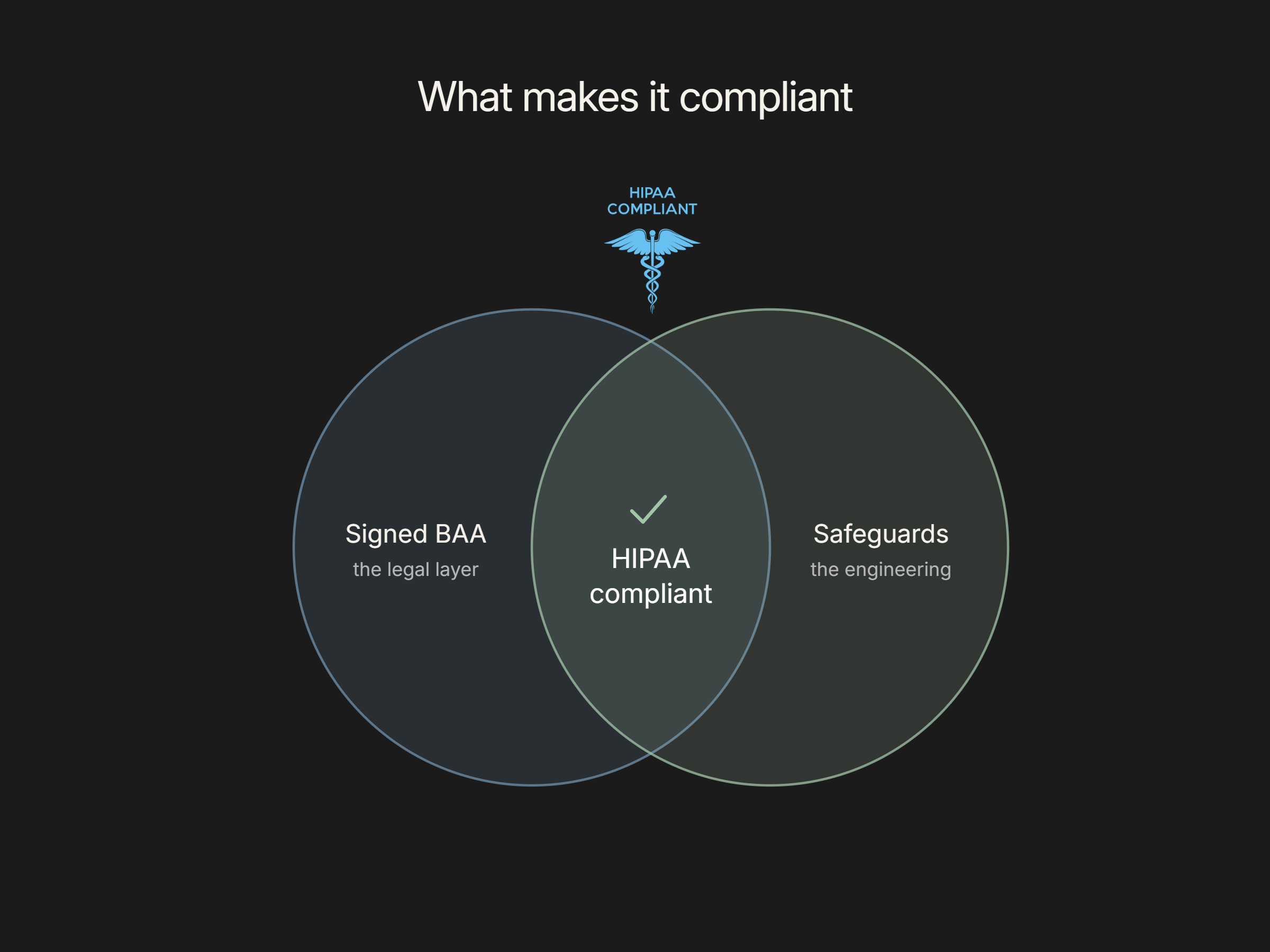
Two things together: a signed business associate agreement and the technical safeguards the Security Rule requires. The agreement is the legal layer; the safeguards are the engineering. HIPAA's technical-safeguards regulation, 45 CFR 164.312, requires access controls, audit controls, integrity protections, and transmission security for electronic PHI. For a phone system that means encrypted call audio and transcripts, unique logins with role-based access, an audit trail of who accessed what, and encryption of data moving between the caller, the AI, and your EHR, such as Epic, Cerner, or athenahealth. A vendor that offers a BAA but cannot describe these controls is offering paperwork without substance. Compliance lives in the combination: the contract that assigns responsibility and the implemented safeguards that make the responsibility real.
Want this mapped against your own call and claim volume? Book a 30-minute audit
What should a BAA cover?
The business associate agreement defines how the vendor may use PHI and what it must do to protect it. HHS publishes sample provisions that a compliant BAA should include: the permitted uses and disclosures of PHI, a commitment to implement Security Rule safeguards, a duty to report security incidents and breaches to the covered entity, terms binding any subcontractors to the same rules, a provision for returning or destroying PHI when the contract ends, and the right for the practice to audit compliance. For an AI phone vendor, pay attention to the subcontractor clause, because voice systems often rely on cloud infrastructure and speech models. Each of those downstream providers must be covered. Read the data-return and destruction terms too, since call recordings and transcripts are PHI that has to be handled at offboarding.
A BAA is the floor, not the evaluation. Flexbone signs one and documents its encryption and access controls on its security page, which is the level of detail worth requesting from any vendor.
See what AI can run at your facility. In a 30-minute audit we map the calls, eligibility, and follow-ups Flexbone can take off your team first.
Book an auditHow is PHI protected on AI calls?
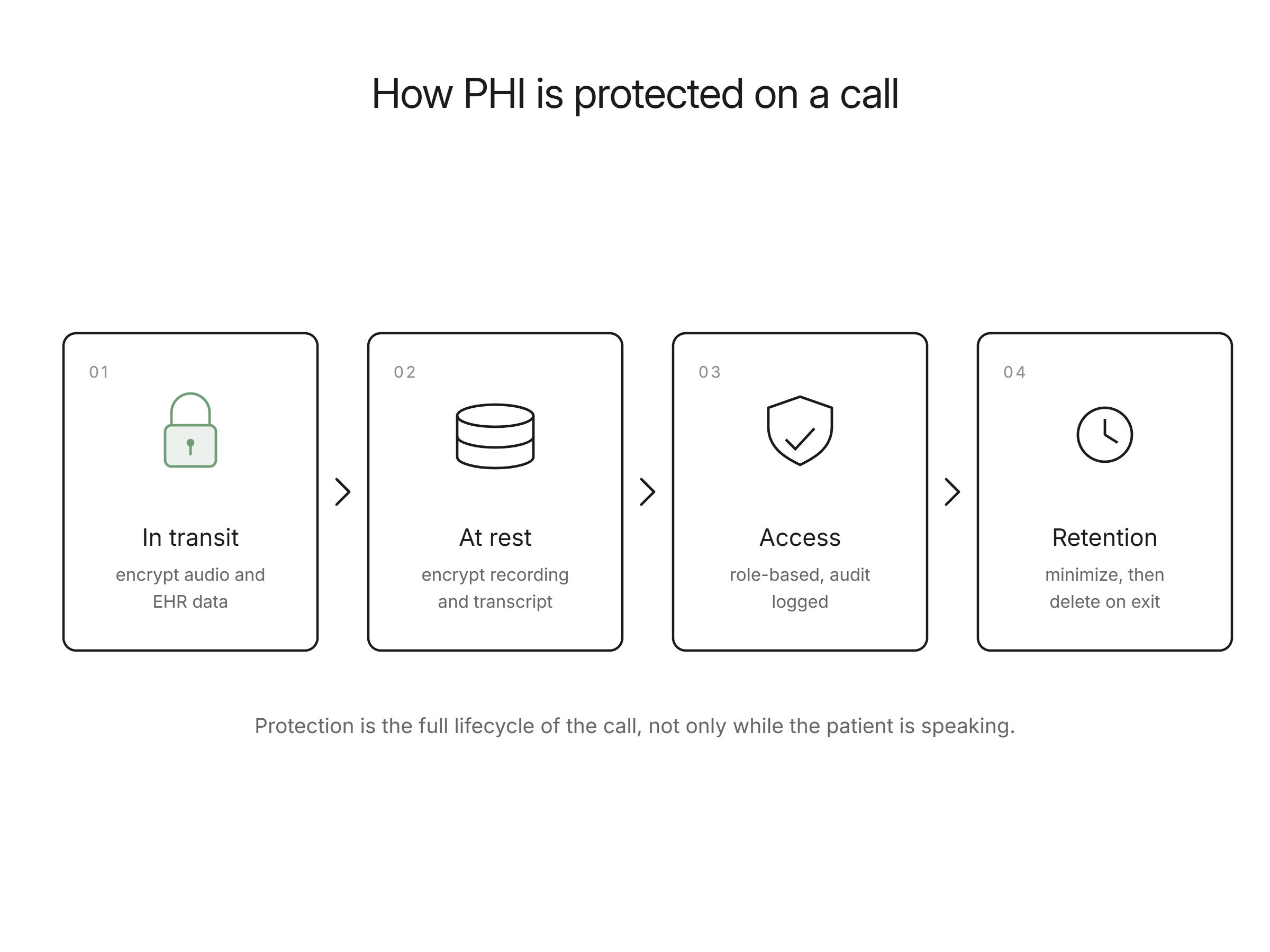
On a call, PHI is protected by encrypting the audio stream and any data exchanged with the EHR, then by encrypting the recording and transcript at rest and restricting who can open them. Encryption is the control HHS emphasizes for data in motion and at rest; the HIPAA Journal's reference notes that encryption renders PHI unusable to an unauthorized party and is the practical standard for transmission and storage. Ask specifically where recordings live, how long they are retained, and whether call data is ever used to train models, because model training on PHI is a use that the BAA must permit and one a practice will usually want to refuse. Good systems minimize what they keep, redact PHI from logs where possible, and give the practice control over retention. Protection is the full lifecycle of the call, not only the moment the patient is speaking.
What questions should you ask a vendor?
Ask five. First, will you sign a BAA, and does it bind your subcontractors and cloud providers? Second, how is PHI encrypted in transit and at rest, and who can access recordings and transcripts? Third, is any call data used to train or improve models, and can we opt out? Fourth, what are your retention and deletion policies, and can we set them? Fifth, can you show a recent third-party audit such as SOC 2? These questions matter more each year as oversight tightens: HHS has proposed strengthening the Security Rule's cybersecurity requirements for electronic PHI, which signals where expectations are heading. A vendor that answers all five plainly, with documentation, is one you can defend to an auditor. Vague answers are the warning sign.
How Flexbone approaches HIPAA-compliant voice
Flexbone deploys AI voice agents for patient access and revenue-cycle calls, including eligibility checks that use the 270/271 transaction and claim-status calls that use 276/277, and treats compliance as engineering rather than a claim. That means a signed BAA that covers subcontractors, encryption of call audio and transcripts in transit and at rest, role-based access with audit logging, and defined retention controls, all under an audit-first, HIPAA compliant, SOC 2-aligned program. Each call leaves a transcript and an outcome you can review, so oversight is built in rather than added later.
Walk through the controls with our team: book a demo, or read more about our healthcare call automation.