Ambulatory surgery centers entered 2026 squeezed from three directions at once. Labor cost per case is up, payer reimbursement per CPT is flat or down, and the talent pool for experienced surgical schedulers, pre-op nurses, and RCM staff has thinned out. ASCA's 2025 benchmark survey pegged median staff cost per case at roughly 28% of net revenue, a number that has crept up every year since 2020. MGMA's 2024 cost survey reported that surgical practices spent more than $12 on administrative labor for every claim submitted, and CAQH's 2024 Index put the manual-versus-electronic cost gap for a single eligibility check at $10.92.
Those numbers are the reason every ASC operator we talk to in 2026 is asking the same question: where does AI actually cut cost in a surgery center, and how much?
This post walks through the five places ASCs are deploying AI right now, the math behind the savings, and the platforms (HST Pathways, SIS, Provation, AdvantX) where the integrations are already production-grade. If you want to run the numbers against your own case volume, use the ASC ROI Calculator, the defaults below match its assumptions.
Why are ASCs looking at AI in 2026?
The short answer is that the arithmetic finally works. Three things changed.
First, voice and browser agents crossed the reliability threshold. A 2024 KLAS report on AI in revenue cycle found that organizations with production AI deployments were reporting 30-70% reduction in manual touches on the workflows they automated, not pilots, production. By 2026 the top RCM vendors and a handful of specialist shops (Flexbone included) are running agents that handle pre-op patient calls, eligibility checks, prior auth submissions, and denial appeals end to end.
Second, the labor math got worse. ASCA's 2025 Salary and Benefits Survey showed RN wages in ASCs rose 18% from 2021 to 2024, and surgical schedulers and insurance verification specialists were both on the BLS's "hard to fill" list for all of 2024 and 2025. Every hour of admin work you can push to an agent is an hour you don't have to hire for.
Third, payer behavior got more adversarial. The 2024 CAQH Index reported that 74% of medical prior authorizations were still fully or partially manual, and KLAS's 2025 denials report showed denial rates at ASCs climbing to 11-13% of submitted charges. Manual appeal writing at $15-25 per appeal makes denial recovery uneconomical below a certain dollar threshold, until an agent writes the first draft in 90 seconds.
The combination means AI isn't a "nice to have" for 2026. It's the way the P&L balances.
What does AI for ASCs actually do?
The useful framing isn't "AI", it's "which agent type does which piece of the ASC workflow." Five categories cover almost every production deployment we've seen:
- Pre-op patient calls, voice agents that call every scheduled patient 3-7 days out, confirm arrival, collect NPO compliance, read pre-op instructions, answer routine questions, and escalate anything clinical to a nurse.
- Insurance eligibility and benefits verification, browser agents that check coverage on every payer portal the center touches, pull copay and deductible, and flag terminated coverage before the case is booked.
- Prior authorization, browser + document agents that submit PAs to payer portals, monitor status, and re-submit when payers request more clinical.
- Denial triage and appeal drafting, document agents that read the 835/EOB, match denial reason to the original claim, and draft a payer-specific appeal letter for human review.
- Post-op outreach, voice agents that call patients 24-48 hours post-procedure for symptom check, satisfaction survey, and readmission risk screening.
Every one of those has a corresponding capability page: healthcare calls, eligibility verification, denials management, and the ASC-specific integration surface at AI for HST Pathways. We'll dig into the unit economics of each below.
How much does AI save per case in an ASC?
Here's the per-case math we use in audits. The numbers are intentionally conservative, ASCs that are starting from a high-touch manual baseline see more, ASCs that have already invested in RCM software see less.
Baseline admin cost per ASC case (manual workflow):
Task
Minutes
Fully loaded labor rate
Cost
Pre-op phone call (sched + clinical + insurance)
12
$0.75/min
$9.00
Eligibility and benefits verification
8
$0.75/min
$6.00
Prior authorization submission
22
$0.85/min
$18.70
Claim scrub + submission
6
$0.85/min
$5.10
Denial triage and appeal (applied to 11% of cases)
35 × 0.11
$1.00/min
$3.85
Post-op call
7
$0.75/min
$5.25
Total per case
~$47.90
That's against ASCA's reported median admin cost per case in the $45-65 range, so the stack checks out. For a 4,000-case-per-year ASC, that's roughly $192,000 of front-office and RCM labor per year, not counting managers, billers' salaries above variable touch time, or denials that never get worked because the appeal isn't worth the labor.
With AI agents deployed across the five categories:
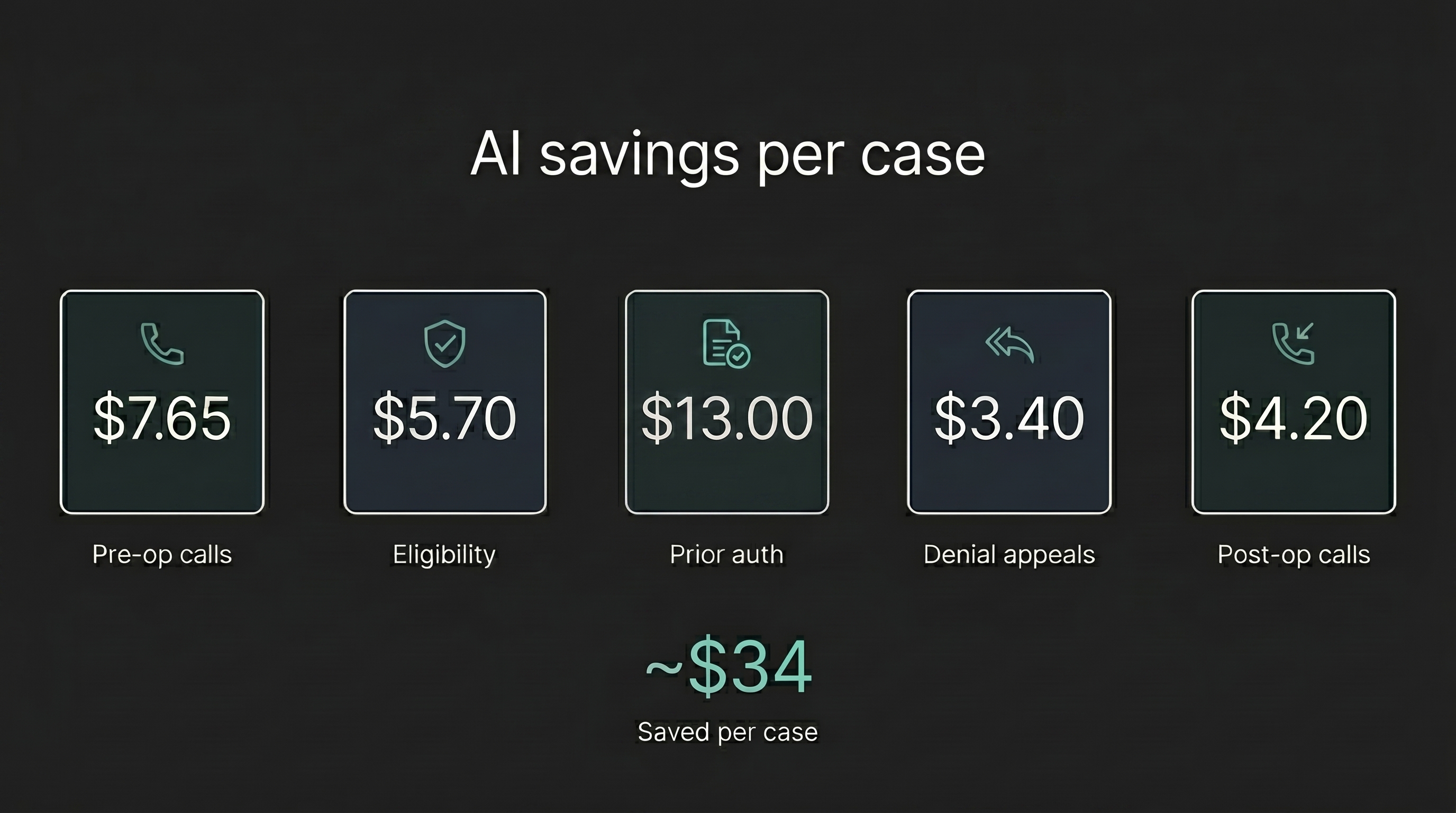
- Pre-op calls: 85% of calls handled agent-only → $7.65 saved per case
- Eligibility: ~95% agent-only → $5.70 saved per case
- Prior auth: 60% agent-only, 30% agent-assisted → $13.00 saved per case
- Denials: first-draft appeal in ~90 seconds vs. 35 min → $3.40 saved per case (weighted)
- Post-op calls: 80% agent-only → $4.20 saved per case
Total modeled savings: ~$34 per case, or roughly $136,000/year for a 4,000-case ASC. That figure matches what we're seeing in deployments and what KLAS reports as the mid-range for "production AI in RCM" case studies. The ASC ROI Calculator lets you vary case volume, denial rate, and automation penetration.
Two things to note about the math. First, the biggest line is prior auth, because it's the most time-expensive task and the one AI handles best. Second, the denial-recovery savings look small per case but are asymmetric: ASCs that previously wrote off appeals under $500 recover meaningful revenue once the marginal cost of drafting an appeal collapses.
How does AI handle prior authorization in ASCs?
Prior auth is the single most expensive admin task at most ASCs, and the 2024 CAQH Index confirms it's still 74% manual industry-wide. Three agent types do the work together:
- A browser agent logs into the payer portal (Availity, UHC, Aetna, BCBS regional, Medicare Advantage plans) and submits the PA using data pulled from the EHR.
- A document agent reads the clinical note, op report draft, and prior test results to build the clinical justification.
- A voice agent handles peer-to-peer review scheduling when a payer escalates.
The result is PAs submitted within hours of the case being scheduled instead of days, which matters because delayed PA is the #1 preventable reason for last-minute cancellations, and every cancelled ASC case is $1,500-$3,000 of fixed cost you can't recover. See our deeper writeup on prior authorization automation for the workflow diagrams.
How does AI reduce ASC denials and speed appeals?
KLAS's 2025 denials report found that 65% of denials are either fully recoverable or partially recoverable, but centers leave roughly a third of that money on the table because manual appeal writing isn't economically worth it below a ~$300-500 threshold per claim.
AI breaks that constraint. An agent reads the 835, identifies the CARC/RARC, pulls the original claim and clinical documentation, and drafts a payer-specific appeal letter, typically in under two minutes. A human biller reviews and sends. The economics flip: appeals that were previously written off because the labor cost exceeded the expected recovery now get worked. Early deployments are reporting 15-25% lift in net collections from previously-written-off denials. Full workflow on the denials management page.
What about eligibility verification, isn't that already automated?
Sort of. 270/271 EDI handles about 60-70% of commercial eligibility today, but ASCs still spend significant time on the portal-only payers, the Medicaid MCOs that return incomplete 271s, and the cases where the 271 says "active" but the patient's plan actually terminated last week. CAQH puts the per-transaction cost of a manual eligibility check at $10.92 vs. $0.31 electronic.
Browser agents close the last-mile gap: they check every payer portal the ASC touches, capture copay and deductible screenshots for the patient file, and flag coverage changes before the patient arrives. See insurance eligibility verification for details on which portals we've integrated.
Which ASC EHR and practice management systems does AI integrate with?
Every ASC we've deployed into runs one of a handful of platforms. Flexbone has production integrations with each:
- HST Pathways, the reference deployment, documented end-to-end on /ai-for-hst-pathways. Voice agents read/write to HST's scheduling, eligibility posts back as a worklist entry, PAs are tracked against the case record.
- SIS Complete (Surgical Information Systems), browser-agent-driven integration for PA, eligibility, and denials; case status sync via desktop agent where needed.
- Provation, document agent integrations for op note extraction and case-level CPT/ICD-10 retrieval feeding claim scrubbing.
- AdvantX (Source Medical / Surgical Notes), browser and desktop agent deployment pattern given AdvantX's thick-client footprint.
Parallel EHR-specific landing pages for each of these are live or going live alongside this post. The short version: if the ASC software has a web UI or a Windows client, we can put an agent on it.
How long does an ASC deployment take?
Every Flexbone engagement starts with a one-week operational audit, listening to call recordings, shadowing schedulers, mapping the exact PA and denial workflows in place today. That's not a sales exercise; it's what keeps the AI from breaking on edge cases. (Our writeup on why we audit before we automate explains the reasoning.)
After the audit, production deployment for the five workflows above typically runs 4-6 weeks:
- Week 1: Audit.
- Weeks 2-3: Voice agents for pre-op and post-op calls go live first (lowest risk, fastest ROI).
- Weeks 3-4: Eligibility browser agents and PA submission agents in parallel.
- Weeks 5-6: Denial triage and appeal drafting agents, tuned against the center's payer mix.
The reason it's not instant is the audit. The reason it's not six months is that the agent infrastructure is already built, deploying to a new ASC is mostly configuration and training against the center's specific payer list, scheduler rules, and EHR layout.
What's the ROI payback period?
For a 4,000-case ASC with a typical 2026 cost structure, AI deployment pays back in roughly 4-6 months, measured as Flexbone fees vs. recovered labor hours + recovered denials. ASCs above 6,000 cases pay back faster because the fixed engineering cost spreads further. ASCs below 2,000 cases should look at specific pain points (usually PA or denials) rather than full-stack deployment.
Run your own numbers on the ASC ROI Calculator, it ships with the baseline assumptions above and lets you swap in your actual case volume, denial rate, and current staffing cost.
What to do next
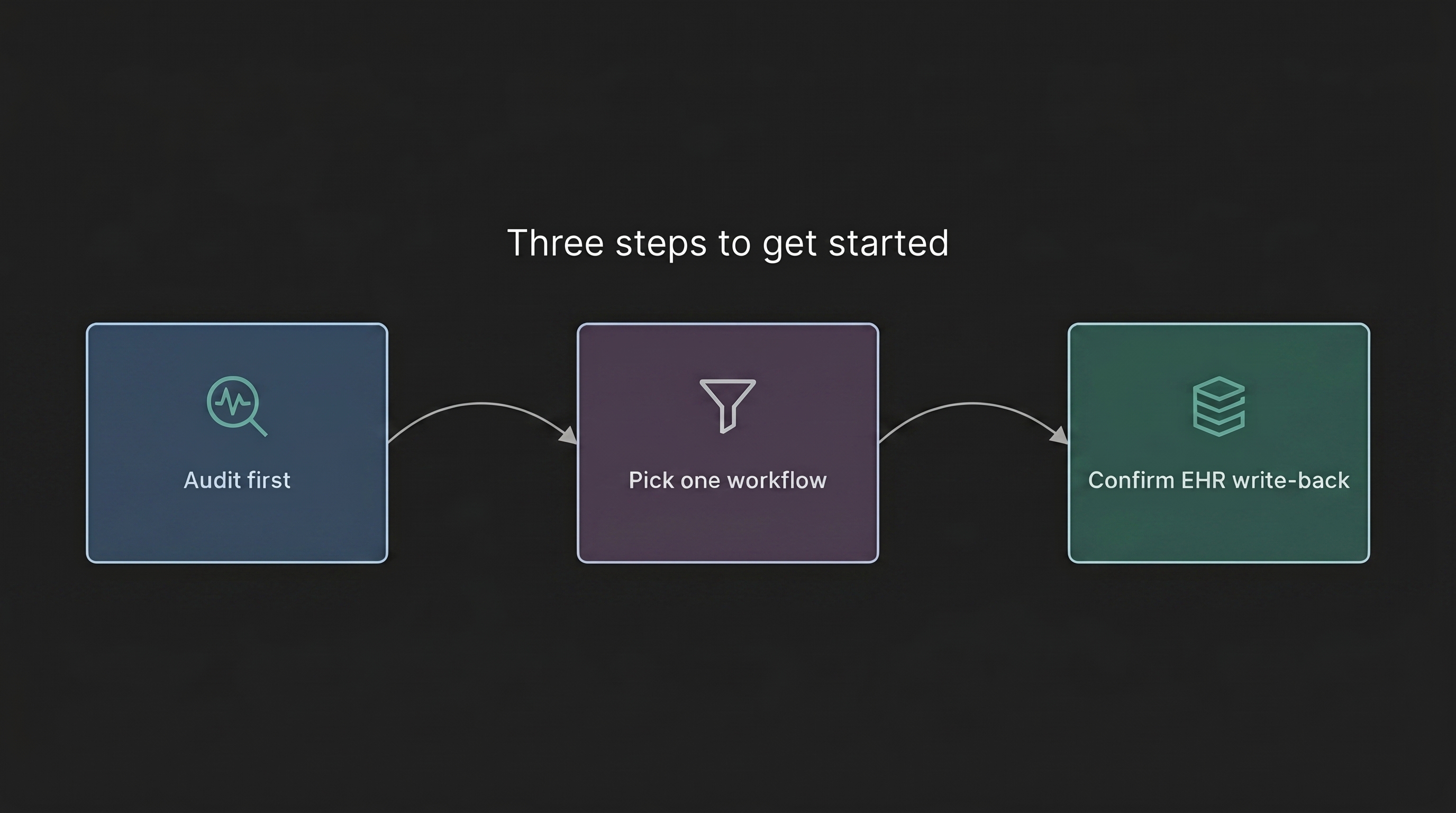
If you operate an ASC and the 2026 P&L is getting tighter, three concrete next steps:
- Audit first. Don't buy AI from a deck. Listen to 100 of your own inbound and outbound calls with someone who knows what automatable looks like. We do this as a one-week engagement; so does a handful of other shops. Either way, do it.
- Pick a single workflow for the first deployment. Usually prior auth (highest $ per hour) or pre-op calls (lowest risk). Prove the unit economics before you do all five.
- Make sure the agent writes into the EHR you actually use. Generic voice-AI vendors don't. Platform-specific integrations, HST Pathways, SIS, Provation, AdvantX, are the difference between an agent that helps and an agent that creates a second queue for staff to clean up.
The ASCs that deploy AI well in 2026 will run the same case volume with materially fewer admin FTEs, rescue a layer of denied revenue that used to be uneconomical to appeal, and cancel fewer cases because PA actually happens on time. The ones that don't will spend the year hiring against a shrinking labor pool.
If you want to talk through the math for your specific center, book an audit. We'll bring the call recordings and the spreadsheet.