
An AI receptionist works by turning a phone call into a short loop: it answers the line, converts the caller's speech to text with speech recognition, and passes that text to a language model that identifies what the caller wants. It then acts on that intent inside connected systems, such as booking a visit in the scheduling calendar, checking hours, or starting a transfer to a person, and it speaks the answer back with text-to-speech. The caller has a normal back-and-forth conversation rather than navigating a menu tree. The point is to keep the phones answered when staff are busy, because they frequently are. MGMA reports that phones remain a persistent backlog that costs practices time. A virtual medical receptionist built this way absorbs that first-line volume and routes anything clinical or sensitive to a human.
How do AI receptionists work?
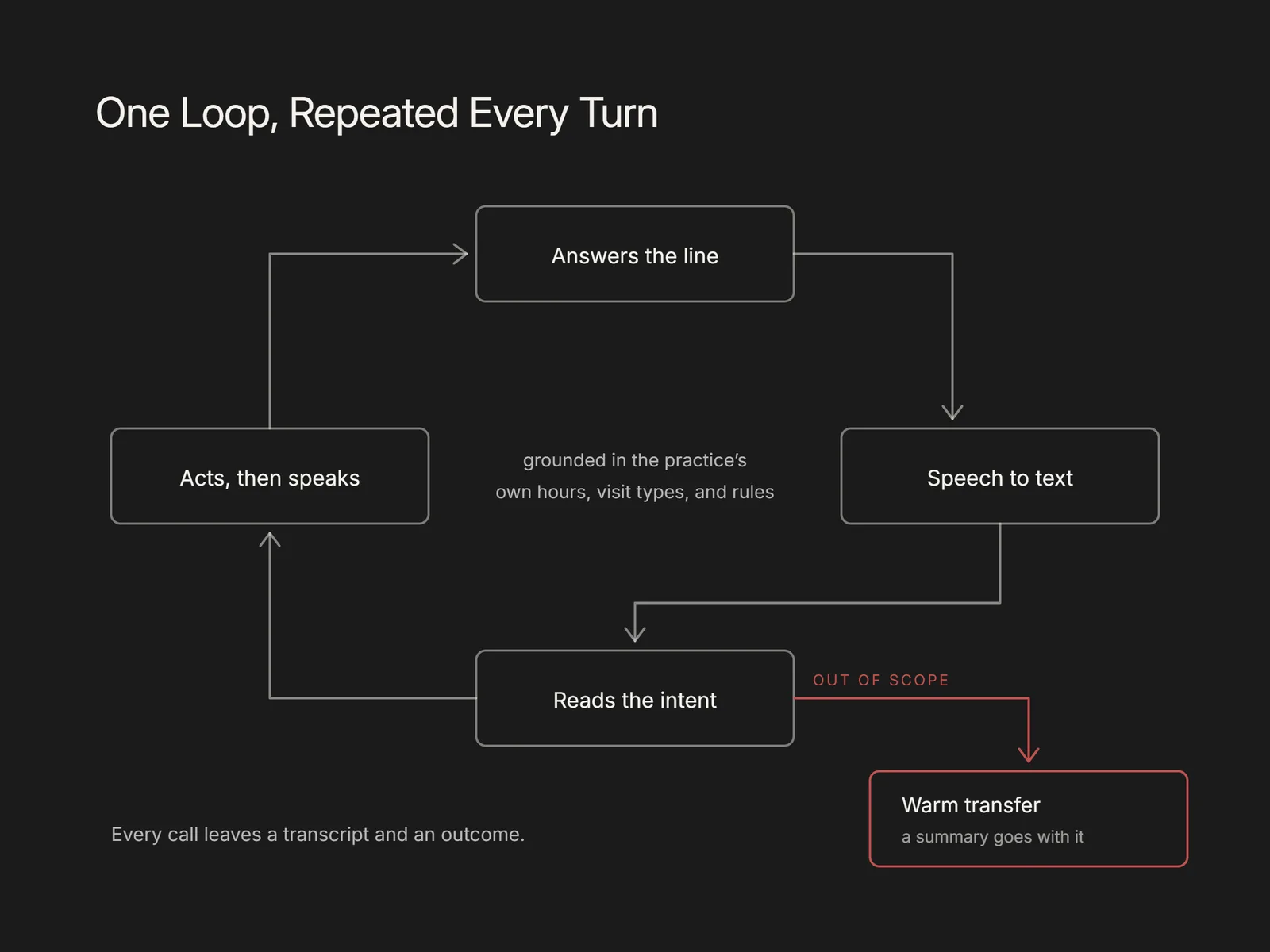
An AI receptionist runs a four-step cycle on each call. First, it answers and captures the caller's audio. Second, speech recognition transcribes what the caller said into text in real time, including handling pauses and interruptions. Third, a language model reads that text against the practice's configured knowledge and rules to determine intent: is this a scheduling request, a coverage question, a refill, or something that needs a person? Fourth, it acts and responds, either completing the task through a connected system or transferring the call, then speaking the reply with a natural voice. Because the model is grounded in the practice's own information, such as provider hours, visit types, and escalation rules, it answers from fact rather than guessing. Each interaction is logged with a transcript and an outcome, so the team can review what was said and what the agent did. This is the mechanism behind a Flexbone AI medical receptionist: understand the caller, act inside the system of record, and hand off when needed.
Want this mapped against your own call and claim volume? Book a 30-minute audit
Can an AI receptionist transfer calls?
Yes, and transfer is a core part of a well-built AI receptionist rather than an afterthought. The agent is configured to recognize when a call should move to a person and to do so cleanly. Three triggers are typical: the caller explicitly asks for a human, the agent has low confidence that it understood the request, or the topic falls outside its defined scope, such as a clinical or urgent question. When one of those fires, the agent performs a warm transfer, meaning it passes a short summary of the call to the staff member who picks up: who the caller is, what they asked, and what the agent already did. That way the caller does not start over and the person is not working blind. The escalation rules are set up front during configuration, so the boundary between what the agent handles and what a person handles is explicit and predictable, not left to chance on each call.
See what AI can run at your facility. In a 30-minute audit we map the calls, eligibility, and follow-ups Flexbone can take off your team first.
Book an auditCan an AI receptionist book appointments?
Yes, and scheduling is one of the highest-value tasks an AI receptionist does because it protects revenue by keeping the calendar full. The agent reads live availability directly in the scheduling system, so it offers slots that are genuinely open rather than a stale list. It matches the request to the correct provider and visit type, confirms the details with the caller, and then writes the appointment back to the system of record, whether that is athenahealth, eClinicalWorks, NextGen, or Epic. It handles reschedules and cancellations the same way and can send a confirmation by text so the caller has a record. It can also run outbound scheduling work, such as calling a waitlist when a slot opens or confirming the next day's visits. A Flexbone virtual medical receptionist books, reschedules, and confirms inside the practice's existing calendar, so the front desk does not re-key anything by hand.
Will AI replace receptionists?
For most front-desk teams the honest answer is no, and it is better understood as a division of labor than a replacement. An AI receptionist is strong on the repetitive, well-defined work: answering many calls at once, covering after-hours and overflow, scheduling, and simple status questions. It is deliberately not the right tool for the calls that need human judgment, such as a distressed caller, a sensitive account issue, or a request that does not fit any script. The arrangement we see work is the agent answering first and resolving the routine volume, then escalating anything ambiguous or emotional to a person with context attached. That keeps two things true at once: no call goes unanswered, and the people on the team spend their time on the calls that actually need them. The goal is coverage without overload, not removing staff from the front desk.
Are AI receptionists HIPAA compliant?
An AI receptionist can be HIPAA compliant, but compliance is a property of the deployment, not a badge the software carries by default. Because the system creates, receives, and stores protected health information on the practice's behalf, the vendor is a business associate and must sign a business associate agreement before handling any calls. Under HIPAA, a covered entity must have a contract that binds the business associate to safeguard PHI. Beyond that contract, look for encryption in transit and at rest, access controls with audit logging, workforce training, and a defined breach-notification process. Ask specifically where call recordings and transcripts are stored, who can access them, and how long they are retained. A vendor that treats HIPAA as a signed BAA plus documented technical safeguards, rather than a marketing claim, is the one to trust with patient calls.
How Flexbone runs an AI receptionist inside your EHR
A generic answering service takes a message and stops. Flexbone deploys AI voice, browser, and document agents that resolve front-desk work inside your EHR: answering calls, scheduling and confirming, verifying coverage on payer portals, and escalating clinical or sensitive calls to your team with full context. The approach is audit-first, HIPAA compliant, and SOC 2-aligned, so each call leaves a transcript and an outcome you can review.
See it run against your workflows: book a demo, or read more about our AI medical receptionist. For how this works across a full practice, including payer calls and escalation design, see AI voice agents for healthcare.