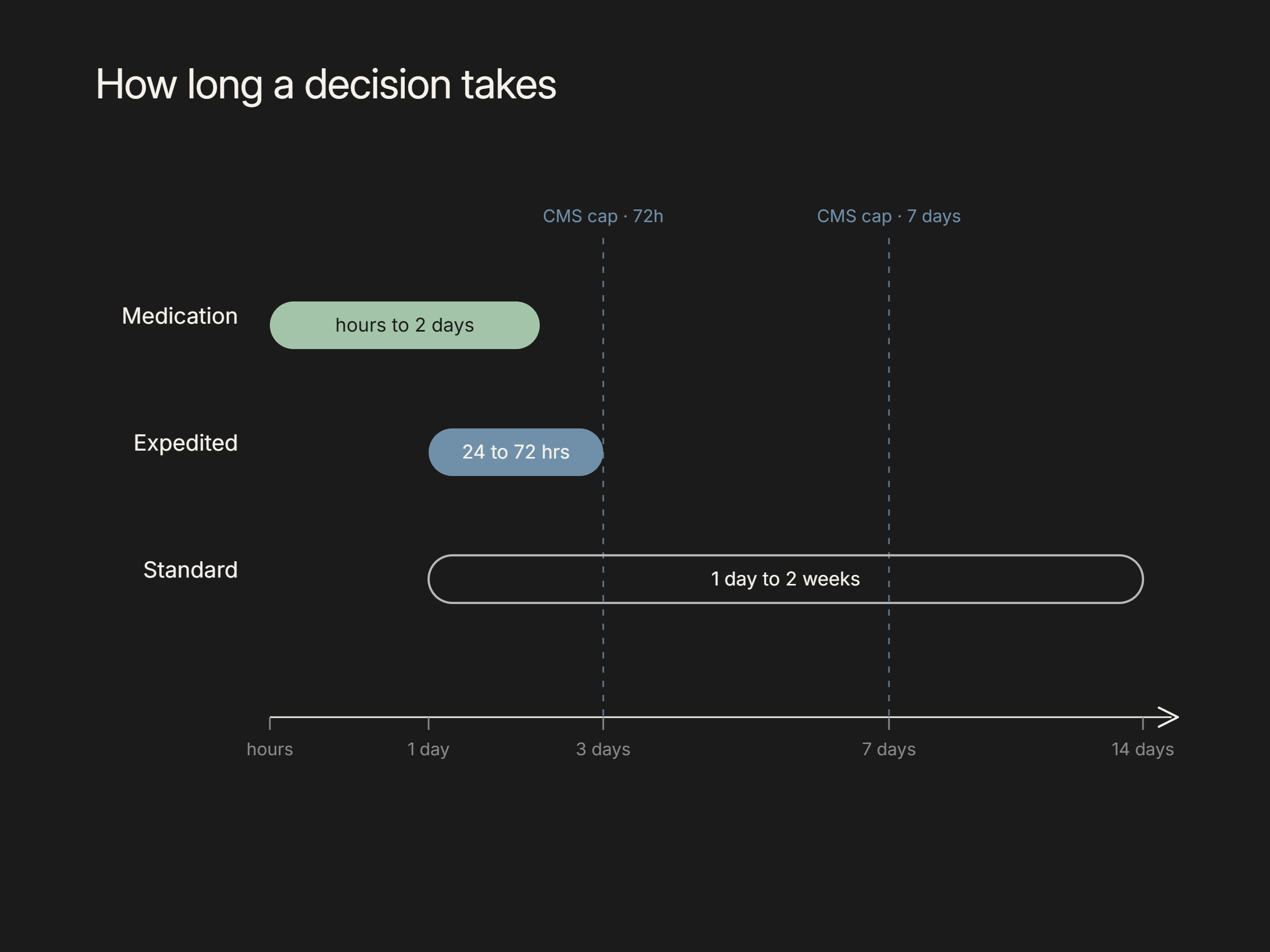
How long does prior authorization take depends on whether the request is standard or urgent and whether it is for a medication or a medical procedure. A standard prior authorization usually takes from one business day to about two weeks, with most decisions landing somewhere in the middle when documentation is complete. Urgent or expedited requests are generally decided within 24 to 72 hours. Prior authorization for medication is often faster than for a procedure, because many drug requests run through electronic systems and can clear in a few hours to two business days. Starting in 2026, the CMS Interoperability and Prior Authorization Final Rule (CMS-0057-F) standardizes these windows for impacted payers, requiring standard decisions within 7 calendar days and expedited decisions within 72 hours.
How long does prior authorization take for a standard versus expedited request?
The single biggest factor in the prior authorization timeline is whether the request is filed as standard or expedited. A standard request is the default path for non-urgent, scheduled care, and payers historically took anywhere from a few days to two weeks to return a determination. An expedited or urgent request applies when a delay could seriously jeopardize the patient's health, and those are decided far faster, commonly within 24 to 72 hours.
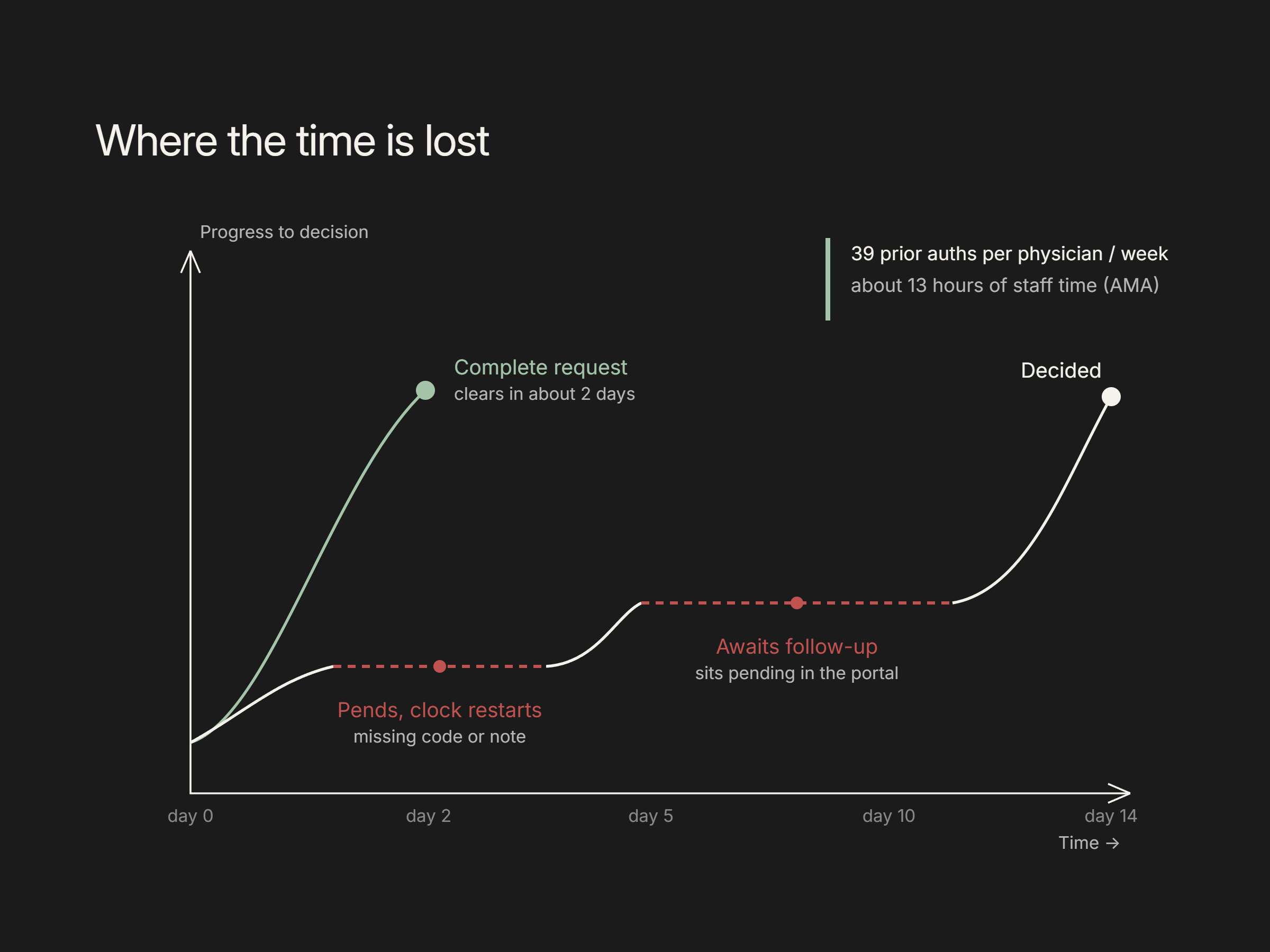
The gap between the two is not about payer generosity. It is about how the request is coded and flagged at submission. A case marked urgent, with documentation that supports the urgency, enters a faster review queue. A case that could have qualified for expedited review but was filed as standard sits in the ordinary queue and waits. Clean documentation matters at both speeds: a request missing a diagnosis code or a supporting note gets returned or pended, and the clock effectively restarts.
Want this mapped against your own call and claim volume? Book a 30-minute audit
Why does prior authorization take so long?
Prior authorization is slow for structural reasons, not because any single step is complicated. There are roughly 1,100 U.S. payers, and each maintains its own code list, its own submission portal, its own clinical criteria, and its own preferred channel. No single connection reaches all of them, so staff move between portals, fax, and phone depending on the plan.
Most of the elapsed time is waiting and rework rather than review: a request sits in a queue, comes back for one missing document, and starts over. Flexbone goes after the rework by assembling complete packets before submission and checking status on a schedule rather than by memory, and it measures where the practice's own requests stall before choosing what to automate. The approach is in prior authorization automation.
Two failure modes account for most of the lost time. The first is incomplete submission: a missing ICD-10 digit, an absent progress note, or a code that requires documentation the payer did not receive. The request pends, someone has to notice, and the correction adds days. The second is the follow-up burden. A determination that sits in a portal marked "pending" does not resolve itself, and a staff member has to log back in or call to move it along. That phone step is often where hours disappear. According to the American Medical Association's prior authorization survey, practices complete an average of 39 prior authorizations per physician per week and spend about 13 hours of physician and staff time on them, which gives a sense of how much manual labor is folded into the timeline.
How long does prior authorization take for medication?
Medication prior authorization is often quicker than medical or procedural authorization, and the reason is infrastructure. Pharmacy benefit managers have supported electronic prior authorization for years, so a clean request for a formulary-adjacent drug can be decided within a few hours to two business days. When the prescriber's system submits the required clinical answers up front, many of these clear without human review at all.
The slower medication cases are predictable. Non-formulary drugs, specialty medications, high-cost biologics, and step-therapy exceptions require additional clinical review, and some trigger a peer-to-peer conversation between the prescriber and the plan's medical director. Those can stretch the timeline from days into a week or more. If a drug denial arrives, the appeal adds its own window on top. The practical takeaway is that the medication itself, and whether it sits on the plan's formulary, predicts the timeline more than the payer does. For a fuller walkthrough of the drug workflow, see our guide to electronic prior authorization workflows.
See what AI can run at your facility. In a 30-minute audit we map the calls, eligibility, and follow-ups Flexbone can take off your team first.
Book an auditWhat does the CMS 2026 rule change about prior authorization timelines?
The CMS Interoperability and Prior Authorization Final Rule, known as CMS-0057-F, sets firm decision windows that previously varied by payer and plan. Under the final rule, impacted payers, which include Medicare Advantage organizations, state Medicaid and CHIP fee-for-service programs, Medicaid and CHIP managed care plans, and Qualified Health Plan issuers on the federal exchanges, must send expedited decisions within 72 hours and standard decisions within 7 calendar days for medical items and services. Most of these operational provisions take effect January 1, 2026, while the underlying prior authorization API requirements follow on a later compliance timeline.
For some payers, the 7-day standard cuts the prior decision window roughly in half. Two caveats keep this grounded. The rule covers government-adjacent plans, so a large share of commercial prior authorization still runs on each plan's own timeline. And the rule sets a maximum, not a typical case: a complete, well-documented request can still resolve well inside these limits, while an incomplete one that pends does not benefit from the ceiling. The rule raises the floor on payer responsiveness; it does not remove the work of assembling and following up on each request.
How can you speed up prior authorization?
Most of the delay in a prior authorization is avoidable, and the levers are practical rather than clever. Getting the first submission right removes the largest source of lost days.
- Submit complete requests. Attach the diagnosis and procedure codes and the supporting clinical notes the payer's criteria call for, so the request does not pend for missing information.
- Flag clinically urgent cases for expedited review, with documentation that supports the urgency, to move into the 72-hour window rather than the standard queue.
- Check requirements before submitting. Confirm whether the specific code needs authorization for that plan, which avoids both unnecessary requests and surprise denials.
- Follow up on a schedule. A pending determination that no one revisits simply waits, so consistent status checks keep it moving.
- Route denials straight into appeals or a peer-to-peer request, since a denied auth that sits untouched compounds the delay for the patient.
For a broader treatment of the end-to-end process, our guide on how to automate prior authorization covers the workflow in depth.
How Flexbone shortens the prior authorization timeline
Flexbone applies AI agents to the parts of the timeline where time is actually lost: submission, waiting, and follow-up. An LLM assembles the medical-necessity packet from the chart so the first submission is complete and less likely to pend. Browser agents log into payer portals, file the request, and capture the reference number, while AI voice agents handle the plans that still require a phone call, hold in payer queues, and check status across portals and phone lines. Results are written back to the EHR so staff see the current state without repeating a lookup.
The design is audit-first: we start by pulling your own prior authorization history, measuring current turnaround by payer and service, and running agents in shadow mode before any autonomous operation. The platform is HIPAA compliant and SOC 2 aligned, and cases the agents cannot finish end-to-end, such as novel drug requests, peer-to-peer reviews, and complex appeals, are escalated to a staff specialist with the context already assembled. The goal is a shorter and more predictable timeline on the volume that follows a pattern, not a claim that the hard cases clear without a person. You can read more on our prior authorization automation page.
If you want to see what this would do to your own turnaround times, book a demo.