
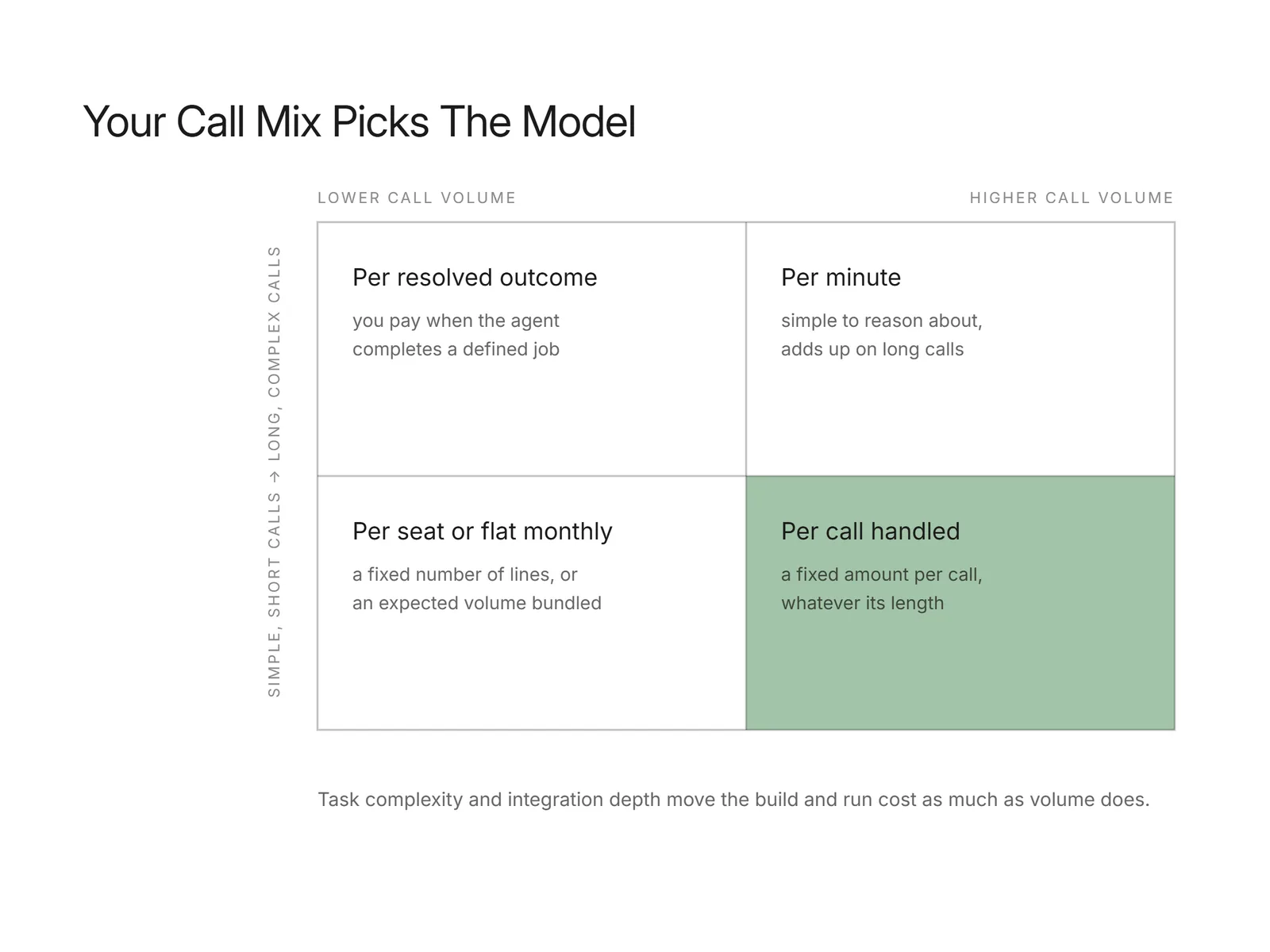
An AI voice agent does not have a single price, because the cost depends on the pricing model and how much you use it. Vendors bill in a few common ways: per minute of call time, per call handled, per resolved task or outcome, per seat for a set number of concurrent agents, or a flat or custom monthly rate. What you actually pay is driven by three things: your call volume, the complexity of the tasks the agent runs, and how deeply it integrates with your systems. A high volume of short, simple calls prices very differently from a low volume of long, complex ones. The useful way to think about cost is as a framework rather than a number: pick the model that matches your call mix, then estimate usage against your real volume.
What pricing models do AI voice agents use?
AI voice agents are usually priced in one of five ways, and some vendors combine them. Per-minute pricing charges for the time the agent spends on calls, which is simple to reason about but can add up on long calls. Per-call pricing charges a fixed amount for each call handled regardless of length, which suits high volumes of short calls. Per-resolved-task or per-outcome pricing charges only when the agent completes a defined job, such as a confirmed appointment or a logged status update, so you pay for results rather than activity. Per-seat pricing charges for a fixed number of concurrent agent lines and fits steady, predictable volume. A flat or custom monthly rate bundles an expected volume into one recurring price, often with usage tiers above a threshold. Many vendors pair a base platform fee with usage on top, so read a quote for both parts rather than the headline rate alone.
Want this mapped against your own call and claim volume? Book a 30-minute audit
What drives the cost of an AI voice agent?
Three factors move the price more than anything else. The first is call volume, which sets the usage side of nearly every model: more calls or more minutes means a higher bill. The second is task complexity. A call where the agent only reads a status and reports it is cheaper to build and run than a call where the agent has to navigate several systems, make decisions, and handle branching conversations. More complex work takes more design, more testing, and often more processing per call. The third is integration depth. Most of the value comes from connecting the agent to your systems so it can read records and write outcomes back, and that connection work is where much of the setup effort lands. On top of these, the total includes onboarding, testing against your real call patterns, and ongoing monitoring and support. When you compare vendors, weigh all of these, because two agents at the same per-minute rate can cost very different amounts once setup and integration are counted.
See what AI can run at your facility. In a 30-minute audit we map the calls, eligibility, and follow-ups Flexbone can take off your team first.
Book an auditHow does AI voice agent cost compare to staffing?
The honest answer is that it depends on the volume and the type of call. An AI voice agent runs the routine, repetitive calls at a usage-based cost that does not rise with shift coverage, overtime, or seasonal hiring, and it can answer calls outside business hours without standing up a night shift. That makes it well suited to predictable, high-volume phone work that follows a script. Staffing still makes sense for calls that need judgment, negotiation, or relationship work, and for the exceptions an agent is not set up to resolve. Rather than framing it as agent versus people, it helps to ask which slice of your call volume is predictable enough to hand to software and which slice genuinely needs a person. In the deployments we run, most operations use both. The comparison that matters is not the agent's rate against a wage in the abstract, but the cost of running your specific call volume each way.
What is included in the price of an AI voice agent?
The scope behind a price varies enough that the included work is often the real difference between two quotes. Some prices cover only call handling. Others include setup, integration with your systems, testing, monitoring, and support as part of the package. A few questions make the comparison fair. Ask whether telephony and phone number costs are bundled into the rate or billed separately, since call carriage is easy to overlook. Ask whether onboarding and integration are a one-time setup fee or folded into the recurring rate. Ask what support is included after launch, because an agent needs monitoring and adjustment as your call patterns change. The Flexbone features page describes what the agents and browser automation cover, and how Flexbone runs voice agents shows the same listen, decide, act loop working end to end on live calls, which is a useful reference for what "included" can mean in practice. For what the agents actually do once deployed, see AI voice agents for healthcare.
How do you evaluate the ROI of an AI voice agent?
To judge the return, compare the fully loaded cost of the agent against the cost of running the same calls the way you run them today. Start by naming the specific calls you want to automate and estimating their volume, then price them under the model a vendor offers, including setup and support, not just the per-call or per-minute rate. On the other side, account for what those calls cost you now: the time your team spends on them, the coverage you staff to answer them, and the calls that go unanswered when volume spikes. The return also shows up beyond raw cost. An agent runs the same call the same way every time, inbound calls can be answered outside staffed hours, and moving predictable calls to software frees your team for the exceptions. Measure the agent against your real call data, not a general claim, since the numbers depend entirely on your volume and call mix.
Flexbone scopes pricing to the specific workflows and call volume in scope, so the quote reflects the calls your operation actually runs rather than a generic package, and it is sized to your operation. If you want a real number for your situation, book a call with Flexbone and we will run a quick audit of the calls your team handles most, then give you a scoped quote for taking them on.