
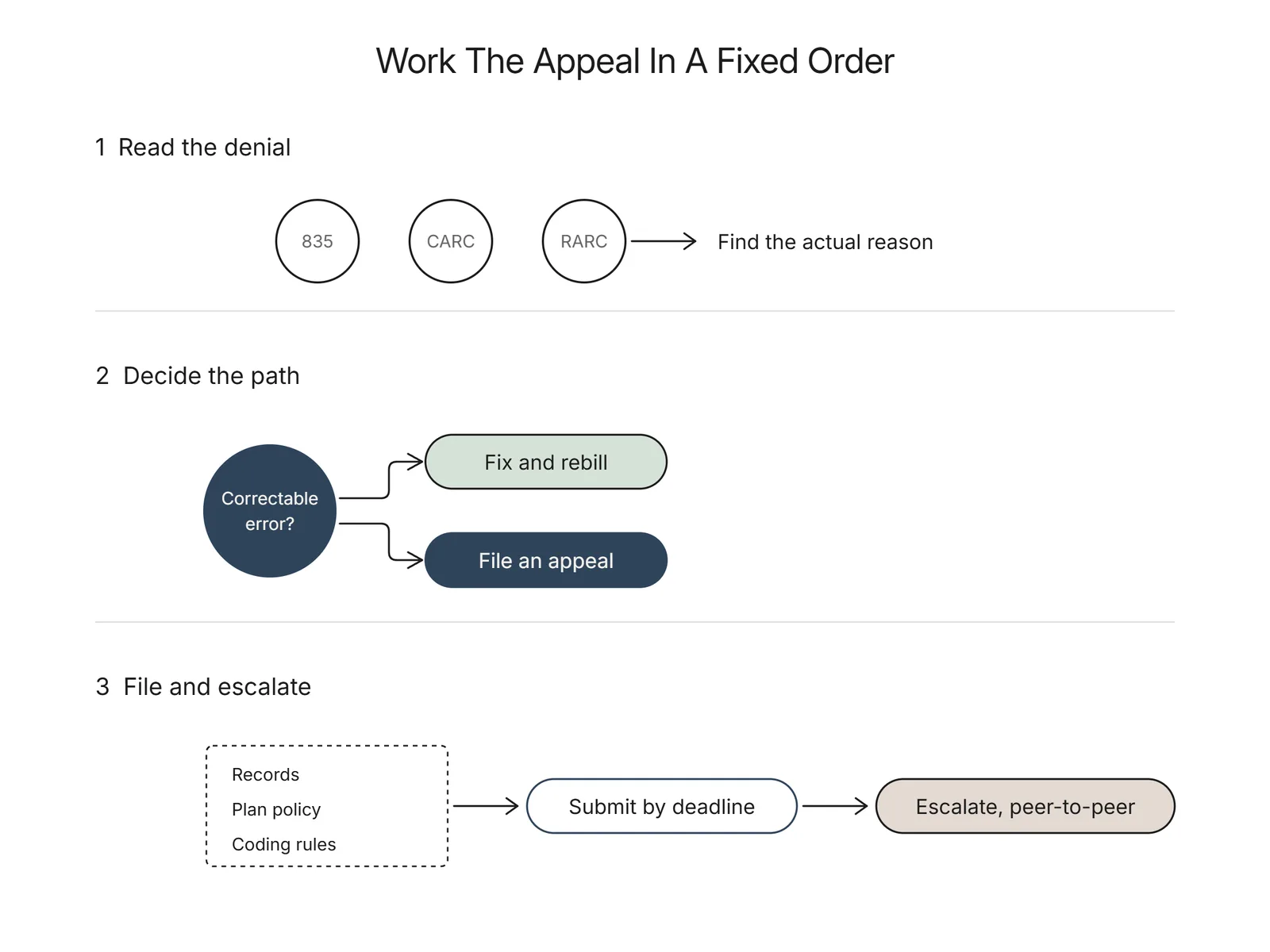
Appealing a denied medical claim starts with reading the denial. Pull the Claim Adjustment Reason Code (CARC) and Remittance Advice Remark Code (RARC) from the 835 remittance advice to learn exactly why the payer did not pay. Decide whether the problem is a correctable error, such as a wrong modifier or missing information, which you fix and rebill, or a true denial of coverage or medical necessity, which you appeal. For an appeal, gather the supporting documentation: the medical records, the plan or policy language, and the coding guidelines that show payment is owed. Submit the appeal within the payer's deadline, which varies by payer and plan. If the first level is upheld, escalate through the payer's higher appeal levels or request a peer-to-peer review with the payer's medical director.
What is the difference between a rejection and a denial?
A rejection and a denial happen at different stages, and confusing them wastes time. A rejection occurs before the payer adjudicates the claim: it fails an edit at the clearinghouse or the payer's front-end system, usually because of a format problem, an invalid member ID, or a missing data element, so it never enters processing. Because it was never adjudicated, you correct the error and resubmit it as a fresh claim rather than filing an appeal. A denial occurs after adjudication. The payer received the claim, processed it, and decided not to pay some or all of it, then reported that decision on the remittance advice with a CARC and often a RARC. A denial is a payer decision on record, so it requires either a corrected rebill or a formal appeal. Reading the remittance tells you which one you are looking at.
Want this mapped against your own call and claim volume? Book a 30-minute audit
What are the steps to appeal a claim denial?
Work the appeal in a fixed order so nothing gets missed. First, read the denial: pull the CARC and RARC from the 835 and translate them into the actual reason. Second, decide the path. If the denial reflects a correctable error, a wrong code, a missing authorization number you actually have, or an eligibility mismatch you can resolve, fix it and rebill rather than appeal, since a rebill is often faster. If it is a true denial of coverage, medical necessity, or bundling, prepare an appeal. Third, gather documentation: the clinical records, the procedure notes, the plan language or medical policy, and the coding references that support the service. Fourth, submit the appeal to the correct address or portal within the payer's deadline, using the payer's appeal form when one is required. Fifth, track it and escalate: if the first-level appeal is upheld, move to the next level the plan offers, and request a peer-to-peer review when the dispute is clinical. This discipline matters because denials are common. The Kaiser Family Foundation found that insurers denied about 20% of in-network HealthCare.gov claims in 2023, while consumers appealed fewer than 1%, so most denied dollars are never contested.
See what AI can run at your facility. In a 30-minute audit we map the calls, eligibility, and follow-ups Flexbone can take off your team first.
Book an auditWhat should a claim appeal letter include?
A strong appeal letter is specific to the exact denial reason and easy for a reviewer to act on. Start with the identifiers the payer needs to locate the claim: patient name, member ID, claim number, date of service, and the billed codes. State plainly which CARC or RARC you are disputing and why the denial is incorrect. Then make the argument with evidence rather than assertion. If the denial cites medical necessity, quote the plan's own medical policy or the clinical guideline the service meets, and point to the records that document it. If it cites a coding or bundling edit, reference the coding guideline or the modifier that applies. Attach the supporting records: office and operative notes, lab or imaging results, prior authorization confirmations, and proof of timely filing if that is at issue. Close by stating the outcome you want, usually reprocessing and payment. Keep the letter focused on the disputed line and submit it within the deadline, because a well-documented, on-time appeal is far harder for a payer to uphold than a vague one.
What is a peer-to-peer review?
A peer-to-peer review is a direct conversation between the treating physician and the payer's medical director about a denied case, most often a medical-necessity denial. Written appeals move through claims staff, but a peer-to-peer lets the physician explain the clinical reasoning in real time, answer the reviewer's questions, and surface details the submitted records did not fully convey. It is commonly available before or alongside a formal written appeal, and payers set short windows to request one, so acting quickly matters. Prepare for the call as you would an appeal letter: know the CARC, have the records and the applicable medical policy in front of you, and be ready to state why the care met the criteria. Physician time is the constraint here, and it is already stretched thin. The American Medical Association reports physicians handle about 39 prior authorizations per week, roughly 13 hours of work, which is why reserving peer-to-peer calls for the cases that need them matters.
How long do you have to appeal a denial?
Appeal deadlines vary by payer, plan, and appeal level, so the governing number comes from the denial notice or the payer contract, not from one universal rule. For commercial plans, first-level appeal windows commonly range from roughly 30 to 180 days measured from the remittance date, and each plan sets its own. Medicare and Medicaid follow their own structured appeal timelines and levels that differ from commercial rules. Two practices keep deadlines from becoming write-offs. First, calculate the due date the moment the denial posts, working from the remittance advice date, and log it against the claim. Second, distinguish the clock for a corrected rebill, governed by timely-filing rules, from the clock for a formal appeal, since a claim can lose one while the other is still open. Because appeal windows are firm and rarely extended, catch each denial early and never let a deadline pass unworked.
How Flexbone helps with denials and appeals
Flexbone is audit-first: before automating anything, we review a sample of your denials to find where they cluster by payer, CARC, and service line, and where deadlines are being missed. Our AI voice and browser agents then work inside your existing EHR, billing system, and payer portals. They read the 835, classify each denial as a correctable rebill or a true appeal, assemble the documentation, draft the appeal from the denial reason and plan policy, and file it while tracking every deadline. Voice agents also handle payer status calls and help schedule peer-to-peer reviews so physician time goes only to the cases that need it. Every appeal is reviewed by your team before it goes out, and the workflow is HIPAA compliant and SOC 2-aligned. This sits alongside our AI denials management work, and upstream of it, our insurance eligibility verification and prior authorization automation prevent many denials before a claim is ever submitted.
Want to see what AI can take off your appeals workload? book a call with Flexbone and we will map it against your denial mix.