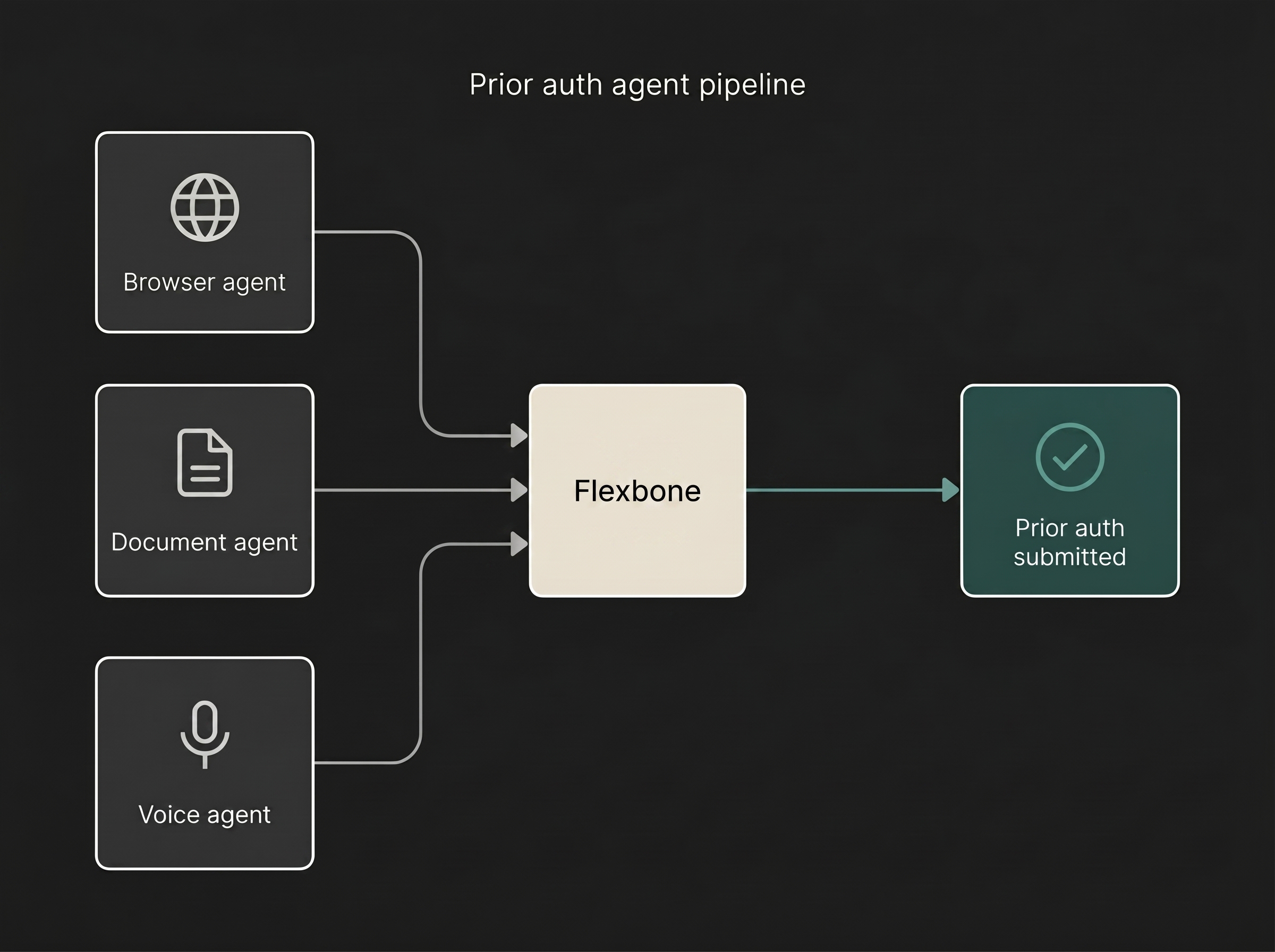
You automate prior authorization by combining three kinds of software agents: an LLM that assembles the clinical medical-necessity packet, a browser agent that submits the request through payer portals, and a voice agent that handles the plans that still require a phone call. Together they cover the requirement lookup, submission, status follow-up, and appeal scheduling that a staff member does by hand today, with the harder exceptions routed to a person with full context. The practice managers we talk to describe the same problem this solves: a patient who waited three weeks for a pre-surgical MRI, a staffer who spent an afternoon on hold with a plan that rejected the request over a missing ICD-10 digit, a denial that arrived the day after the procedure was already performed.
The numbers back up the stories. According to the AMA's 2024 Prior Authorization Physician Survey, practices now complete an average of 39 prior authorizations per physician per week, consuming roughly 13 hours of staff and physician time weekly. In the same survey, 94% of physicians report that PA delays access to necessary care, and 24% say PA has led to a serious adverse event for a patient in their care.
Much of this becomes automatable in 2026. Between the CMS Interoperability and Prior Authorization Final Rule (CMS-0057-F) taking effect January 1, 2026, the maturation of LLM-powered voice agents, and browser-automation agents that can operate payer portals like a human, most PA workflows can now be handled by software with a person on the exceptions. This guide walks through exactly how to do it.
What is prior authorization automation?
Prior authorization automation is the use of software, increasingly, AI agents, to handle the end-to-end workflow of obtaining a payer's approval for a service, drug, or device before it's delivered. A full automation stack replaces four manual activities:
- Eligibility and PA requirement lookup, determining whether a code requires auth for a given plan.
- Submission, populating and sending the PA request through the payer's preferred channel (portal, fax, phone, or X12 278).
- Status checks and follow-up, chasing pending determinations.
- Appeals and peer-to-peer scheduling, when auth is denied.
Historically, vendors automated pieces (most famously CoverMyMeds for pharmacy PA). What's new in 2026 is the ability to automate the hard parts, commercial medical PAs that require portal logins, phone calls, and judgment, using AI agents rather than static rules. This is the approach Flexbone's prior authorization automation platform takes.
Want this mapped against your own call and claim volume? Book a 30-minute audit
Why is prior authorization so hard to automate?
Three reasons, and understanding them explains why most legacy "PA software" has underdelivered for two decades.
Reason 1: Fragmentation. There are roughly 1,100 U.S. payers, and each publishes its own PA code list, its own submission portal, its own clinical criteria, and its own quirky rules (one plan requires notes in the "supplemental fax," another rejects them if submitted by fax). No single API reaches all of them. The 2024 CAQH Index report has tracked prior authorization as the least electronically adopted transaction in the revenue cycle, far behind eligibility and claim submission.
Reason 2: Unstructured clinical criteria. PA decisions hinge on medical necessity, labs, imaging findings, conservative therapy history, functional assessments. That data lives in free-text progress notes, not discrete EHR fields. Rules engines can't parse it.
Reason 3: The phone. Many payers still require a phone call to initiate, follow up on, or escalate a PA. Legacy automation tools stop at the portal edge. That's the gap voice agents close.
How does AI automate the prior authorization process?
A modern AI PA stack has three layers:
Layer 1, Clinical packet assembly. An LLM reads the patient's chart (progress notes, imaging reports, lab results, prior treatment history) and assembles a medical-necessity packet that matches the payer's specific clinical criteria for that CPT code. This is where LLMs beat rules engines: they can infer from a neurosurgeon's note that "patient has failed 8 weeks of PT, continues with 8/10 radicular pain, MRI shows L4-L5 herniation impinging nerve root" satisfies the plan's conservative-therapy-failure requirement.
Layer 2, Browser agents for portal submission. A browser agent logs into the payer portal (Availity, Navinet, UHC Provider, Cigna for Providers, regional BCBS sites, Medicaid MMIS), navigates the PA submission flow, uploads the clinical packet, and captures the reference number. Unlike RPA, browser agents handle portal UI changes without breaking, they see the page the way a human does.
Layer 3, Voice agents for phone PAs and status checks. When a payer requires a phone call, or when a portal status has been "pending" for five days, an AI voice agent dials the payer line, navigates the IVR, authenticates with NPI and tax ID, answers the rep's questions about the patient and procedure, and captures the determination. Flexbone's healthcare calls platform powers this layer.
Together, these three layers handle roughly 85-92% of PA volume end-to-end, with the remaining edge cases (novel drug requests, peer-to-peer reviews, complex appeals) routed to a human PA specialist with full context pre-assembled.
How long does prior authorization take, and how much does automation save?
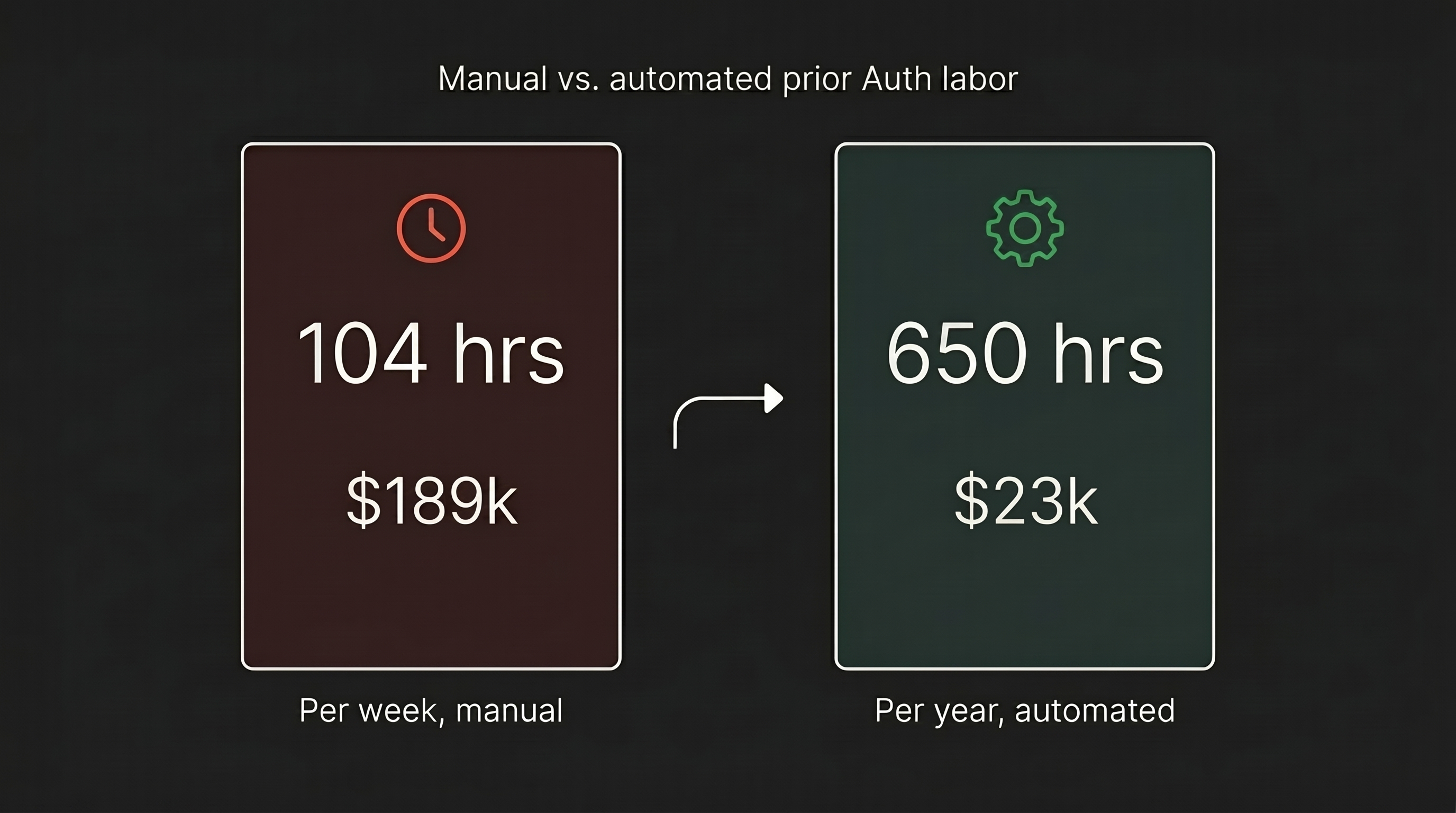
Let's do the math for a mid-sized orthopedic practice: 8 physicians, 39 PAs/physician/week = 312 PAs/week = ~16,200 PAs/year.
Manual baseline (AMA-reported average):
- 13 hours/physician/week × 8 physicians = 104 staff hours/week on PA
- At a blended rate of $35/hour (fully-loaded for a PA coordinator) = $3,640/week = ~$189,000/year in labor
- Add denied PAs and rescheduled procedures and the revenue leakage is meaningfully higher
Automated baseline (typical Flexbone deployment):
- Agents handle 88% of volume end-to-end → ~14,250 PAs/year fully automated
- Remaining 12% (~1,950 PAs) handled by human specialists with AI-assembled packets at ~25% of normal handling time
- Net human hours: ~1,950 × 20 min = 650 hours/year
- Labor cost: ~$22,750/year + platform fee
Net savings: roughly $140-160K/year for this practice, plus a 3-5x faster average turnaround time (from 4-7 days to under 48 hours for most cases). We run this calculation for each engagement, see why we audit before we automate for how we pressure-test the numbers against your actual data.
See what AI can run at your facility. In a 30-minute audit we map the calls, eligibility, and follow-ups Flexbone can take off your team first.
Book an auditWhat does the CMS 2026 prior authorization rule change require?
The CMS Interoperability and Prior Authorization Final Rule (CMS-0057-F), finalized January 2024 and effective January 1, 2026 for most provisions, changes the PA landscape in four important ways:
- Required PA APIs. Medicare Advantage, Medicaid, CHIP, and ACA Marketplace plans must implement a FHIR-based Prior Authorization API that supports the HL7 Da Vinci standards (PAS, CRD, DTR).
- Decision timelines. Standard PA decisions must be issued within 7 calendar days; expedited decisions within 72 hours.
- Denial reasons. Payers must provide specific reasons for denial, not just a code.
- Public metrics. Payers must publicly report PA approval/denial/overturn rates annually.
What this means operationally: for covered payers, some PAs will eventually flow through structured FHIR APIs. But the majority of commercial PAs, and a meaningful portion of Medicaid PAs during the multi-year transition, will still require portal and phone workflows through at least 2027-2028. You still need browser and voice automation. The rule is a floor, not a ceiling.
What are the best prior authorization automation software options?
Buyers typically evaluate PA automation in three buckets:
Bucket 1, Pharmacy-only tools (CoverMyMeds, Surescripts ePA). Excellent for retail pharmacy PA. Don't solve medical PA.
Bucket 2, EHR-native PA modules. Epic's PA module, athenaOne PA, eClinicalWorks PA. Good for eligibility check and submission-to-portal-via-X12. Limited on phone, limited on non-integrated payers, limited on clinical packet assembly.
Bucket 3, AI-native agent platforms (Flexbone, and a handful of newer entrants). Voice + browser + LLM-assembled clinical packets. Operates on top of your EHR rather than replacing any module. This is what we build.
The right answer is usually Bucket 2 + Bucket 3 in combination: use the EHR's native PA module where it works cleanly, and layer AI agents for the portal-and-phone workflows where it doesn't. Our AI denials management stack plugs into the same infrastructure to catch the ~15% of auths that still get denied and auto-generate appeals.
How do you implement prior authorization automation? (Step-by-step)
Here's the deployment sequence we use, tuned from dozens of PA deployments:
Step 1, PA volume and taxonomy audit (Week 1). Pull 90 days of PA history from your practice management system. Classify by payer, CPT, submission channel, and turnaround time. Identify the top 20 payer-service combinations, these usually cover 70-80% of volume.
Step 2, Clinical criteria mapping (Week 2). For each top combination, document the payer's medical-necessity criteria and map them to discrete and free-text data in your EHR.
Step 3, Voice + browser agent configuration (Weeks 2-3). Build the browser agent flows for each top portal (Availity, Navinet, UHC, regional BCBS, etc.) and train voice agents on the payer phone scripts using recordings of your staff's real PA calls.
Step 4, Shadow mode (Week 4). Run agents in parallel with your human team. Agents submit, humans verify before release. Measure accuracy against the real determinations.
Step 5, Progressive cutover (Weeks 5-8). As confidence builds for a payer-service combination (usually after 50-100 shadow submissions), cut over to autonomous operation with human review only on exception.
Step 6, Denials and appeals integration. Connect PA outputs to a denials workflow so auto-denied auths feed directly into appeals generation.
This matches the approach we use for insurance eligibility verification, tight feedback loop, measured cutover, no "big bang" deployment.
What about Medicare Advantage prior authorization automation?
Medicare Advantage is where the CMS 2026 rule has the biggest near-term impact. MA insurers made nearly 53 million prior authorization determinations in 2024, per KFF, and under CMS-0057-F they must stand up PA APIs by January 1, 2027 (one year after the main rule). In the interim:
- MA plans must adhere to the 7-day / 72-hour decision timelines starting 2026
- Denial transparency requirements apply immediately
- Most MA PAs still flow through Availity, Navinet, or plan-specific portals
Practically, this means your MA PA automation in 2026 looks a lot like your commercial PA automation, browser agents on portals, voice agents on phone lines, with the reasonable expectation that a portion will migrate to FHIR APIs through 2027-2028. The Flexbone platform is designed so an MA plan flipping to a FHIR API is a configuration change, not a re-platform.
What happens to my staff when I automate prior authorization?
Practice leaders ask this question, and the honest answer is: your PA team gets smaller in headcount and much more valuable per person. The ~12% of cases the agents can't finish end-to-end are the hard ones, novel drug requests, peer-to-peer reviews, complex appeals, Medicaid edge cases. That's where human judgment matters and where a skilled PA specialist earns their salary.
In our client engagements, practices redeploy PA coordinators into:
- Peer-to-peer scheduling and clinical-staff liaison roles
- Appeals and denials management (which gets busier, not quieter, as PA volume automates)
- Patient-facing navigation, helping patients understand and accept covered alternatives
We build these transition plans into the audit phase, not as an afterthought. And for specialties like ortho, cardiology, and specialty infusion where PA volume is highest, we often pair this work with the AI patient coordinator so staff time freed from PA goes to patient throughput.
Ready to automate prior authorization?
The gap between practices that automate PA in 2026 and the ones that don't will be one of the larger operating-cost differences in the revenue cycle over the next few years. Twelve-plus hours a week per physician is not a line item to ignore.
If you want to see what automation would look like on your actual PA volume, not a generic demo, book a PA audit. We pull 30 days of your data, run our agents against it in shadow mode, and show you the end-to-end numbers before you commit to anything. See also our AI-for-HST-Pathways case study for how this same agent stack works inside a surgery center environment.