CSAT, NPS, and CES each answer a different question, and each uses a different formula. CSAT (Customer Satisfaction Score) is the percentage of survey responses that are positive: divide satisfied responses (usually the top two ratings on a 1 to 5 scale) by total responses, then multiply by 100. NPS (Net Promoter Score) subtracts the percentage of detractors from the percentage of promoters on a 0 to 10 recommendation question, giving a number from -100 to 100. CES (Customer Effort Score) averages agreement ratings on how easy it was to get an issue resolved, usually on a 1 to 7 scale. According to the American Customer Satisfaction Index cited by IBM, the cross-industry CSAT average sits near 78 percent. The sections below give the formula and a worked example for each.
What is the CSAT formula?
CSAT measures how satisfied customers are with a specific interaction, product, or service. The formula is straightforward: count the positive responses, divide by the total number of responses, and multiply by 100 to get a percentage.
CSAT = (Number of satisfied responses / Total responses) x 100
On a 1 to 5 scale, "satisfied" usually means the responses that scored 4 or 5. So if 170 of 200 respondents rated their experience a 4 or 5, your CSAT is (170 / 200) x 100 = 85 percent. According to IBM, a good CSAT score generally falls between 75 and 85 percent, though the range shifts by industry. CSAT works best for a single touchpoint, such as a support call or a checkout flow, because you can ask about it while the experience is fresh.
Want this mapped against your own call and claim volume? Book a 30-minute audit
How do you calculate NPS?
NPS measures loyalty by asking one question: how likely are you to recommend this company to a friend or colleague, on a scale of 0 to 10? You then sort respondents into three groups. Promoters score 9 or 10, passives score 7 or 8, and detractors score 0 through 6.
Surveys measure how a small share of callers felt; the transcripts show why. Flexbone's Voice Room ties sentiment and repeat-call patterns to call types, which gives a satisfaction score a cause a team can act on.
NPS = Percentage of promoters minus percentage of detractors
According to Bain and Company, which developed the metric with Fred Reichheld, if 70 percent of respondents are promoters, 20 percent are passives, and 10 percent are detractors, your NPS is 70 minus 10, or 60. Passives count toward the total but not the score. The result ranges from -100 to 100. NPS is a relationship metric: it tracks how customers feel about you overall, not how one call went.
See what AI can run at your facility. In a 30-minute audit we map the calls, eligibility, and follow-ups Flexbone can take off your team first.
Book an auditWhat is CES and how do you calculate it?
CES measures how much effort a customer had to spend to get something done, such as resolving an issue or completing a purchase. You ask customers to rate their agreement with a statement like "The company made it easy for me to handle my issue," typically on a 1 to 7 scale where 7 is strongly agree.
CES = Sum of all response scores / Number of responses
The result is an average, so a CES of 5.5 or higher is generally considered strong. According to Gartner research, effort is a powerful predictor of loyalty: high-effort experiences push customers toward competitors, while low-effort ones keep them. CES is the metric to watch when the goal is friction reduction, because it points directly at the steps that made a task harder than it needed to be, such as repeated transfers, long holds, or having to explain the same problem twice.
Which metric should you use when?
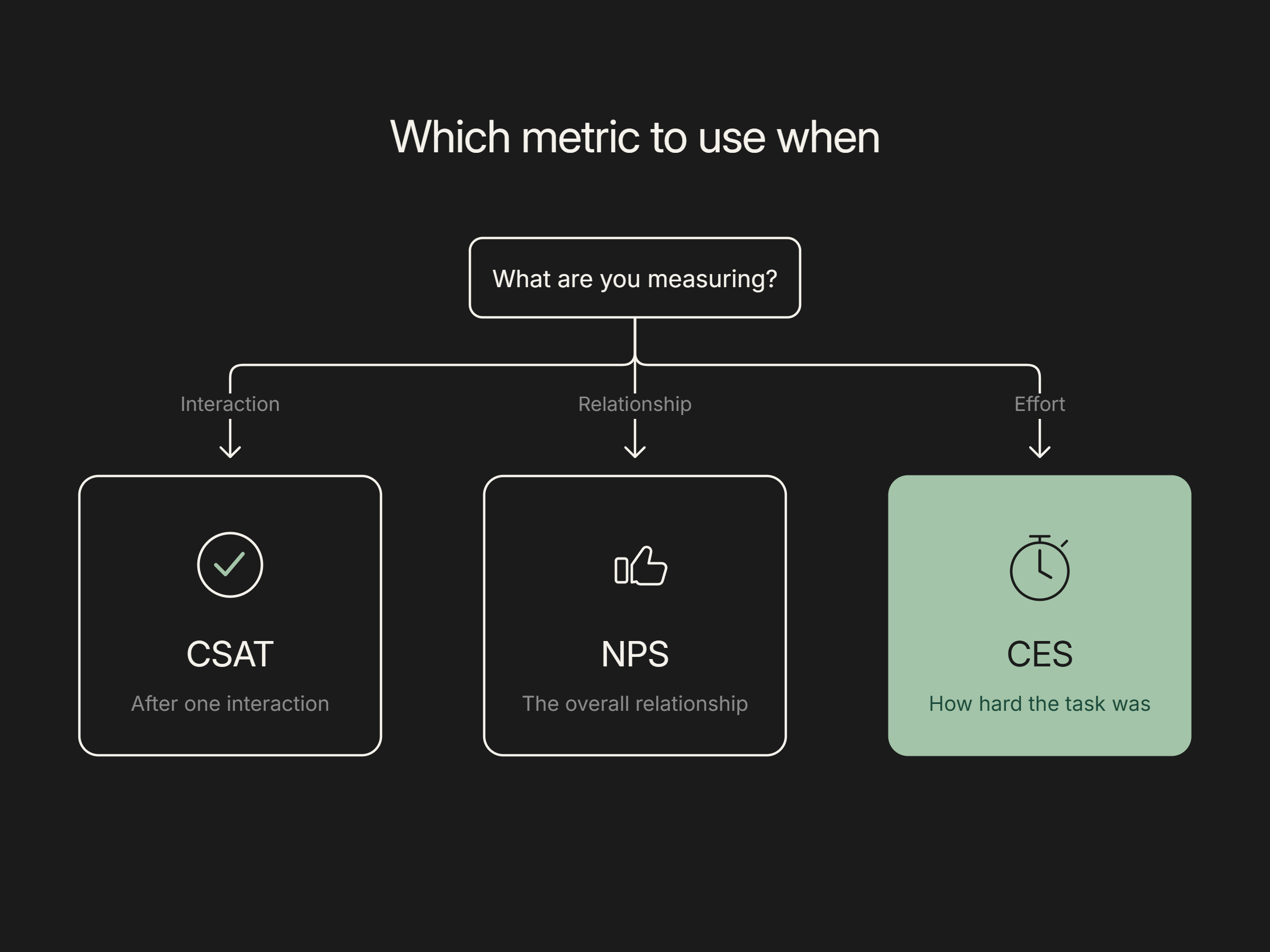
Use each metric for the question it was built to answer. CSAT is best for a specific interaction: run it right after a support call or a delivery to gauge satisfaction with that moment. NPS is best for the overall relationship: survey the customer base periodically to track loyalty and word-of-mouth risk over time. CES is best for process and friction: run it after a task-based interaction to find where resolution took too much work.
Many contact centers track all three, because a call can score high on satisfaction yet still take three transfers to resolve, which CES would catch. According to Qualtrics, NPS is most useful as a trend line rather than a single reading. The practical rule: pick the metric whose formula matches the decision you are about to make.
How Flexbone helps you move these scores
The fastest way to lift CSAT and lower CES is to resolve more issues on the first contact without long holds or repeated transfers. Flexbone builds AI agents (voice, browser, document, and desktop) that handle routine contact-center and back-office work in secure, regulated settings. Because we audit call and case data before we automate anything, we target the specific interactions dragging your scores down, whether that is a BPO queue, an insurance eligibility line, a healthcare scheduling desk, or a public-sector intake process. Agents that answer immediately, pull the right record, and complete the task in one pass reduce the effort a customer has to spend, which is exactly what CES and CSAT measure. To see how this maps to your own score data, book a demo at flexbone.ai/contact.