
To check if a service needs prior authorization, start from the exact code, not the procedure name, then check that code against the patient's specific plan before the visit. The reliable method has three steps: find the CPT or HCPCS code for the service, look it up in the payer's provider portal or prior authorization lookup tool for that plan, and, when the portal is ambiguous, read the plan's published medical policy or call the payer to confirm. The same code can require authorization under one plan and not another, and requirements change during the year, so a general answer to "does my procedure need prior authorization" is unreliable. Confirming the requirement before the service is scheduled is what prevents a denied claim, because a payer can refuse to pay for a service that needed authorization and did not have it.
How do I check if a service needs prior authorization?
The dependable way to check if a service needs prior authorization is a short sequence that starts from the code and finishes before the visit is scheduled.
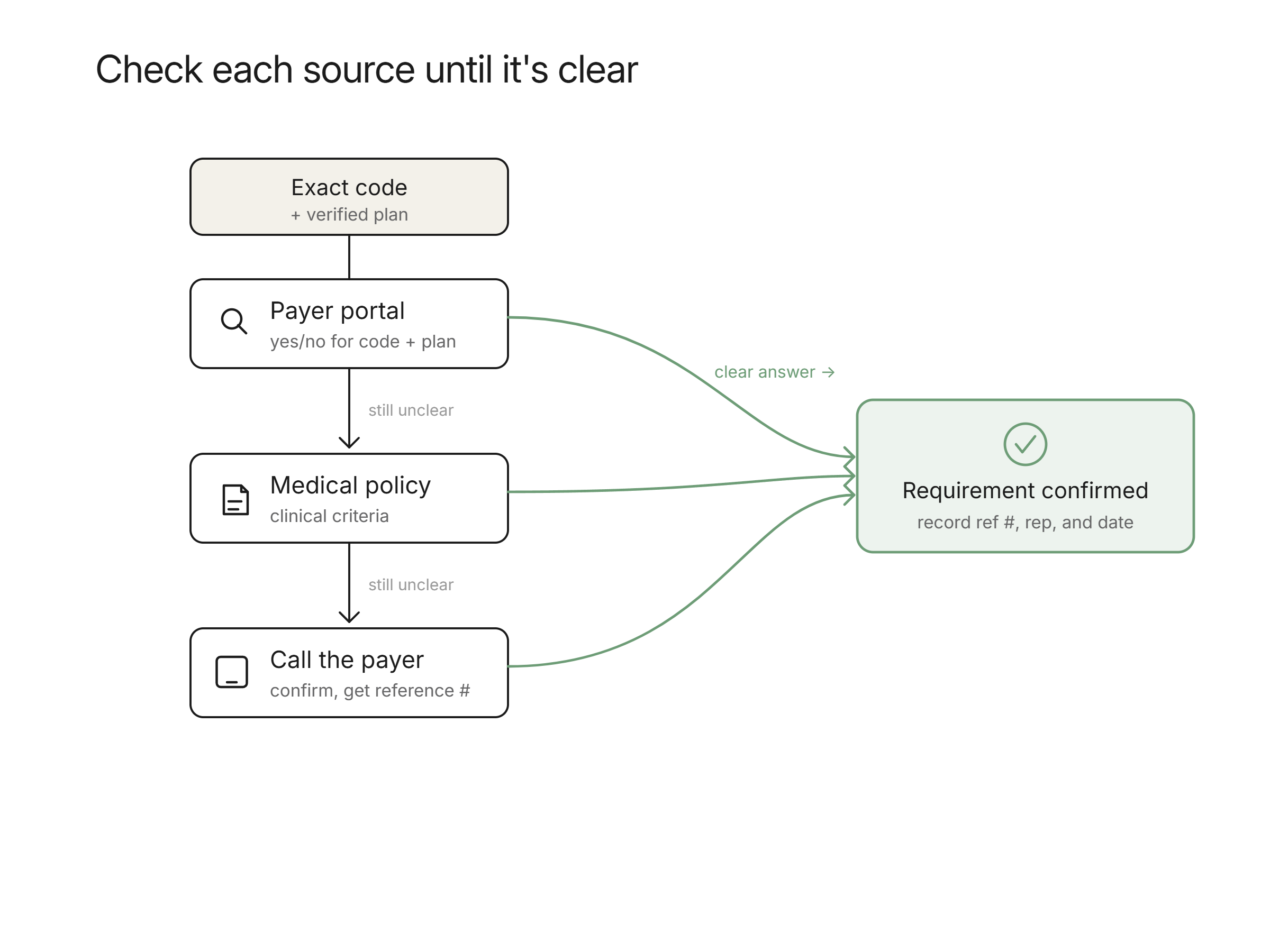
- Pin down the exact code. Identify the CPT or HCPCS code for the procedure, imaging study, drug, or device. "An MRI" or "a knee scope" is not specific enough, because authorization rules attach to codes, not to plain-language descriptions.
- Confirm the patient's active plan. Run eligibility first, so you know the payer, the product, and the group. Requirements differ across a payer's plans, and a policy that fits a commercial PPO may not fit that payer's Medicare Advantage product.
- Look the code up for that plan. Use the payer's provider portal or its prior authorization lookup tool. Most return a clear yes or no for a code and plan pair. For Medicare Fee-for-Service, CMS publishes the services that require prior authorization, including certain hospital outpatient department procedures such as blepharoplasty, vein ablation, and cervical fusion with disc removal.
- Read the medical policy when the portal is unclear. If the lookup is ambiguous or the code sits near a coverage boundary, open the plan's published medical policy for the service. It states the clinical criteria and whether authorization applies.
- Call to confirm, and record the result. When a payment is large or the tools disagree, call the payer, and note the reference number, the representative, and the date. Do this before the service is scheduled.
Want this mapped against your own call and claim volume? Book a 30-minute audit
Does my procedure need prior authorization?
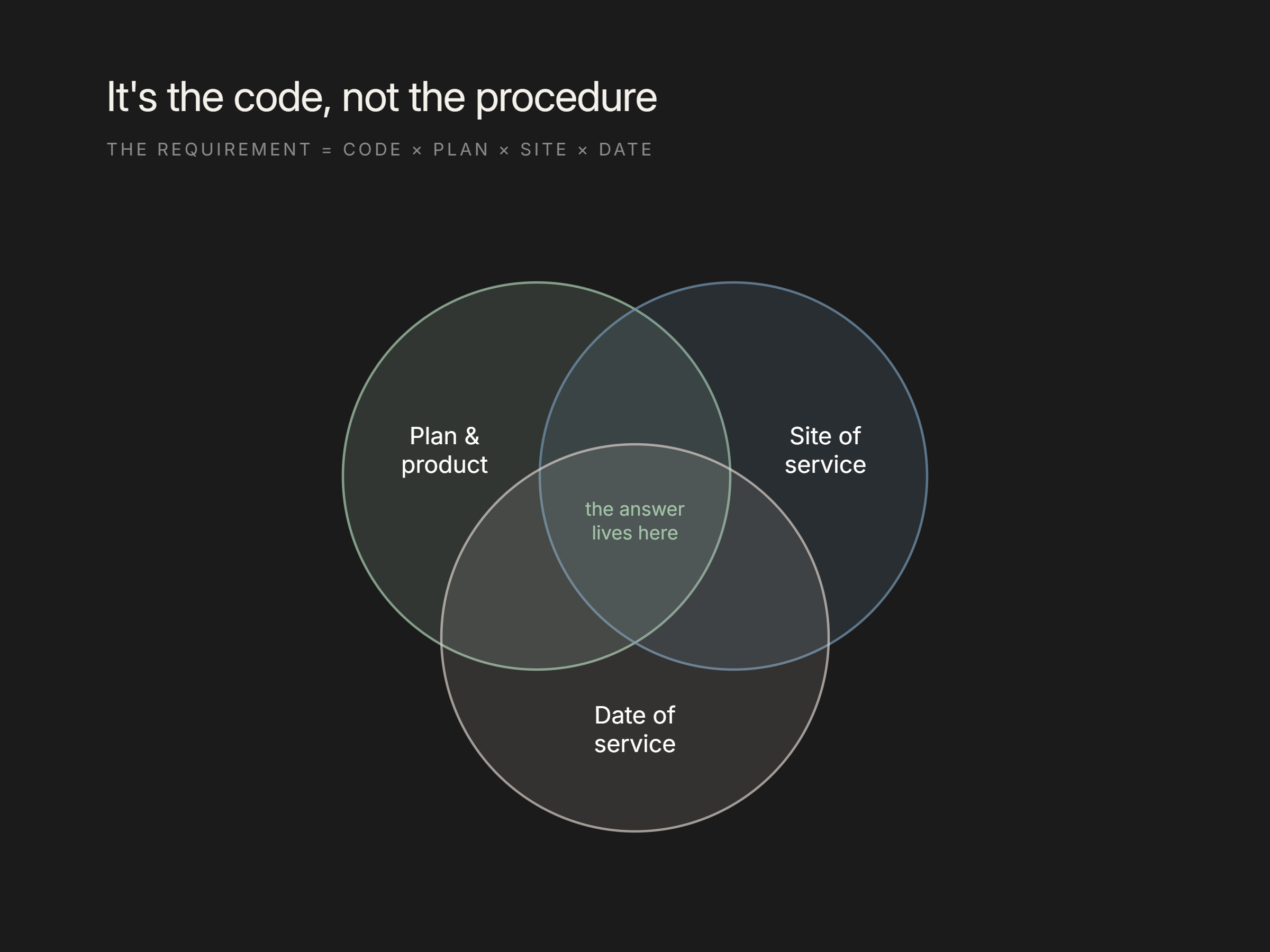
Whether a procedure needs prior authorization is not a property of the procedure, it is a property of the specific code under the specific plan on the date of service. This is the most common misunderstanding, and it is why a blanket list carried over from last year leads to denials.
The check is a lookup against a payer list keyed to the CPT code and the member's plan, repeated for every scheduled service. Flexbone runs it as an agent task when the visit is booked, so a missing authorization surfaces before the patient arrives instead of after the denial. The rest of the workflow is in prior authorization automation.
Three factors move the answer. The plan and product matter, so the same CPT code can require authorization under a Medicare Advantage plan and not under a commercial plan from the same payer. The site of service matters, because a procedure done in a hospital outpatient department can carry a requirement that the same procedure in an office does not. Timing matters, since payers revise their authorization lists during the year. The practical rule is to treat "does my procedure need prior authorization" as a question you answer per patient, per plan, at scheduling, rather than a fact you memorize once.
See what AI can run at your facility. In a 30-minute audit we map the calls, eligibility, and follow-ups Flexbone can take off your team first.
Book an auditHow do I know if prior authorization is required for a medication?
For drugs, the source of truth is the plan's formulary and its pharmacy benefit rules. The formulary marks each covered drug with any conditions attached to it, and the ones that create a prior authorization are usually labeled prior authorization, step therapy, or quantity limit. Medicare drug plans, for example, may require prior authorization when a drug is only covered for certain medical conditions, and commercial pharmacy benefit managers apply similar rules.
There are two moments to catch a medication requirement. The first is at prescribing, by checking the formulary or the e-prescribing system, which often surfaces the flag before the script is sent. The second is at the pharmacy, where a claim for a drug that needs authorization rejects with a prior authorization message. Catching it at prescribing is better, because it lets the prescriber start the request while the patient is still in front of them rather than after a rejected claim at the counter. Non-formulary drugs, specialty medications, and step-therapy exceptions are the cases most likely to carry a requirement.
What happens if you skip prior authorization?
If a service that required prior authorization is performed without it, the payer can deny the claim. Depending on the contract and state rules, the cost then falls on the practice as a write-off or on the patient as a balance, and neither is a good outcome. Some payers offer a retrospective review or an urgent exception after the fact, but approval is discretionary and slower than doing the check up front.
The volume behind this is not trivial. According to the American Medical Association's prior authorization survey, practices complete an average of 39 prior authorizations per physician per week and spend about 13 hours of physician and staff time on them. Every missed check that turns into a denial adds an appeal on top of that load. There is also a timing floor worth knowing: under the CMS Interoperability and Prior Authorization Final Rule (CMS-0057-F), impacted payers, including Medicare Advantage, Medicaid, and CHIP plans, must return standard decisions within 7 calendar days and expedited decisions within 72 hours, with most operational provisions effective January 1, 2026. That sets a ceiling on how long a submitted request can sit, but it only helps if the request was filed in the first place, which is why the pre-visit check matters.
How Flexbone checks whether a CPT code needs prior authorization
Flexbone runs the same determination described above, applied consistently across a schedule rather than case by case. For an upcoming service, an AI agent takes the CPT or HCPCS code and the patient's verified plan, checks the payer's portal or lookup tool, and reads the relevant medical policy when the portal is ambiguous. AI voice agents handle the plans that still answer only by phone, holding in payer queues to confirm the requirement. When a code does need authorization, browser agents can assemble and submit the request, follow up on pending determinations, and write the status and reference number back into the EHR so staff see the current state without repeating a lookup. You can read the full approach on our prior authorization automation page, and a wider walkthrough in our guide on how to automate prior authorization.
The design is audit-first. We start by pulling a practice's own history, measuring how often requirements are missed and where denials cluster, and running the agents in shadow mode before any autonomous action. The platform is HIPAA compliant and SOC 2 aligned, and cases that fall outside a clear pattern, such as an unusual code, a coverage-boundary policy, or a payer that gives conflicting answers, are escalated to a staff specialist with the context already gathered. The aim is a reliable check on the volume that follows a pattern, not a claim that every edge case resolves without a person.
What belongs on a pre-visit prior authorization checklist?
A short checklist, run at scheduling, catches most authorization problems before they reach a claim.
- Confirm active eligibility and capture the exact plan, product, and group.
- Identify the specific CPT or HCPCS codes for the planned service, including the site of service.
- Look each code up in the payer's portal or lookup tool for that plan, and check the plan's medical policy when the portal is ambiguous.
- For drugs, check the formulary for a prior authorization, step therapy, or quantity limit flag.
- If authorization is required, start the request early enough to clear before the scheduled date, and record the reference number.
- Note that requirements change, so re-check codes you looked up months ago rather than relying on an old list.
If you want to see how automated pre-visit checks would fit your own scheduling and payer mix, book a demo.