
Choosing a revenue cycle management company comes down to matching the vendor's scope to your gap, then verifying the outcomes they promise with real numbers. Decide first whether you need a full-cycle partner to run billing end to end or a point solution for a single stage such as eligibility or denials. Then evaluate every candidate on four measured metrics: first-pass clean-claim rate, days in accounts receivable, net collection rate, and denial rate, each with a baseline and a target. Ask how they prevent denials on the front end, how they appeal denials by CARC and RARC code, and whether they work inside your EHR. Confirm pricing on a cost-per-resolved-claim basis. The right choice is the one whose measured results, EHR fit, and pricing line up with the part of the cycle you actually need fixed.
What does a revenue cycle management company do?
A revenue cycle management company handles the administrative and financial work that turns a clinical encounter into collected payment. Depending on scope, that can include patient access and registration, insurance eligibility verification, prior authorization, medical coding, claim submission, payment posting, denial management, appeals, and patient collections. Some vendors run the entire cycle as an outsourced operation. Others plug into one stage where a provider has a bottleneck. The common thread is reducing the rework and lost revenue that come from claims going out with errors or getting denied after the service is delivered. In the engagements we run, the most valuable work sits on the front end, where a clean eligibility check or a completed prior authorization prevents a denial that would otherwise surface weeks later. Comparing revenue cycle management companies starts with matching that scope to your own gap.
Want this mapped against your own call and claim volume? Book a 30-minute audit
What should you look for in an RCM company?
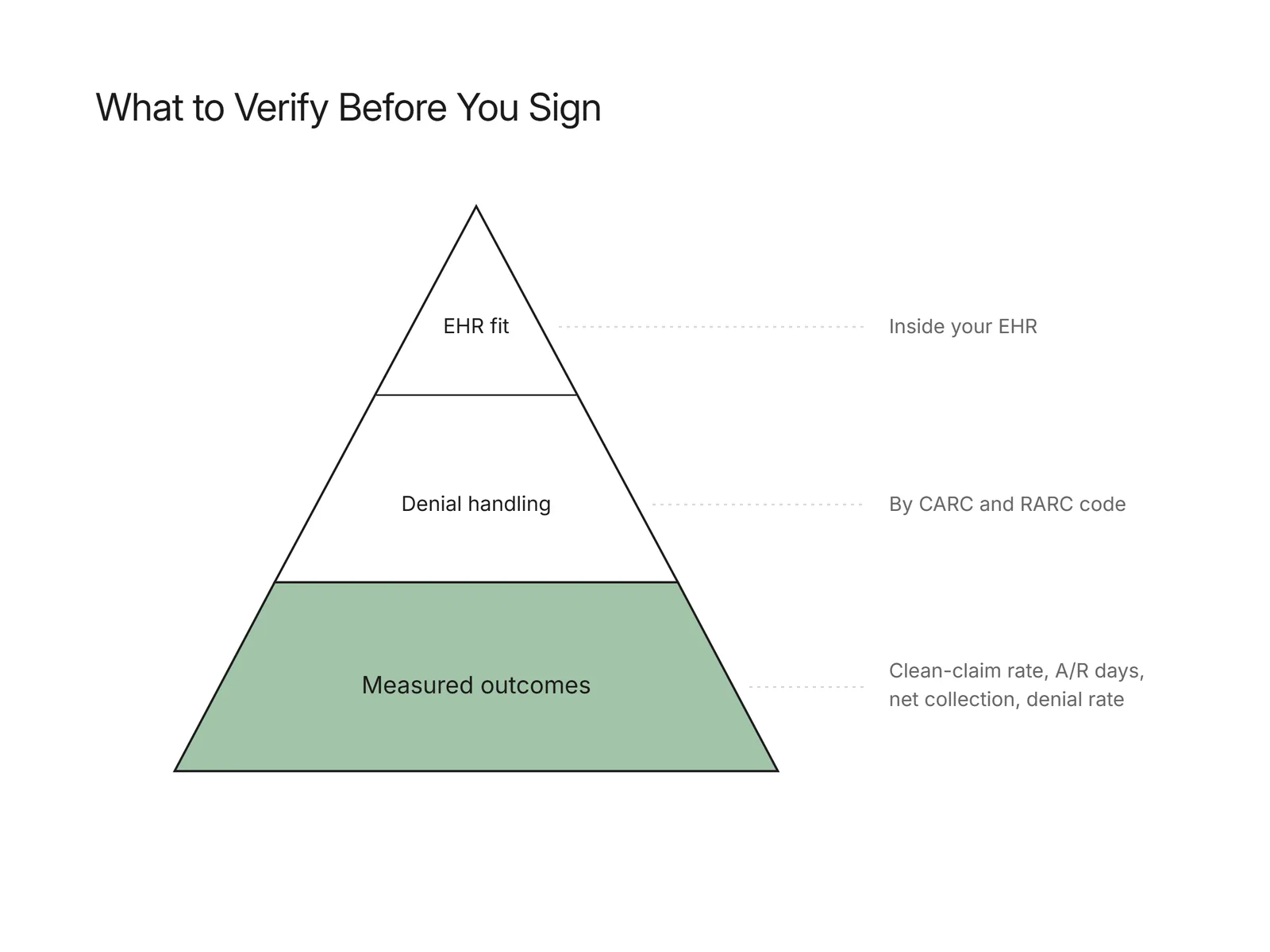
Look for measured outcomes, denial handling, and EHR fit, in that order. Start with the numbers and ask each vendor for a baseline and a target on four metrics:
- First-pass clean-claim rate. The share of claims that pay on first submission without rework. This is the single clearest signal of front-end quality.
- Days in accounts receivable (A/R). How long money sits unpaid on average. Lower is better, and the trend matters more than the snapshot.
- Net collection rate. The share of collectible revenue you actually collect after contractual adjustments. It tells you how much you leave on the table.
- Denial rate. The share of claims denied before appeals. Denials are common: in HealthCare.gov marketplace plans, insurers denied 20% of in-network claims in 2023, and consumers appealed fewer than 1% of them, according to KFF.
Then ask three operational questions. How do you appeal denials, and can you show your process by CARC and RARC code rather than in bulk? What do you do on the front end to prevent denials before a claim goes out? Do you work inside our EHR, or in a separate system our staff has to reconcile? A vendor that only reworks denials after the fact is treating symptoms; one that fixes eligibility and authorization up front is treating the cause. On the appeal side, our AI denials management work sorts denials by reason code and routes each to the right response.
See what AI can run at your facility. In a 30-minute audit we map the calls, eligibility, and follow-ups Flexbone can take off your team first.
Book an auditHow are RCM companies priced?
RCM companies price in a few common ways, and the model shapes their incentives. Full-cycle vendors most often charge a percentage of net collections, which ties their fee to what you actually bring in. Point solutions tend to price per transaction, per seat, or as a flat monthly subscription. Percentage-of-collections is aligned but can get expensive at scale; per-transaction pricing is predictable but can reward volume over resolution. To compare bids fairly, translate every quote into two numbers: cost per resolved claim and cost as a share of collections. Then confirm what is included. Are appeals, patient statements, and eligibility checks part of the base fee, or billed as add-ons? In the engagements we run, the hidden cost is usually the exception work, the calls and appeals that fall outside standard per-claim scope, so price that explicitly.
Full-cycle vs point-solution RCM: which do you need?
The answer depends on whether you want to hand off billing operations or fix a specific stage. Full-cycle RCM covers the entire process, from patient access through collections, and usually replaces or heavily supplements your billing team. It suits providers that want billing off their plate entirely or lack the staff to run it well. Point-solution RCM handles one stage, such as eligibility verification, prior authorization, or denial appeals, alongside a team you keep. It suits providers whose billing is mostly healthy but who have a clear bottleneck. A practical test: if more than one stage is underperforming and you cannot staff to fix it, look at full-cycle. If a single metric is dragging, for example eligibility-related denials, a point solution that targets that stage is faster and cheaper. Front-end eligibility is a frequent point-solution target because payers exchange coverage data through standard electronic transactions, the 270 and 271, defined by CMS, which makes the check well-defined enough to automate. That is the pattern behind insurance eligibility verification.
In-house vs outsourced RCM?
In-house RCM gives you control and keeps knowledge close, while outsourcing shifts the operational burden and adds capacity faster. Running RCM in-house means you own the workflow, see every claim, and keep institutional knowledge on staff. The cost is hiring, training, and coverage: when a biller leaves or a prior-authorization queue spikes, the cycle stalls. Prior authorization alone is a heavy load, running about 39 requests per physician per week and roughly 13 hours of staff time, according to the AMA. Outsourcing hands that burden to a vendor that can scale up quickly, at the cost of some visibility and direct control. A hybrid model often fits best: keep clinical judgment, coding review, and unusual cases in-house, and send the repetitive, rules-based transactions elsewhere. That is the split an AI-first approach is built around. Agents handle the high-volume, well-defined transactions, the eligibility checks, benefit lookups, and claim-status calls, and US-based staff through our partnership with Nav Central take the exceptions that need a human on the phone or a judgment call. You keep control of the hard cases while the routine volume runs without adding headcount.
Before you sign with any vendor, ask for a baseline and target on the four metrics above, a walkthrough of how they appeal denials by CARC and RARC code, what they do on the front end to prevent denials, whether they operate inside your EHR, and total cost per resolved claim with add-ons named. If you want to see which of these tasks an AI-first model can run across your revenue cycle, and where US-based staff step in for the exceptions, book a call with Flexbone and we will map it against your current workflow and metrics.