To reduce days in accounts receivable (A/R), remove the delays that keep a billed service from turning into collected cash. Four levers do most of the work. First, submit clean claims up front by verifying coverage and securing prior authorization before the service, so fewer claims come back as denials. Second, submit claims quickly after charge capture, since a claim sitting in a work queue is aging with no payer response. Third, work every denial systematically by reason code rather than letting rejections accumulate. Fourth, follow up on open claims consistently, sorted by aging bucket and by payer, so nothing sits untouched past 90 days. Each lever attacks a specific source of waiting or rework, and together they pull the average age of your receivable down toward the date of service.
What is days in A/R and how is it calculated?
Days in A/R measures how long, on average, it takes to collect payment after a service is billed. The standard formula is average net accounts receivable divided by average daily net charges. To get average daily net charges, take your net charges over a chosen period and divide by the number of days in that period. Worked plainly: suppose net charges over 90 days total 900,000 dollars, so average daily net charges are 900,000 divided by 90, or 10,000 dollars per day. If your average net A/R balance is 450,000 dollars, then days in A/R is 450,000 divided by 10,000, which equals 45. That means it takes roughly 45 days to turn a billed service into cash. Because the metric is a ratio of a balance to a daily rate, it moves when either the outstanding balance changes or the pace of charges changes, so read it alongside the underlying numbers rather than on its own.
Want this mapped against your own call and claim volume? Book a 30-minute audit
What is a good days in A/R benchmark?
A good days in A/R figure depends on your specialty, payer mix, and service lines, so a benchmark is most useful compared against your own trend and against peers doing similar work. In the engagements we run, we treat a figure in roughly the 30 to 45 day range as healthy for a broad payer mix, and we watch the direction of the trend more closely than any single reading. A related and often more revealing number is the share of your balance sitting past 90 days: when that slice grows, average days climb even if the headline number looks acceptable this month. The reliable practice is to track days in A/R over time within your own book, segment it by payer, and investigate movement rather than borrow a fixed target from a different practice.
Why is our A/R too high?
A/R climbs for a small set of repeatable reasons, and most of them start before the claim ever goes out. The first is claims held before submission: a service is delivered but the claim waits in a work queue, aging with no payer response. The second is avoidable denials from front-end data problems, such as coverage that was never verified through an eligibility (270/271) transaction, a missing prior authorization (278), or a demographic error captured at registration. These issues are invisible until the payer rejects the claim weeks later. The scale is real: in HealthCare.gov marketplace plans, insurers denied 20% of in-network claims in 2023, and consumers appealed fewer than 1% of those denials, according to KFF. The third reason is open claims that no one touches until they age past 90 days. When denials pile up unworked and old claims sit untouched, the average age of your receivable rises.
See what AI can run at your facility. In a 30-minute audit we map the calls, eligibility, and follow-ups Flexbone can take off your team first.
Book an auditHow do you reduce days in A/R?
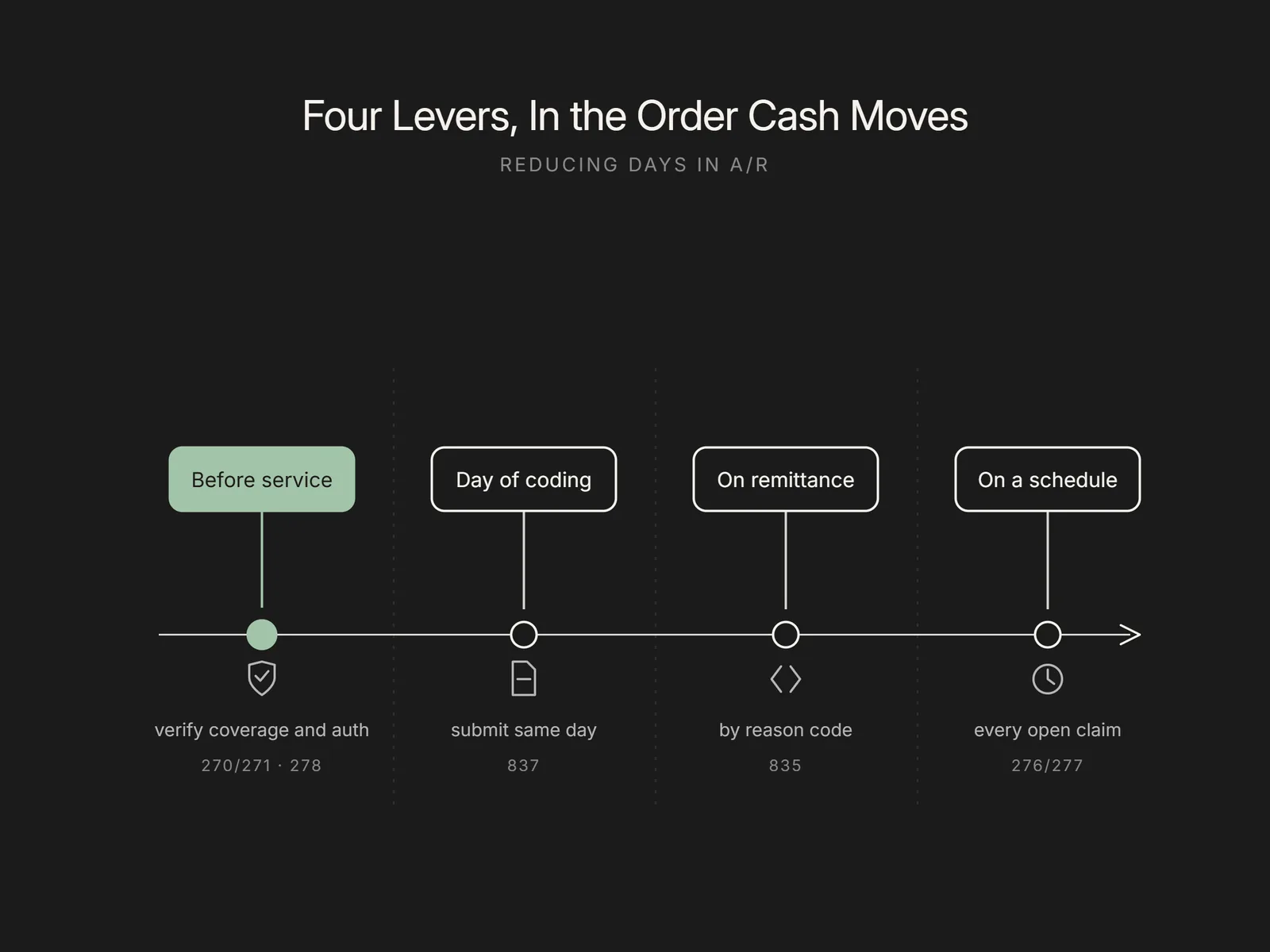
You reduce days in A/R by pulling the four levers in the order that cash moves, tying each to the payer transaction behind it. Start on the front end: verify coverage with an eligibility (270/271) check and secure prior authorization (278) before the service, so the claim goes out clean. Next, compress the gap between charge capture and submission, because a claim that leaves the same day it is coded stops aging in your own queue. Then work denials systematically: read the CARC and RARC codes on the 835 remittance, group rejections by reason, and route each group to the fix it needs. Finally, follow up on open claims on a schedule, sorted by aging bucket and by payer, using the claim status (276/277) transaction so nothing waits for a human to remember it. Prior authorization alone consumes real staff time, with practices completing an average of 39 requests per physician each week and spending about 13 hours on them, per the AMA, which is why handling it early prevents downstream aging rather than reworking it later.
How does automation lower days in A/R?
Automation lowers days in A/R by removing the waiting on the repetitive, rules-based tasks that sit in front of cash, while leaving the judgment work to people. AI agents are well suited to the high-volume lookups and follow-up calls that are slow for staff but well defined: running eligibility (270/271) checks before the service, checking prior authorization (278) status, and following up on claim status (276/277) so open claims get touched on a schedule instead of only when they age past 90 days. CMS specifies the eligibility 270/271 transaction under its Administrative Simplification rules, per CMS, and where an electronic path exists an agent can run it directly, falling back to a payer portal or a phone call when it does not. Agents remove the delay from status checks and follow-up calls; staff still work the appeals, reading the CARC and RARC codes on the 835 and deciding how to argue each denial. That division keeps the receivable moving without asking people to spend their day on lookups.
Where do agents and staff each fit in A/R follow-up?
The practical split is that agents handle the chasing and staff handle the deciding. Agents run the front-end access work that produces clean claims, insurance eligibility verification and prior authorization, then follow up on submitted claims by status and record what came back, so the follow-up queue never goes stale. When a denial lands, the agent surfaces it with its 835 reason codes rather than resolving it alone, which is where AI denials management hands off to a person who writes the appeal or corrects the claim. Staff keep the exception work: appeals, payer disputes, and anything that requires reading a contract or making a coverage argument. Choosing between running this in house and outsourcing it to one of the revenue cycle management companies comes down to matching that division of labor to where your own A/R backs up. Either way, the work is audit-first: every agent action is logged, so a person can review what was checked and what the payer returned before anything is finalized.
If you want to see which parts of your A/R follow-up AI can take on, and which stay with your team, book a call with Flexbone and we will map your eligibility, prior authorization, claim status, and denial workflow against what agents can run today.